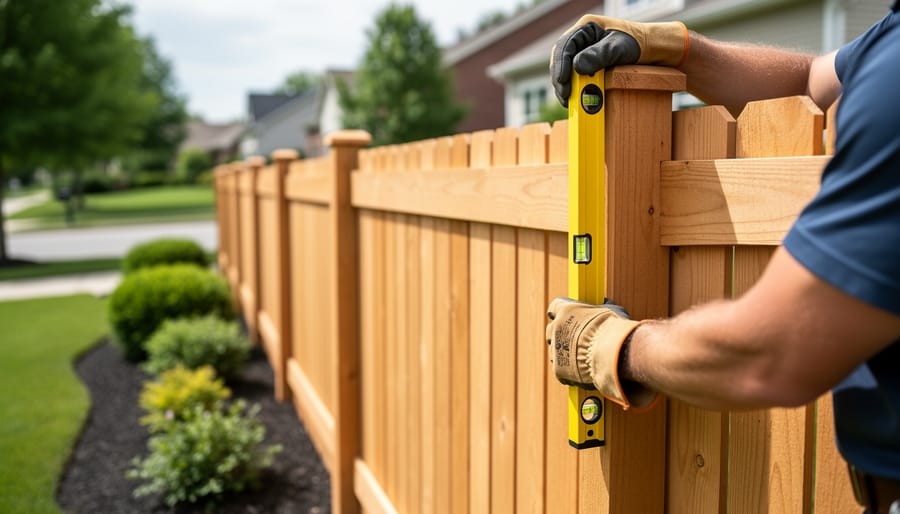
Before you sink that shovel into your lawn to plant a new tree, install a fence, or even dig a simple garden bed deeper than 12 inches, Virginia law requires you to contact Miss Utility by calling 811 before digging—and ignoring this step could result in fines up to $2,500, catastrophic utility strikes, and serious injury. The Virginia Underground Utility Damage Prevention Act isn’t just bureaucratic red tape; it’s a critical safety law that protects you, your family, and your community from accidentally severing underground power lines, gas pipes, water mains, and telecommunications cables buried beneath your property.
Here’s what catches most gardening enthusiasts off guard: you’re required to call 811 at least three business days before starting any excavation project, regardless of how minor it seems. That includes installing mailbox posts, building raised garden beds with deep foundations, aerating your lawn beyond certain depths, and planting trees or shrubs where roots might eventually interfere with utilities. The law places the responsibility squarely on your shoulders as the property owner or person doing the digging.
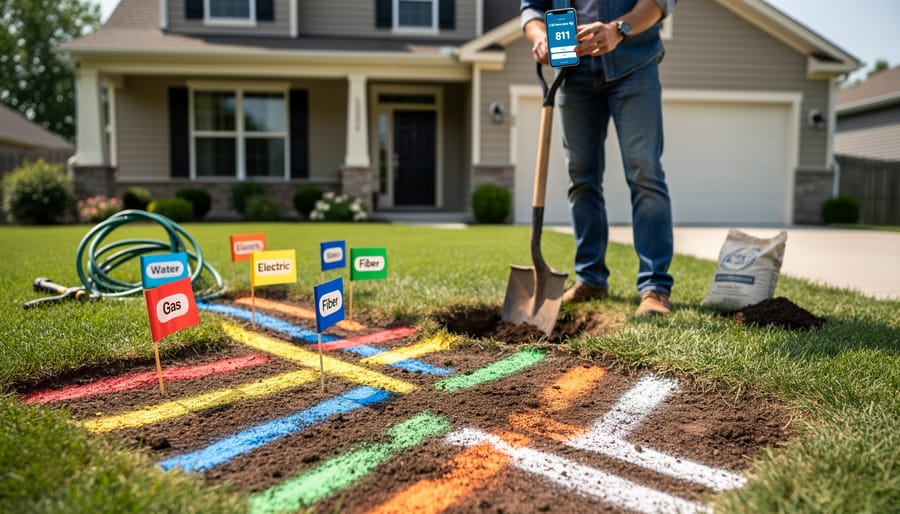
The good news is that compliance is straightforward and the service is completely free. When you call 811, utility companies send professionals to mark the approximate location of underground lines with colored flags and spray paint within three business days. These markings remain valid for 15 days in Virginia, giving you a clear window to complete your project safely. Understanding this law transforms what might feel like an inconvenient bureaucratic requirement into an essential safety step that protects your investment, prevents costly repairs, and keeps your neighborhood’s infrastructure intact while you create the lawn and garden of your dreams.
What the Virginia Underground Utility Damage Prevention Act Actually Means for Your Yard
Common Lawn Projects That Require Calling 811
You might be surprised at how many common lawn projects trigger the 811 requirements under Virginia law. Before you grab that shovel, let’s walk through the activities that absolutely require making that call.
Installing a sprinkler or irrigation system is at the top of the list. Even if you’re planning to dig just a few inches for lateral lines, you’ll be working across a large area where underground utilities might be lurking. Similarly, planting trees and large shrubs requires contacting 811, especially when you’re creating planting holes deeper than 12 inches. Those beautiful shade trees you’re envisioning could have roots that eventually reach utility lines, so proper placement matters from day one.
Planning to build raised garden beds with deep corner posts? That’s another project requiring notification. The same goes for any fence installation, whether you’re using a post-hole digger or renting an auger. Core aeration typically gets a pass since it only penetrates a few inches, but deep-tine aeration that goes down 6 inches or more enters that gray area where calling 811 becomes the smart, safe choice.
Installing French drains or other drainage solutions definitely requires advance notification. These projects often involve trenching 18 to 24 inches deep, exactly where water lines, gas pipes, and electrical conduits commonly run. Even creating a simple dry creek bed might need clearance if you’re excavating significantly. Remember, protecting yourself and your community’s infrastructure is just as important as creating that beautiful, sustainable landscape you’re dreaming about.
What Happens If You Don’t Call (And Why It’s Not Worth the Risk)
I know it’s tempting to skip that 811 call, especially when you’re eager to get your spring planting started or install that new garden bed. But let me be completely honest with you—the risks just aren’t worth it.
Under the Virginia Underground Utility Damage Prevention Act, failing to call before you dig can result in fines up to $2,500 per violation. That’s a hefty price tag for what seems like a simple oversight. But financial penalties are actually the least of your worries.
If you accidentally damage a utility line, you’re personally liable for the repair costs. We’re not talking about a few hundred dollars here—depending on what you hit, repair bills can easily climb into tens of thousands of dollars. Imagine damaging a major gas line or fiber optic cable while installing a fence for your vegetable garden. That’s a conversation with your insurance company nobody wants to have.
Even more concerning is the potential for service disruptions. One accidental strike could knock out power, internet, or water for your entire neighborhood. Your fellow community members won’t be thrilled when their refrigerators stop running because of an unmarked dig.
But here’s what really matters: your safety and that of your family. Hitting a gas line or electrical cable can cause explosions, fires, or electrocution. These aren’t scare tactics—these are real dangers that have resulted in serious injuries and fatalities. No garden project is worth risking your life or the lives of others working alongside you.
The 811 call is free, quick, and gives you complete peace of mind. It’s truly the easiest part of any digging project.
How the 811 Dig-Safe System Works: A Simple Walkthrough
Making Your 811 Request (It Takes Less Than 5 Minutes)
Good news—the 811 notification process is genuinely quick and straightforward. You have two options: call 811 directly or submit your request online through Virginia 811’s website. Most gardeners find the whole process takes less than five minutes.
Before you start, gather this essential information: your exact project location (street address and nearest cross street), the start date of your digging, and a clear description of what you’re planning to do. Whether you’re installing a rain garden, planting trees, or building raised beds, be specific about your project area.
When describing your dig site, think like you’re giving directions to a friend. Mark the boundaries with white paint or flags if you’re calling, or use the online mapping tool to outline the area. Include details like “15 feet from the front porch toward the street” or “along the entire north fence line.” The more precise you are, the better utility companies can mark their lines.
You’ll receive a ticket number at the end—write it down and keep it handy. This number proves you’ve complied with Virginia law and serves as your reference if questions arise.
For online requests, you can attach photos showing your planned work area, which is incredibly helpful for utility locators. The system walks you through each step, making it virtually impossible to miss required information. Remember, your request is valid for 15 working days, so time your notification accordingly if you’re planning a larger project that might extend beyond that window.
Understanding the Marking Process and Timeline
Once you’ve contacted Virginia 811, patience becomes your gardening virtue. The law requires you to wait 2-3 business days before breaking ground, giving utility companies time to send crews to mark their underground lines. Think of it as a mandatory waiting period that could save you from a very expensive mistake. Weekends and holidays don’t count toward this timeline, so plan accordingly when scheduling your spring planting or fall bed preparation.
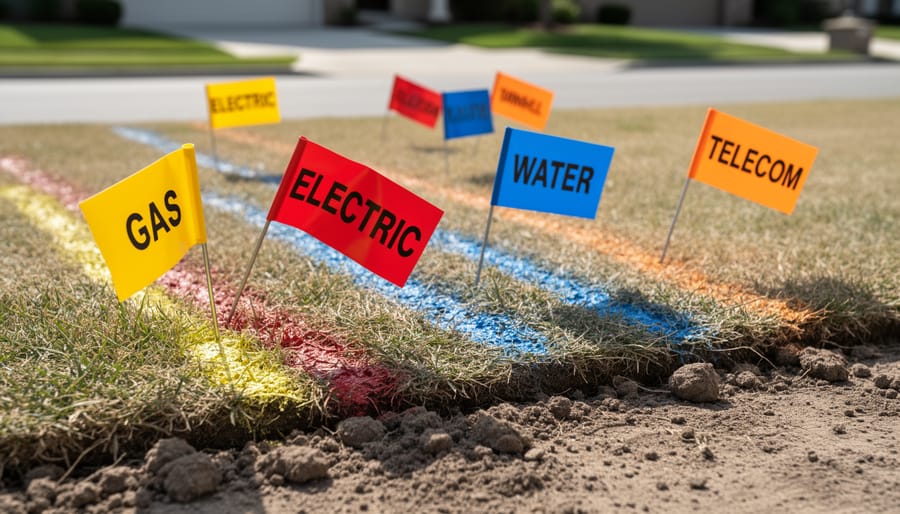
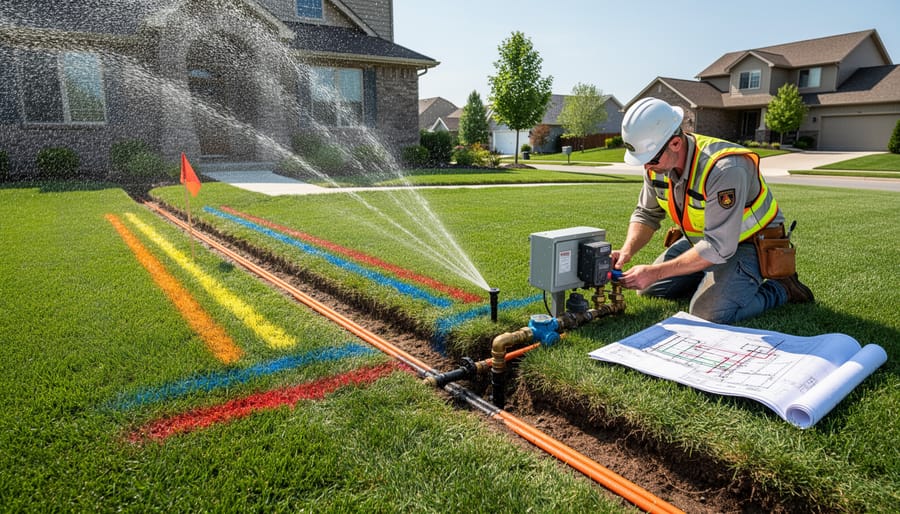
When the utility markers arrive, they’ll leave behind a rainbow of flags and spray paint on your lawn. Don’t worry about the paint – it’s designed to wash away naturally with rain and won’t harm your grass. Each color tells a specific story about what’s buried beneath. Red marks indicate electric power lines, yellow signals gas or oil lines, orange represents communication cables, blue identifies water lines, and green marks sewer systems. Purple indicates reclaimed water, while white shows the proposed excavation area you described in your initial call.
These colorful markings typically remain valid for 15 working days in Virginia. If your project extends beyond this window, you’ll need to contact 811 again for a refresh. It’s a small inconvenience that protects both you and your community’s infrastructure.
What happens if the marking deadline passes but your yard remains unmarked? First, call Virginia 811 again to report the issue. Never assume utilities don’t exist just because they haven’t been marked. Some utility companies may need additional time, or there might have been a communication error. If you’re working on a time-sensitive landscaping project, this waiting period can feel frustrating, but rushing ahead without proper markings puts you at serious legal and safety risk.
Reading Those Colorful Marks: Your Underground Utility Map
Planning Your Project Around Marked Utilities
Once those colorful flags and paint marks appear in your yard, it’s time to adapt your project plans to work safely around them. Don’t worry – a few adjustments now can save you from costly repairs and dangerous accidents later.
Start by walking your marked area and taking photos from multiple angles. This documentation helps you visualize how to redesign your project. If utility lines run through your planned garden bed location, consider shifting the bed a few feet to one side or creating a curved design that flows around the markings. I’ve found that some of my most creative garden layouts came from working with these constraints rather than against them.
For irrigation systems, flexibility is key. If a water line conflicts with a marked electric or gas line, reroute your irrigation pipes to run parallel to existing utilities rather than crossing them. Surface drip irrigation can be an excellent alternative in areas dense with underground utilities, eliminating the need for deep trenching altogether.
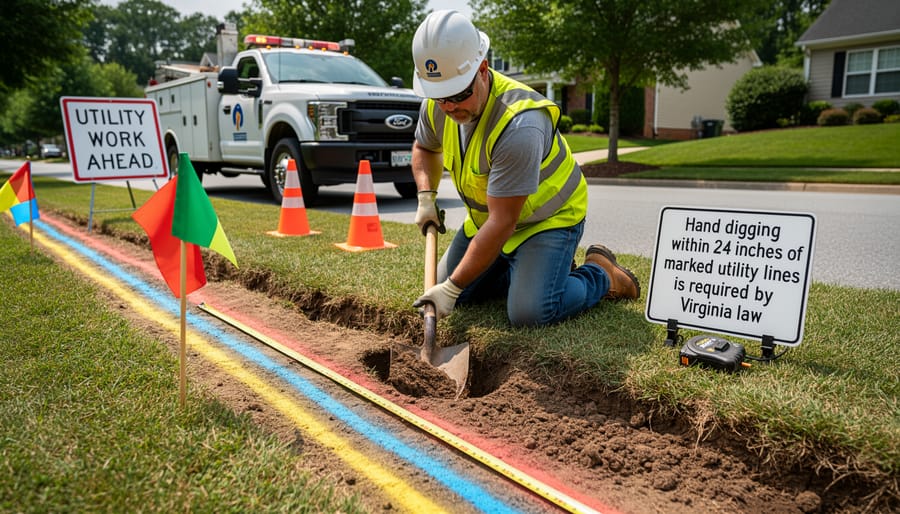
Planning a fence? The 24-inch hand-digging requirement around marked utilities is non-negotiable under Virginia law. Measure 24 inches from each side of the marked line and mark these safe-digging boundaries with temporary stakes. Within this zone, set aside your post-hole digger and use a hand shovel or spade. Yes, it’s slower work, but you’ll have complete control and can feel for underground obstacles.
When hand-digging near utilities, work carefully and progressively. Dig in small increments, removing soil gradually rather than driving your shovel deep. If you encounter a utility line, stop immediately and expose it gently by hand. Never assume the exact depth or location – ground settling and previous landscaping can shift lines from their original positions.
Special Considerations for Lawn Care Equipment
Deep-Root Fertilization, Core Aeration, and Utility Safety
Here’s where lawn care gets interesting. Most of us have used liquid fertilizers or hand aerators without a second thought, but when do these activities require calling 811? Let’s break it down with practical guidelines.
For deep-root fertilization using injection systems, you’ll typically penetrate 8 to 12 inches below the surface. Since Virginia’s law requires notification for excavation that “may” damage utilities, and many utility lines sit just 12 to 18 inches deep, calling 811 before deep-root feeding is your safest bet. Think of it this way: if you’re injecting anything deeper than a standard garden trowel’s blade, make that call.
Core aeration presents a more nuanced scenario. Most residential aerators pull plugs 2 to 4 inches deep, which generally falls below the notification threshold. However, if you’re using commercial-grade equipment that penetrates 6 inches or deeper, you’re entering the zone where utility markings become essential. Professional lawn services typically handle these notifications, but if you’ve rented heavy-duty equipment, the responsibility falls on you.
Here’s a practical rule: when your lawn care tool requires significant force, penetrates deeper than 6 inches, or you’re simply unsure, calling 811 is free and takes about 10 minutes. Utility companies will mark lines within a few business days. It’s a small investment that protects both your property and your community’s infrastructure. Remember, sustainable lawn care includes respecting what lies beneath our feet, ensuring we’re nurturing grass without risking gas lines or electrical systems.
Creating a Utility-Aware Lawn Care Strategy
Once you understand where your utilities run, you can transform this knowledge into a smart, sustainable lawn care strategy that works with your underground infrastructure rather than fighting against it. Think of it as creating a friendship with what lies beneath—your lawn will thank you, and you’ll save yourself countless headaches down the road.
Start by mapping out your utility-free zones. These are your green lights for deeper projects like installing raised beds, planting trees, or creating water features. I like to keep a simple sketch in my gardening journal showing where utilities run and marking the safe zones in a different color. It’s surprisingly empowering to have this visual reference when inspiration strikes for a new garden project.
Your irrigation system deserves special attention in utility-aware planning. Drip irrigation and soaker hoses work beautifully because they operate at shallow depths and can snake around utility corridors without issue. If you’re dreaming of an in-ground sprinkler system, work with your installer to route lines in utility-free areas. Modern systems are incredibly flexible, and a good designer can create efficient coverage while respecting those underground boundaries.
When it comes to planting, shallow-rooted perennials, groundcovers, and ornamental grasses become your best friends near utility lines. These beauties provide visual impact without sending roots into dangerous territory. Save your deeper-rooted trees and shrubs for those safe zones you’ve identified. A good rule of thumb is keeping trees at least ten feet from utility lines, though more distance is always better.
Hardscaping projects like patios, walkways, and retaining walls need careful planning too. Pavers set in sand rather than concrete footings offer flexibility near utilities, and they’re easier to lift if future utility work becomes necessary. It’s similar to following label requirements for lawn products—working within established guidelines protects both you and your investment.
Consider creating a permanent garden journal entry or digital file documenting your utility locations. Include photos of the marked lines, dates of service, and notes about depths if provided. Future you will appreciate this thoughtfulness, especially when planning that dream pergola or considering where to expand your vegetable garden. This proactive approach turns compliance into opportunity, helping you design a beautiful, safe landscape that stands the test of time.
Here’s the truth about calling 811: it’s one of the easiest, most impactful steps you can take to protect what matters most. Your family playing in the yard, your thriving garden beds, your property’s value, and even your neighbors down the street all benefit from this simple, completely free phone call. Whether you’re planting a single tree, installing a mailbox post, or planning an elaborate raised bed garden, making 811 a non-negotiable habit takes just minutes but prevents potentially devastating consequences.
Think of it this way—you wouldn’t skip watering your seedlings or forget to mulch your perennials, right? Calling 811 before digging should become just as automatic in your gardening routine. The Virginia Underground Utility Damage Prevention Act exists to keep communities safe, and compliance isn’t complicated. It’s actually empowering to know you’re doing your part to prevent accidents, protect essential services, and practice truly responsible lawn stewardship.
When you embrace safe digging practices, you’re not just following the law—you’re demonstrating genuine environmental stewardship. Preventing utility strikes means avoiding fuel leaks, gas releases, and service disruptions that harm ecosystems and communities. Every marked line is a chance to garden smarter, safer, and more sustainably. So before that shovel touches soil, make the call. Your garden, your family, and your community will thank you.