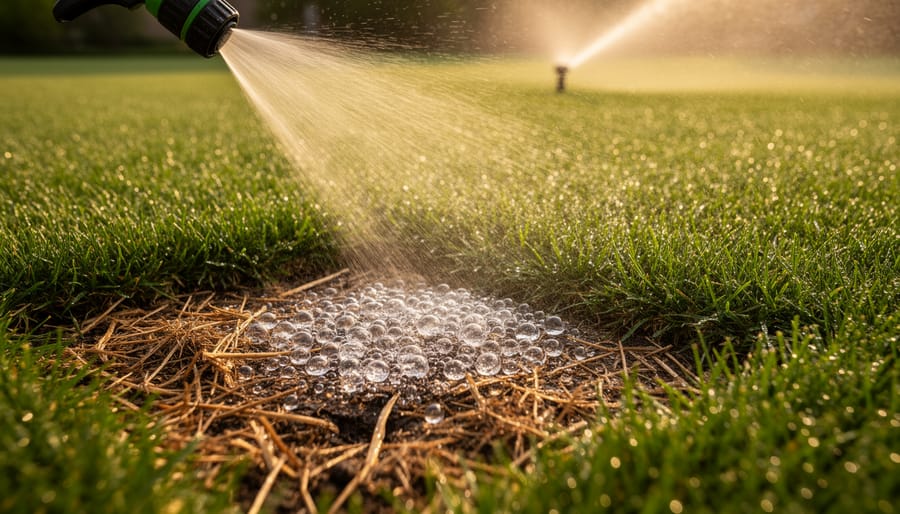
You’ve been watering religiously, fertilizing on schedule, and yet your lawn still has those frustrating dry patches that repel water like a raincoat. The puddles that form on the surface while roots below remain parched tell a troubling story: your soil has become hydrophobic, meaning it literally refuses to absorb moisture no matter how much you irrigate.
This phenomenon affects millions of lawns, particularly in regions with sandy soils, heavy thatch buildup, or organic matter that has become waxy and water-repellent over time. When water beads up and runs off instead of soaking in, nutrients can’t reach grass roots, leading to weak turf that’s vulnerable to stress, disease, and weed invasion. Your irrigation system might be running perfectly, but if the water isn’t penetrating the soil profile, you’re essentially watering the sidewalk.
Turfgrass wetting agents, also called soil surfactants, solve this problem by breaking down the surface tension between water and soil particles. Think of them as a bridge that helps water move where it needs to go, ensuring every drop of irrigation reaches the root zone instead of evaporating or running off. These products transform hydrophobic soil back into a moisture-accepting medium, maximizing the effectiveness of both your watering schedule and fertilizer applications.
Understanding how wetting agents work, when to apply them, and which formulations best suit your specific lawn conditions will help you finally achieve the lush, healthy turf you’ve been working toward while conserving water and reducing maintenance costs.
The Hidden Problem: When Water Quality Sabotages Your Soil
What Makes Soil Turn Water-Repellent
You know how a freshly waxed car causes water to bead up and roll right off? That’s essentially what’s happening in hydrophobic soil, though the cause is quite different. When organic matter in your soil breaks down, whether from grass clippings, thatch buildup, or decomposing roots, it releases waxy compounds that coat soil particles. These compounds create an invisible barrier that literally repels water instead of absorbing it.
Here’s where things get interesting: poor water quality acts as an accelerant for this process. If your irrigation water contains high levels of salts, minerals, or bicarbonates, these substances accumulate in your soil over time. Think of it like hard water stains in your shower, except these deposits change your soil’s chemistry and encourage those waxy coatings to become even more stubborn. The salts essentially create a one-two punch, both contributing to water repellency and making it harder for your grass to absorb nutrients.
This matters tremendously for nutrition because hydrophobic soil creates what I call the “starvation paradox.” You’re applying fertilizer and watering regularly, but your grass can’t access either one. Water can’t penetrate the soil to dissolve nutrients, and even liquid fertilizers simply run off the surface. Your lawn ends up both thirsty and hungry despite your best efforts. Understanding this relationship between water quality, soil condition, and nutrient availability is the first step toward breaking this frustrating cycle and restoring your lawn’s health naturally.
Signs Your Irrigation Water Is Creating Nutrient Problems
Has your lawn been giving you mixed signals lately? Here’s a practical checklist to help you identify whether your irrigation water might be causing nutrient problems rather than solving them.
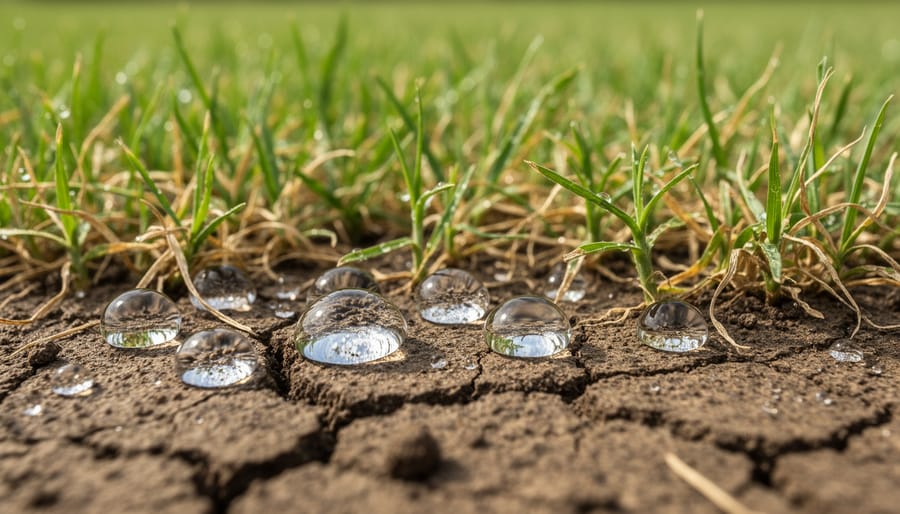
First, look for persistent dry spots that reappear shortly after watering. If certain areas seem perpetually thirsty no matter how much you irrigate, that’s your first red flag. Next, watch how water behaves during irrigation. Does it run off the surface instead of soaking in? That’s a telltale sign of hydrophobic soil conditions.
Take a close look at your soil surface between watering sessions. A crusty, hard layer that forms on top indicates minerals from your water are binding soil particles together, preventing proper water and nutrient absorption. You might also notice yellowing grass despite fertilizing regularly, which happens when poor water penetration prevents roots from accessing the nutrients you’re applying.
Finally, check for uneven growth patterns across your lawn. Some patches growing lush and green while others struggle often indicates inconsistent water and nutrient distribution. These symptoms together suggest your irrigation water quality needs attention, and a wetting agent might be the sustainable solution to restore balance to your lawn’s ecosystem.
What Turfgrass Wetting Agents Actually Do
How Wetting Agents Restore the Soil-Water-Nutrient Connection
Think of water molecules as tiny magnets that would rather stick together than soak into your soil. That’s surface tension at work, and it’s the invisible culprit behind those frustrating dry patches in your lawn. When soil becomes hydrophobic, whether from natural waxes, organic buildup, or simple compaction, water beads up and rolls away instead of penetrating where your grass needs it most.
This is where wetting agents become your lawn’s best friend. These clever compounds act like mediators between stubborn soil particles and reluctant water droplets. They work by reducing surface tension, essentially loosening water’s tight grip on itself. Picture a wetting agent as a bridge with one end that loves water and another that loves soil. When applied, these molecules surround water droplets and help them spread out and penetrate rather than pool on the surface.
Here’s the beautiful part: once water moves through the soil profile properly, it becomes a delivery vehicle for nutrients. Those fertilizers you’ve been applying can finally reach hungry grass roots. The dissolved nitrogen, phosphorus, and potassium hitch a ride with water as it travels through newly opened pathways in the soil.
Without this soil-water-nutrient connection, you’re essentially trying to feed your lawn with a locked door between the food and the roots. Wetting agents unlock that door, restoring the natural flow that healthy turf depends on. The result? More efficient irrigation, better nutrient uptake, and ultimately, the lush green lawn you’ve been working toward.
The Nutrition Connection: Better Water Penetration Means Better Feeding
Why Fertilizer Fails When Water Can’t Penetrate
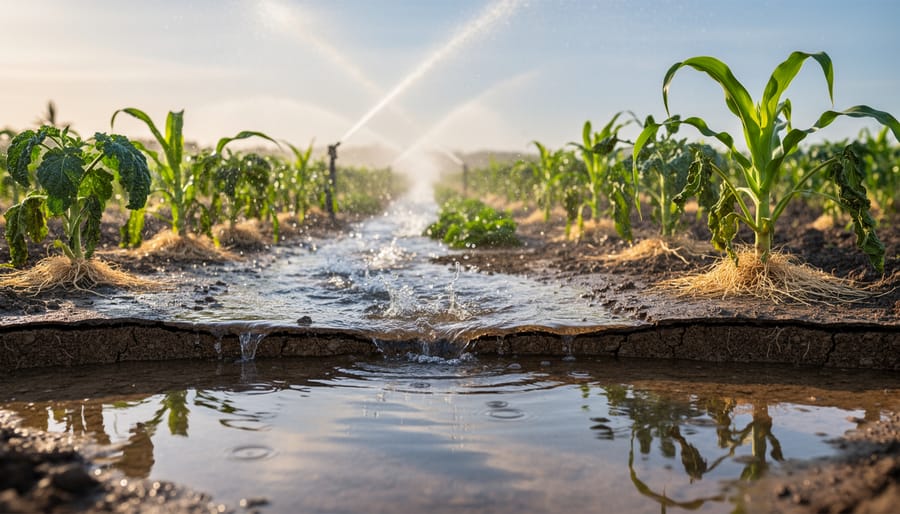
Here’s the frustrating reality many of us face: you can pour all the fertilizer you want on your lawn, but if water can’t penetrate the soil properly, those nutrients aren’t going anywhere beneficial. When hydrophobic soil or poor water quality prevents proper infiltration, your carefully applied fertilizer essentially sits on the surface like a disappointed dinner guest who wasn’t invited inside.
What happens next is a double disappointment. Nutrients either wash away with the next rain or irrigation cycle, running off into storm drains and waterways where they contribute to environmental problems like algae blooms, or they remain trapped in a thin surface layer where grass roots can’t effectively access them. This severely limits nutrient availability, leaving your turf starving despite your investment.
Think about it like trying to water a plant in a bucket with a lid on it. The water and dissolved nutrients just pool on top or spill over the sides. Your grass roots are waiting below, ready to absorb those nutrients, but they never arrive at the root zone where the real magic happens. This means you’re literally watching your money and effort wash away while inadvertently harming local waterways. It’s a lose-lose situation that wetting agents are specifically designed to prevent.
Reducing Nutrient Runoff and Salt Buildup
Here’s something that often surprises gardeners: wetting agents can actually help protect our environment while making your lawn care efforts more effective. When you’ve got challenging irrigation water, whether it’s high in salts or minerals, these products become your ally in keeping nutrients where they belong and preventing pollution.
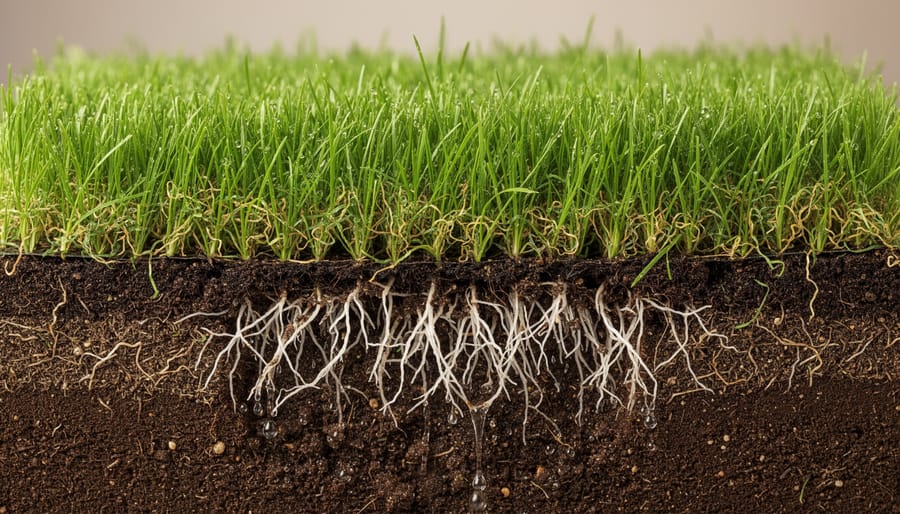
Think about it this way. When water penetrates evenly through your soil instead of running off the surface, fertilizers you’ve applied move down to the root zone where they’re actually needed. Without proper water infiltration, you’re essentially watching your fertilizer investment wash away into storm drains, taking those nutrients straight to local waterways where they don’t belong. That’s not just wasteful for your wallet; it’s harmful to aquatic ecosystems.
Wetting agents also play a crucial role in managing salt accumulation, which is particularly important if you’re irrigating with hard water or water containing high sodium levels. By improving water movement through the soil profile, these products help flush accumulated salts below the root zone before they can damage your grass. This leaching process maintains healthy soil health and reduces the need for excessive watering to manage salt buildup. You’re essentially working smarter, not harder, while reducing your environmental footprint through more efficient water and fertilizer use.
Choosing and Using Wetting Agents for Your Lawn
Types of Wetting Agents for Homeowners
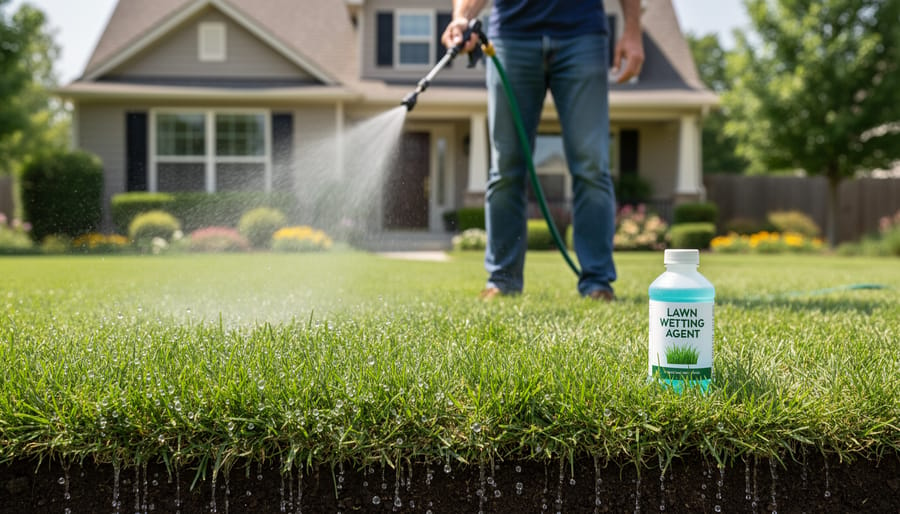
When you’re shopping for wetting agents, you’ll find two main formats: granular and liquid. Granular products are incredibly beginner-friendly since you can apply them with your regular spreader, just like fertilizer. They release slowly over time, making them forgiving if you’re still getting the hang of application rates. Liquid wetting agents, on the other hand, work faster and give you more control over where they go, but they require a hose-end sprayer or backpack sprayer for application.
You’ll also need to choose between natural and synthetic options. Natural wetting agents, often derived from yucca extract or other plant materials, are gentler on beneficial soil microbes and work beautifully if you’re committed to organic lawn care. They’re my go-to recommendation for homeowners prioritizing sustainability. Synthetic products typically cost less and may work faster, but they’re not always compatible with a chemical-free approach.
Budget matters too. If you’re treating a small problem area, a concentrated liquid gives you the most bang for your buck. For larger lawns with widespread hydrophobic soil, granular products often prove more economical per square foot, even though the upfront cost seems higher.
First-timers should start with granular natural products, they’re the most forgiving while you learn. Once you understand how your soil responds, you can experiment with liquids for targeted treatment of stubborn dry spots. Remember, the best choice depends on your specific situation, not what worked for your neighbor.
Application Tips for Maximum Benefit
Getting the most from your wetting agent investment comes down to smart timing and consistent application. Think of it like building a friendship with your lawn – regular attention yields the best results.
For timing, spring and fall are your power seasons. Apply wetting agents in early spring before heat stress hits, giving your soil time to develop improved water movement patterns. A fall application is equally valuable, preparing your lawn for winter dormancy and next season’s growth. In areas with persistent dry spots or heavy clay soil, you might benefit from applications every 4-6 weeks during the growing season.
Application method matters more than you might think. Most wetting agents work best when watered in immediately after application, so coordinate with your irrigation schedule. Apply in the early morning or evening when temperatures are cooler and evaporation is minimal. This isn’t just about water conservation – it’s about giving the product time to penetrate the soil rather than sitting on the surface.
Here’s a practical tip from experience: combine your wetting agent application with your fertilization program, but apply them separately. Use the wetting agent first, then fertilize a few days later. The improved water penetration will help nutrients reach root zones more effectively, maximizing your fertilizer investment.
Water deeply but less frequently after application. This encourages roots to grow downward into the newly receptive soil, creating a more drought-resistant lawn. Remember, sustainable lawn care isn’t about working harder – it’s about working smarter with nature’s systems.
Product Recommendations and What to Look For
When shopping for turfgrass wetting agents, you’ll want to prioritize products that are both effective and environmentally responsible. Let’s talk about what makes a quality wetting agent and which products actually deliver results for homeowners like us.
The best wetting agents contain non-ionic surfactants, which work by reducing water’s surface tension without leaving harmful residues. Look for products listing ingredients like alkyl polyglycosides or ethoxylated alcohols. These biodegradable compounds break down naturally in soil without accumulating or harming beneficial microorganisms. I’ve had excellent results with Revolution, a product that combines multiple surfactant types for comprehensive water penetration. It’s labeled for organic production, which gives me peace of mind when my kids play on the lawn.
Another solid choice is Penterra, which uses a patented colloidal micelle technology. It sounds fancy, but basically it means the product disperses evenly and works quickly to move water through hydrophobic soil. Many golf courses use it, but it’s perfectly suitable for residential applications at a fraction of the commercial rate.
For budget-conscious gardeners, LawnStar Hydrate Plus offers good value without compromising on environmental safety. It contains plant-based surfactants and includes soil penetrants that help rehydrate severely dry patches.
Warning signs of inferior products include those with petroleum-based ingredients, synthetic dyes that serve no functional purpose, or vague labeling that doesn’t specify active ingredients. Avoid products making unrealistic claims like “permanent soil modification” or those requiring frequent reapplication at unusually high rates, which suggests poor efficacy.
Remember, even the best wetting agent won’t fix underlying issues like compacted soil or poor drainage. These products work best as part of a comprehensive lawn care approach that includes proper aeration and appropriate watering practices.
Testing Your Irrigation Water and Soil
Simple At-Home Tests You Can Do
Before investing in wetting agents, it’s helpful to confirm you actually have water penetration problems. The good news? You can diagnose hydrophobic soil conditions right in your own yard with a couple of simple tests.
The easiest method is the water droplet test. Simply place a few drops of water on your dry soil surface and watch what happens. If the water beads up and sits on top for more than 30 seconds without soaking in, you’ve got hydrophobic conditions. Healthy soil should absorb water almost immediately.
Another helpful observation is the screwdriver test. After watering your lawn, wait 30 minutes and try pushing a screwdriver into the soil. It should slide in easily to at least 6 inches deep. If you’re meeting resistance or the soil feels dry just below the surface, water isn’t penetrating properly.
You can also dig a small hole about 6 inches deep in a problem area shortly after watering. Check if the soil is moist throughout or if water is pooling on top while lower layers remain bone dry. This visual inspection often reveals the telltale signs of water repellency that wetting agents are designed to address.
When to Get Professional Testing
If you’ve been battling dry spots, water runoff, or persistent lawn issues despite your best efforts, investing in professional soil testing can be a game-changer. Consider lab analysis when water seems to roll off your lawn rather than soak in, when you notice uneven growth patterns despite consistent care, or when you’re dealing with heavily compacted or clay-heavy soil.
A comprehensive water and soil test will reveal your soil’s pH levels, organic matter content, and hydrophobic tendencies. You’ll also learn about your irrigation water’s salt content and mineral composition, which directly affects how well wetting agents can work. Most tests cost between $30-75 and provide actionable data that takes the guesswork out of treatment.
When interpreting results, look for high sodium levels in water or soil, which indicate wetting agents could help dramatically. A pH reading outside the 6.0-7.0 range or organic matter below 5 percent also suggests you’ll benefit from these products. Think of testing as an investment that prevents you from throwing money at symptoms while missing the underlying cause.
Here’s the truth: wetting agents aren’t magic bullets, and that’s actually good news. They’re one piece of a larger puzzle that includes understanding your water quality, nurturing your soil biology, and providing balanced nutrition. When you view them through this holistic lens, you’re not just treating symptoms—you’re building a foundation for genuine, lasting lawn health.
Think of it like this: your lawn is an ecosystem, not a carpet. Every element works together. Hard water affects how nutrients move through soil. Compacted soil prevents roots from accessing those nutrients. Hydrophobic conditions create dry spots that no amount of fertilizer can fix. Wetting agents help break this cycle by improving water infiltration, but their real value emerges when paired with good cultural practices like core aeration, appropriate fertilization, and attention to your irrigation water’s mineral content.
The sustainable approach doesn’t mean more work—it means smarter work. Start by testing your soil and water quality. Choose a wetting agent appropriate for your specific conditions. Apply it consistently during the growing season. Monitor how your lawn responds and adjust accordingly.
Remember, improving your lawn’s health is a journey, not a destination. Small, informed changes compound over time. You don’t need to become a soil scientist overnight or overhaul everything at once. Begin with one or two improvements, observe the results, and build from there. Your lawn will reward your patience with resilience, health, and that deep green color that comes from thriving roots, not just surface appearances.