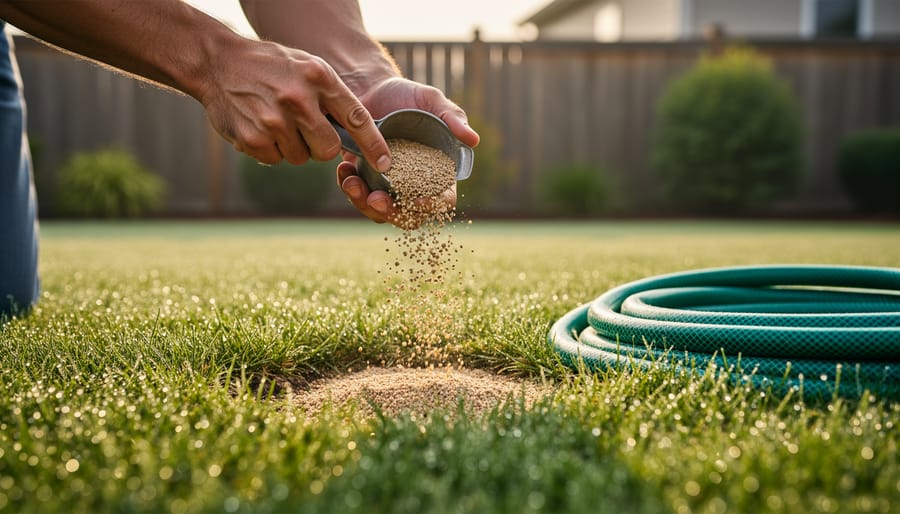
Send a soil sample to Kansas State University’s Soil Testing Lab and receive professional-grade analysis for under $20—the same service commercial turf managers rely on to make precise fertilization decisions. Located in Manhattan, Kansas, this research-backed facility has been helping homeowners unlock their lawn’s potential for decades by measuring exactly what nutrients your soil contains and, more importantly, what it’s missing.
Understanding your soil’s actual nutrient levels eliminates guesswork and prevents the wasteful cycle of applying generic fertilizers that might worsen existing imbalances. When your grass won’t grow despite regular watering and mowing, the answer usually lies beneath the surface in pH problems, phosphorus deficiencies, or potassium imbalances that only testing can reveal.
K-State’s comprehensive reports go beyond simple numbers, providing specific lime and fertilizer recommendations tailored to your grass type and climate zone. This precision approach saves money by helping you purchase only what your lawn truly needs while supporting sustainable practices that protect local waterways from nutrient runoff.
Whether you’re struggling with patchy growth, preparing a new lawn, or simply want to optimize your current maintenance routine, soil testing transforms lawn care from expensive trial-and-error into targeted, science-based decisions. The process takes just minutes to complete at home, and results typically arrive within two weeks, giving you a clear roadmap for building the healthy, resilient turf you’ve been working toward.
What Makes K-State Soil Testing Lab Different
The Science Behind Their Testing Methods
When you send your soil sample to the K-State Soil Testing Lab, you’re tapping into decades of agricultural research and expertise that few commercial labs can match. As part of Kansas State University’s College of Agriculture, this lab isn’t just running tests—it’s applying knowledge gained from years of studying the unique conditions of the Great Plains and surrounding regions.
What sets university-based testing apart is the connection to ongoing research. The scientists at K-State aren’t working in isolation; they’re part of a larger community that’s constantly refining our understanding of soil health, nutrient availability, and plant needs. Their testing methods have been validated through field trials and peer-reviewed research, which means the numbers on your report aren’t just measurements—they’re backed by science that’s been tested in real-world conditions.
Here’s what really matters for your lawn: K-State’s fertilizer recommendations are calibrated specifically for regional soils and climate patterns. They understand that Kansas clay soil behaves differently than sandy loam, and that our hot summers and variable rainfall affect nutrient availability. Rather than giving you generic advice, they’re providing guidance that reflects local growing conditions.
This regional expertise translates into more accurate, economical fertilization plans. You won’t be over-applying nutrients your soil doesn’t need, which saves you money and protects local waterways from runoff. It’s sustainable lawn care grounded in legitimate science, not marketing hype.
Cost and Turnaround Time
One of the most appealing aspects of the K-State Soil Testing Lab is its exceptional value. Standard soil tests typically cost between $10-15 per sample, making it one of the most budget-friendly options available for quality analysis. This affordable pricing puts professional-grade soil testing within reach for every gardener, whether you’re maintaining a small backyard or managing several acres.
Turnaround time is remarkably efficient, especially during off-peak seasons. You can generally expect results within 7-10 business days during fall and winter months. Spring tends to be busier as everyone gets their gardens ready, so allow 2-3 weeks during March through May. The lab emails your results directly, complete with detailed recommendations for fertilization and lime application specific to your lawn’s needs.
What makes this service particularly valuable for sustainable lawn care is the precision it offers. Rather than guessing at fertilizer needs or over-applying nutrients that can harm waterways, you’re making informed decisions based on actual data. Spending fifteen dollars now saves you from wasting money on unnecessary amendments later and protects the environment from nutrient runoff. It’s a small investment that pays dividends in healthier turf and a lighter environmental footprint.
How to Collect Soil Samples That Actually Tell the Truth
When to Sample Your Lawn
Timing your soil sample collection can make a real difference in getting accurate, actionable results from the K-State lab. The best windows for sampling are early spring or fall when soil conditions are stable and representative of your lawn’s actual nutrient levels. I like to think of spring sampling as getting ahead of the growing season, giving you time to apply amendments before your grass really takes off. Fall sampling works beautifully too, since you can adjust your lawn care plan over winter and be ready for spring success.
Avoid sampling right after fertilizing or heavy rainfall, as these can skew your results. Wait at least six weeks after any fertilizer application to ensure the readings reflect your soil’s baseline nutrient levels, not just what you recently added. Soil should be slightly moist but not soggy when you collect samples.
As for frequency, most home lawns benefit from testing every three to four years if you’re maintaining good care practices. However, if you’re addressing specific problems like persistent bare spots or struggling grass, annual testing helps you track progress and fine-tune your sustainable lawn care approach. This regular monitoring prevents over-fertilizing, which saves money and protects our environment.
The Right Tools and Technique
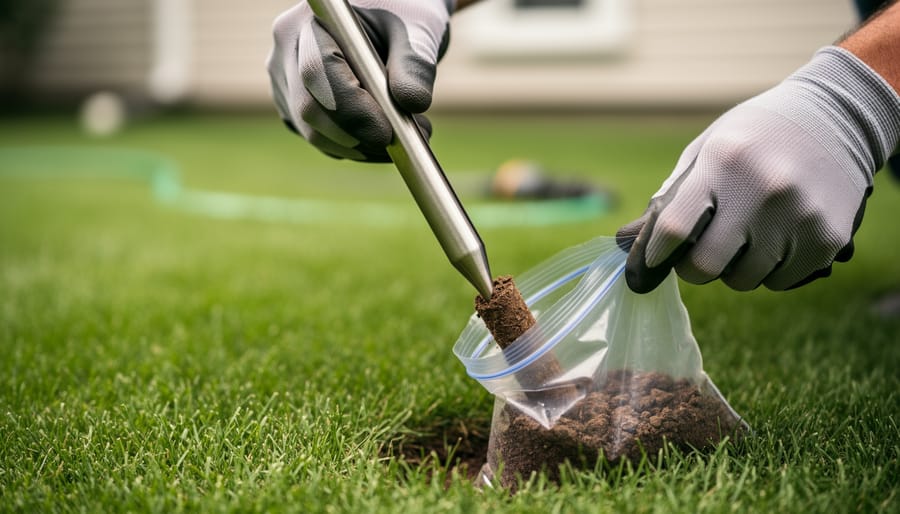
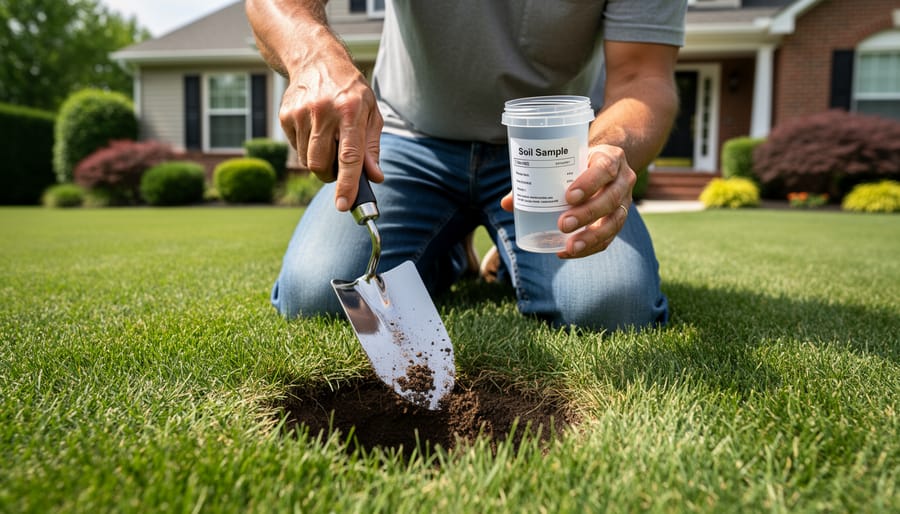
Getting an accurate soil test starts with collecting your sample correctly, and the good news is you don’t need fancy equipment. A soil probe is the gold standard for sampling, making it easy to collect consistent cores at the right depth, but if you don’t have one, a simple garden spade or trowel works perfectly fine. You’ll also need a clean bucket for mixing your samples.
For turf areas, you’ll want to collect soil from the top 3 to 4 inches of your lawn. This is where grass roots actively feed, so testing this layer gives you the most relevant information about nutrient availability. Here’s a beginner-friendly tip: if you’re using a spade, dig a small V-shaped wedge, then slice a thin layer from the smooth side of the hole. Think of it like cutting a narrow slice of cake from the center.
One mistake I see often is contamination, which can throw off your results. Before you start, make sure your tools and bucket are clean and free from fertilizer residue or rust. Avoid sampling near driveways, sidewalks, or recently fertilized spots, as these areas aren’t representative of your overall lawn health. Instead, collect 10 to 15 samples from different spots across your yard and mix them together in your bucket. This composite approach averages out any variations and gives K-State’s lab a true picture of your soil’s needs. Remember, taking a few extra minutes during collection ensures you’ll get reliable results worth acting on.
Creating a Representative Sample
Getting a truly accurate soil test starts with collecting a representative sample, and I’ll be honest—this is where many folks unknowingly sabotage their results before they even send anything to the lab. Think of it this way: your lawn isn’t uniform. That sunny spot near the driveway has different nutrient levels than the shady area under your oak tree, so one scoop of soil won’t tell the whole story.
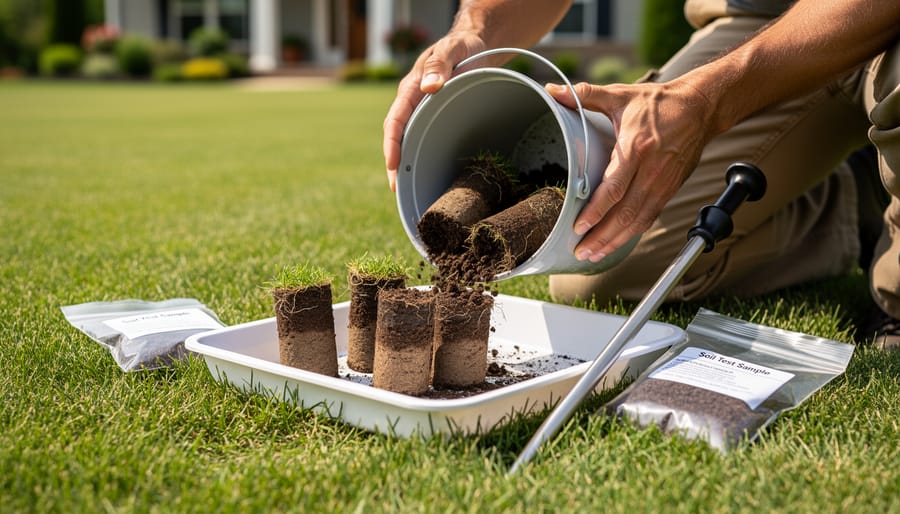
The key is collecting multiple cores from different areas of your lawn. For a typical residential yard, aim for 10 to 15 cores spread across the entire testing area. Walk in a zigzag or random pattern, taking samples from various spots to capture the overall nutrient picture. Each core should go about 3 to 4 inches deep—that’s where your grass roots are actively feeding.
Once you’ve gathered your cores, here’s the important part: mix them thoroughly in a clean bucket. This creates one composite sample that represents your entire lawn’s average condition. Remove any grass clippings, sticks, or debris, then take about a cup of this mixed soil to send to the K-State lab.
Now, let’s talk about common mistakes. Avoid sampling within 20 feet of foundations, sidewalks, driveways, or where you’ve recently applied lime or fertilizer. These areas have skewed nutrient levels from construction materials or concentrated applications and will throw off your results significantly.
If you have a problem area—say, a brown patch that won’t green up or a section with persistent weeds—sample it separately. Label it clearly as “problem area” on your submission form. This gives you targeted information for troubleshooting specific issues while still understanding your lawn’s overall health. This approach is both practical and supports making precise, sustainable fertilization decisions rather than blanket applications.
Decoding Your K-State Soil Test Report
Understanding pH and Why It Controls Everything
Think of pH as the gatekeeper to your lawn’s nutrient buffet. Even if your soil is loaded with nitrogen, phosphorus, and potassium, the wrong pH locks those nutrients away where grass roots can’t access them. For most turfgrasses, the sweet spot sits between 6.0 and 7.0—slightly acidic to neutral territory where nutrients flow freely.
Here’s a helpful analogy: imagine pH like water temperature in your shower. Too hot or too cold, and you’re uncomfortable. Similarly, when soil pH controls everything about nutrient availability, extreme readings create an inhospitable environment. Below 6.0, essential nutrients like phosphorus and calcium become chemically bound and unavailable. Above 7.5, iron and manganese get locked up, leading to that telltale yellowing despite healthy soil.
The K-State soil test reveals your current pH and provides specific recommendations for correction. If your pH runs too low, you’ll likely need lime—ground limestone that gradually raises pH over several months. Think of it as a slow-release remedy rather than a quick fix. Too high? Sulfur products can bring levels down, though this process takes patience too.
The beauty of knowing your exact pH through testing means you can stop guessing and start making targeted improvements. You’ll fertilize more effectively, waste less money on products your lawn can’t use, and create sustainable growing conditions that keep your turf thriving year after year.
The Big Three: Nitrogen, Phosphorus, and Potassium
When you receive your K-State soil test report, the first numbers you’ll likely notice are the NPK values—the big three nutrients that form the foundation of lawn health. Understanding these numbers transforms your report from confusing data into a practical roadmap for a thriving lawn.
Nitrogen is the workhorse of lawn nutrition, responsible for that rich green color and vigorous blade growth. While K-State doesn’t typically test for nitrogen levels (since it’s highly mobile and changes rapidly in soil), their recommendations section will suggest nitrogen application rates based on your grass type and management goals. Without adequate nitrogen, you’ll notice pale, slow-growing grass and potentially face nitrogen deficiency issues that leave your lawn looking tired.
Phosphorus, the middle number, powers root development and helps grass establish quickly. K-State reports phosphorus levels using the Mehlich-3 extraction method, with results shown in parts per million. You’ll see ratings like “low” (under 15 ppm), “medium” (15-30 ppm), or “high” (above 30 ppm). Many established Kansas lawns actually test high in phosphorus, meaning you can skip this nutrient and save money while protecting local waterways from unnecessary runoff.
Potassium, the final number, acts as your lawn’s immune system booster. It strengthens cell walls, improves drought tolerance, and helps grass survive temperature extremes—crucial for Kansas weather. K-State rates potassium similarly to phosphorus. A “low” rating means your lawn needs supplemental potassium, while “high” levels indicate you’re already set.
The beauty of K-State’s straightforward rating system is its simplicity. You don’t need a chemistry degree to understand that “low” means add more, “medium” means maintain, and “high” means hold off. This practical approach makes sustainable lawn care accessible to everyone.
Secondary Nutrients and Micronutrients
Here’s the good news: if your K-State soil test shows adequate nitrogen, phosphorus, and potassium, you can usually trust that secondary nutrients and micronutrients are fine too. Kansas soils are generally rich in calcium and magnesium, so deficiencies are rare for most home lawns.
The K-State report includes calcium, magnesium, and sulfur levels. Unless these show up as deficient, there’s no need to add them separately. Your lawn will tell you if something’s off—persistent yellowing despite proper nitrogen application might indicate a micronutrient issue, but this is uncommon.
For beginners, here’s the simple rule: focus on NPK first. Don’t buy expensive micronutrient blends or calcium supplements unless your test specifically recommends them. Many fertilizers already contain trace amounts of these elements anyway.
If your report does flag a deficiency in sulfur or micronutrients like iron or manganese, follow K-State’s recommendations carefully. But honestly, for 90 percent of Kansas lawns, getting the big three right solves most problems. Don’t overcomplicate things chasing nutrients you probably don’t need.
Organic Matter and CEC Explained
Your K-State soil test report includes two numbers that might seem mysterious at first: organic matter percentage and cation exchange capacity, or CEC. Think of organic matter as your soil’s natural savings account. When you see a number like 3% or 5%, that represents decomposed plant material that holds water, feeds beneficial microbes, and slowly releases nutrients throughout the growing season. Higher organic matter means your lawn stays greener longer between waterings and fertilizer applications.
CEC measures your soil’s ability to hold onto nutrients like a sponge holds water. Sandy soils typically have low CEC numbers (under 10), meaning they need lighter, more frequent fertilizer applications since nutrients wash away quickly. Clay soils with higher CEC (above 15) can hold more nutrients for extended periods. Understanding your CEC helps you avoid wasting money on excessive fertilizer that either leaches away or sits unused. Together, these measurements guide sustainable fertilization strategies that match your soil’s actual capacity to store and deliver nutrients to grass roots.
Turning Test Results Into a Feeding Strategy
Following K-State’s Fertilizer Recommendations
When your soil test results arrive, you’ll see a clear breakdown of nutrient levels and fertilizer recommendations tailored to your specific lawn needs. The report uses a straightforward format that shows your current phosphorus (P), potassium (K), and pH levels, along with recommended application rates measured in pounds per 1,000 square feet.
The tricky part for many gardeners is translating those numbers into actual bags of fertilizer at the store. Here’s the key: look at the three numbers on any fertilizer bag, which represent nitrogen (N), phosphorus (P), and potassium (K) in that order. If K-State recommends 1 pound of phosphorus per 1,000 square feet and you’re holding a bag labeled 10-10-10, that middle number tells you it’s 10% phosphorus. You’d need 10 pounds of that fertilizer to deliver 1 pound of actual phosphorus.
Timing matters as much as the products themselves. For cool-season grasses common in Kansas, apply your primary fertilization in fall when grass is actively growing and building root reserves. A lighter spring application keeps your lawn healthy without encouraging excessive top growth that demands constant mowing and watering. This approach aligns beautifully with sustainable lawn care since you’re working with your grass’s natural growth cycles rather than against them.
Don’t feel pressured to apply everything at once. Split applications reduce nutrient runoff and give your lawn time to actually use what you’re providing. Your soil test results remain relevant for about three years, though retesting helps you track improvements and adjust your approach.
Sustainable Alternatives and Organic Options
Once your K-State soil test results arrive, you have a wonderful opportunity to feed your lawn in ways that nurture both your grass and the environment. Instead of reaching for synthetic fertilizers, consider organic alternatives like compost, which slowly release nutrients while improving soil structure and microbial life.
If your test shows low nitrogen, top-dress with quality compost or apply organic fertilizers like blood meal or alfalfa meal. These work more gradually than synthetics but build long-term soil health. For phosphorus deficiencies, bone meal provides a natural solution, while greensand or kelp meal can address potassium needs.
Low pH? Consider agricultural lime, which is naturally derived. High pH? Elemental sulfur offers an organic correction method. The beauty of these amendments is they align perfectly with your test results while avoiding the salt buildup and environmental runoff associated with chemical fertilizers.
Remember, sustainable lawn care is a marathon, not a sprint. Your K-State results give you the roadmap, and organic amendments provide the fuel for a healthier, more resilient lawn that benefits your local ecosystem.
What Not to Add (Even If You Think You Should)
Here’s the temptation we all face: your soil test comes back, and you think, “Well, a little extra nitrogen couldn’t hurt, right?” Actually, it could. When your K-State results show sufficient levels of a nutrient, resist the urge to add more. Over-fertilizing doesn’t make grass greener faster—it creates problems. Excess nitrogen runs off into waterways, contributing to algae blooms and environmental damage. Phosphorus buildup harms aquatic ecosystems. Plus, you’re literally throwing money onto your lawn that won’t benefit your turf.
Think of soil testing as your gardening budget advisor. If the test says you don’t need phosphorus, skip it entirely. Your wallet and local streams will thank you. Precision fertilizing based on actual soil needs represents sustainable gardening at its best—you’re applying only what your lawn can actually use, reducing waste and environmental impact while saving money on unnecessary products.
Common Lawn Problems Your Soil Test Will Explain
Have you ever looked at your lawn and wondered why it just doesn’t thrive like your neighbor’s? Those mysterious patches of yellowing grass, thinning areas that never seem to fill in, or that persistent susceptibility to every disease that comes along – these frustrating problems often have their roots in what’s happening beneath the surface. That’s where a soil test from the K-State lab becomes your detective tool.
Thin, patchy grass that refuses to spread is frequently a telltale sign of nutrient imbalances that a soil test will reveal. When your results show low phosphorus levels, you’ve found your culprit. Phosphorus is essential for strong root development, and without adequate amounts, your grass simply can’t establish the dense root system needed to fill in those bare spots. You might have been overseeding for years without realizing the real issue was hiding in your soil.
Yellowing or pale grass, particularly if it’s uniform across your lawn, often points to nitrogen deficiency or pH problems. A K-State soil test will show you exactly where your pH stands. When soil becomes too acidic or alkaline, your grass literally can’t access nutrients even if they’re present in the soil. It’s like having a full refrigerator but no way to open the door. Adjusting pH based on test results often transforms struggling lawns without adding excessive fertilizers.
Disease susceptibility is another issue with soil roots. Imbalanced potassium levels, which your test results will identify, can leave grass vulnerable to fungal infections and stress. Potassium strengthens cell walls and improves overall plant health, acting like your lawn’s immune system.
Poor root growth despite adequate watering usually indicates compacted soil or mineral deficiencies that testing reveals. By identifying specific deficiencies rather than guessing, you’ll save money on unnecessary products while targeting the actual problems. This precision approach is better for your wallet, your lawn, and the environment.

Taking the guesswork out of lawn care doesn’t have to be complicated or expensive. By partnering with the K-State Soil Testing Lab, you’re making a smart investment that pays dividends season after season. Instead of applying fertilizers blindly and hoping for the best, you’ll have concrete data guiding every decision you make. This precision approach saves you money by preventing over-application of nutrients your lawn doesn’t need, and it protects our waterways from unnecessary runoff. That’s a win for your wallet and the environment.
The results you receive aren’t just numbers on a page—they’re your roadmap to a healthier, more vibrant lawn that you can feel good about maintaining. You’ll know exactly what your soil needs, when it needs it, and in what amounts. This kind of confidence transforms lawn care from a stressful chore into an empowering practice.
Ready to take control of your lawn nutrition? Order your K-State soil test today and join the growing community of homeowners choosing sustainable, science-based lawn care. Your lawn will thank you, and so will future generations who benefit from the responsible stewardship you practice today.