

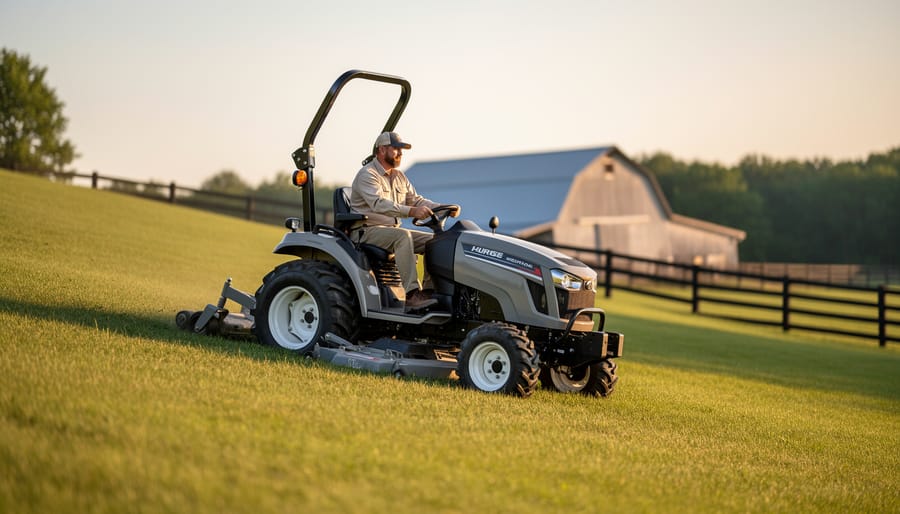
Every year, tractor rollovers claim the lives of operators who never imagined their reliable farm equipment could become a deadly hazard in seconds. Whether you’re mowing steep slopes on your property, managing a small farm, or considering your first compact tractor purchase, understanding rollover protection isn’t just about compliance—it’s about coming home safely to your family after every job.
Tractor rollovers happen faster than you can react. A wheel catching in soft soil, an unexpected dip in terrain, or misjudging a slope’s angle can flip a multi-ton machine in under two seconds. The statistics are sobering: tractors without proper rollover protective structures (ROPS) account for the majority of agricultural fatalities, yet this is one of the most preventable tragedies in equipment operation.
The good news? Modern rollover protection has evolved dramatically. From factory-installed roll bars to retrofitted ROPS systems, today’s options provide proven life-saving protection without sacrificing functionality or comfort. These structures create a protective zone around the operator, preventing crushing injuries when paired with proper seatbelt use—a combination that reduces fatality risk by 99 percent according to safety research.
This guide will walk you through everything you need to know about tractor rollover protection. You’ll discover the different types of ROPS available, learn how to assess whether your current equipment meets safety standards, understand installation options for older tractors, and explore practical operating techniques that reduce rollover risk from the start. Whether you’re managing acres of land or maintaining a large garden with tractor assistance, this information applies to your situation and could save your life.
The Real Danger: Understanding Tractor Rollover Risks

What Makes Slopes So Dangerous
Understanding what makes slopes dangerous is the first step in protecting yourself while working on your lawn or garden. The critical factor is slope angle—most tractor manufacturers recommend avoiding inclines steeper than 15 degrees, which is roughly a 3-foot rise over 10 feet of distance. What catches many people off guard is how modest that actually looks when you’re standing in your yard. A gentle-looking hillside can easily exceed this threshold.
Wet conditions multiply the risk dramatically. Morning dew on grass, recent rainfall, or irrigated areas reduce tire traction significantly, turning a manageable slope into a hazardous situation. I’ve heard from experienced gardeners who’ve worked the same hill dozens of times without issue, only to have their tractor slide unexpectedly after a light rain.
Turning while on an incline is particularly treacherous. The shift in weight distribution during a turn—even a gradual one—can tip the center of gravity just enough to start a rollover. This is why safety guidelines emphasize mowing straight up and down slopes rather than across them, and never turning on the incline itself.
Hidden hazards like ruts, holes, stumps, or embedded rocks create sudden changes in terrain that can throw off your tractor’s balance instantly. These obstacles are especially dangerous because they’re often concealed by tall grass or ground cover. Taking time to walk your property and identify these risks before mowing isn’t just good practice—it’s essential prevention.
Common Rollover Scenarios Every Homeowner Should Know
Understanding where rollovers commonly occur can help you stay alert in risky situations. Many homeowners experience close calls when mowing steep slopes or drainage ditches along property lines. What seems like a gradual incline can become dangerous when combined with morning dew or recent rain, causing tires to lose traction unexpectedly.
Working near water features presents another frequent hazard. The ground surrounding ponds, streams, or retention areas often has softer soil that can give way under a tractor’s weight, especially after wet weather. Similarly, the embankments you’ve carefully landscaped may look stable but can collapse when supporting heavy equipment.
Hillside mowing deserves extra caution, particularly when turning at slope edges or operating across rather than up and down inclines. Even experienced operators can misjudge angles when focused on achieving an even cut. Before tackling any challenging terrain, consider underground utility safety as well, since unexpected obstacles can cause sudden directional changes that lead to instability.
Pay attention to areas where you’ve recently added fill dirt or where erosion has changed the landscape. These spots may not support your tractor as well as established ground, creating unexpected tipping points during routine property maintenance.
Types of Rollover Protection Systems Explained
ROPS (Rollover Protective Structures): The Gold Standard
If you’re serious about protecting yourself while using a tractor, ROPS should be at the top of your safety checklist. Think of a Rollover Protective Structure as a protective cage specifically engineered to create a survival zone if your tractor tips over. When paired with a seatbelt, ROPS have been proven to prevent up to 99% of rollover fatalities, making them genuinely life-saving equipment.
ROPS come in two main varieties, each with distinct advantages. Fixed ROPS are permanently mounted bars or frames that arch over the operator’s seat. They’re incredibly sturdy and require no adjustment, which means there’s no risk of forgetting to raise them before operation. However, they do add height to your tractor, which can be problematic if you’re working in low-clearance areas like orchards or under barn doorways.
Folding ROPS address the clearance issue by allowing you to lower the structure when needed. This versatility makes them popular among property owners who navigate varied terrain and structures. The critical point here is that folding models must be in the upright, locked position during operation to provide protection. If you’re working on slopes or uneven ground, never operate with folded ROPS, regardless of the clearance challenge you’re facing.
When shopping for ROPS, certification matters tremendously. Look for structures that meet OSHA, ASAE, or SAE standards, which ensure the frame can withstand specific crush forces. Many older tractors weren’t manufactured with ROPS, but retrofit kits are available for most models. Contact your tractor’s manufacturer or a certified dealer to find the correct ROPS for your specific make and model. Remember, a properly installed, certified ROPS combined with consistent seatbelt use creates a protective system that dramatically improves your chances of walking away from a rollover incident unharmed.

Safety Frames and Roll Bars: What’s the Difference?
If you’re new to tractors, the terminology around rollover protection can feel confusing at first. Let me break it down in simple terms. A Roll-Over Protective Structure, or ROPS, is the umbrella term for any framework designed to create a survival zone if your tractor tips over. Think of it as a protective cage that keeps you from being crushed.
Within this category, you’ll encounter different types. A roll bar is typically a two-post structure mounted behind the operator’s seat, often found on smaller garden and lawn tractors. It’s similar to what you might see on a convertible sports car. A safety frame, sometimes called a safety cab, is a more comprehensive four-post structure that surrounds the operator on multiple sides, offering protection from rollovers in any direction.
Many modern tractors come with ROPS already installed, though some older models or compact tractors might not. Here’s what’s crucial to understand: these structures only work when paired with a proper seatbelt. The frame creates a protected zone, but you need to stay within that zone during a rollover. Without buckling up, you could be thrown from the tractor and end up beneath it, which defeats the entire purpose of having the protective structure in the first place.
Seatbelts: Your Critical Second Line of Defense
Here’s an important reality check: a ROPS frame alone won’t keep you safe during a rollover. Think of it this way—your tractor’s rollover protection works like a protective cage around you, but only if you stay inside that cage. That’s where your seatbelt becomes absolutely critical.
When a tractor tips, the natural human instinct is to jump clear. Unfortunately, this reflex can be fatal. Without a seatbelt, you risk being thrown from the operator’s seat and crushed under the tractor or caught beneath the ROPS structure itself. Studies show that ROPS combined with seatbelts reduces fatality risk by 99%, but ROPS alone provides minimal protection if you’re ejected.
I like to explain it to fellow gardeners this way: you wouldn’t wear only one gardening glove when handling thorny roses, right? ROPS and seatbelts work as a team—they’re both essential parts of your safety system. Before starting any work session, especially on slopes or uneven terrain common in sustainable land management, make buckling up as automatic as turning the key. This simple habit could genuinely save your life.
Slope Compliance: Know Your Limits

How to Measure Your Property’s Slope Angles
Understanding your property’s slope is easier than you might think, and it’s a crucial first step in preventing tractor rollovers. Let’s explore some practical methods that don’t require fancy equipment or engineering expertise.
The smartphone method is remarkably accurate and probably the easiest option. Download a free clinometer or inclinometer app on your phone. Simply hold your phone flat against the slope (or use a straightedge placed on the ground), and the app displays the angle instantly. Popular options include Clinometer + Bubble Level and Measure, both available for iOS and Android. I’ve used these myself while planning terraced garden beds, and they’re surprisingly reliable.
For a low-tech approach, try the simple string and weight method. Tie a weight to a string about three feet long, then hold the other end at shoulder height while standing on the slope. Have a helper measure the horizontal distance from the weight to your body and the vertical drop. Divide the vertical by the horizontal and multiply by 100 to get the percentage grade. A 15-degree angle equals roughly a 27% grade.
Visual estimation works too, especially once you’ve practiced. A 15-degree slope (the maximum safe operating angle for most tractors without protection) is gentler than you might imagine. Picture a ski bunny slope, not a black diamond run. If you’re thinking twice about walking across an area comfortably, your tractor will struggle even more.
Remember, slopes can look deceptive when covered in lush grass. Always measure rather than guess, especially before mowing unfamiliar terrain or operating near ditches and embankments.
Understanding Manufacturer Slope Ratings
Your tractor manual contains crucial slope ratings that deserve your attention, though they’re often tucked away in fine print. These specifications aren’t arbitrary numbers—they’re based on extensive testing to determine when your machine’s center of gravity becomes dangerously unstable. Think of them as your equipment’s honest conversation about its limitations.
Most manufacturers list slope ratings in degrees or percentages, and here’s what confuses many people: a 15-degree slope sounds gentle, but it’s actually quite steep when you’re sitting on it. That translates to roughly a 27% grade. If you’re unsure what that looks like in your yard, a 15-degree slope means the ground rises about 15 feet over a 100-foot horizontal distance.
Here’s something important that catches people off guard: your tractor handles differently depending on which direction you’re mowing. Traveling straight up and down a slope is typically more dangerous than mowing across it, which is why manuals often provide separate ratings for each direction. Going uphill, your tractor’s weight shifts backward, reducing front-wheel traction. Downhill presents braking challenges and the risk of forward pitching.
Following manufacturer specifications isn’t about being overly cautious—it’s about understanding the physics of your specific machine. Factors like tire condition, grass moisture, and whether you’re using attachments all affect stability, so those ratings assume ideal conditions. Your real-world safe limit might actually be lower, especially on wet grass or uneven terrain.
Choosing the Right Rollover Protection for Your Situation
Retrofitting Older Tractors: What You Need to Know
If you’ve inherited grandpa’s trusty old tractor or picked up a vintage model at auction, chances are it’s missing rollover protection—most tractors manufactured before the 1980s came without ROPS as standard equipment. The good news? You can absolutely add this life-saving feature, though it requires some planning.
First, compatibility is key. Not all ROPS fit all tractors, so you’ll need the exact make, model, and year to source the right kit. Many manufacturers offer retrofit kits for their older models, and several third-party companies specialize in universal options. However, universal kits may require custom mounting brackets or modifications, which brings us to installation.
While some mechanically-inclined folks tackle ROPS installation themselves, professional installation is strongly recommended. This isn’t just about bolting on a frame—proper installation ensures the structure’s integrity during an actual rollover. The mounting points must attach to the tractor’s strongest structural components, and torque specifications matter tremendously. A poorly installed ROPS can fail when you need it most or even create new hazards.
Cost-wise, expect to invest between 500 and 2,000 dollars for the kit itself, plus installation fees if you’re hiring help. Before starting any installation project, remember to call 811 before digging if you’re working near buried utilities.
Some agricultural extension offices and farm safety organizations offer rebate programs or cost-sharing initiatives for ROPS retrofits, making this essential upgrade more affordable while protecting what matters most—you.
What to Look for When Buying a New Tractor
When you’re shopping for a new tractor, safety features should be at the top of your checklist, not an afterthought. Start by asking your dealer direct questions: Does this model come standard with ROPS? Is there a seatbelt included? Can I see documentation about the rollover protection system? If a dealer tries to sell ROPS as an optional add-on to save costs, consider that a red flag. Quality manufacturers understand that rollover protection isn’t a luxury feature, it’s essential equipment.
Look for tractors with certified ROPS that meet current safety standards. The protection structure should be solidly built and properly attached to the frame, not something that looks like it could be bolted on as an afterthought. Check that the seatbelt is in good condition and easily accessible. Some modern tractors also include operator presence systems that automatically shut off the engine if you leave the seat, an excellent additional safety feature.
Don’t hesitate to test the visibility from the operator’s seat. You should have clear sightlines to potential hazards and the terrain ahead. Remember, investing a bit more upfront in proper safety equipment is far more sustainable than dealing with the devastating costs of an accident later.
Safe Mowing Practices for Slopes and Hills
The Right Way to Mow on Slopes
When mowing slopes with your tractor, the cardinal rule is surprisingly simple: always mow across the slope, never up and down. Moving side-to-side keeps your center of gravity more stable and dramatically reduces rollover risk. Think of it like traversing a hiking trail rather than climbing straight up.
Before you even start the engine, walk the area and identify the steepest sections. If you’re feeling uncertain about stability while standing there, trust that instinct. Your tractor will feel it even more. Keep your speed low and steady. This isn’t a race, and rushing on slopes is where accidents happen. I’ve learned that patience on a hillside saves more than just time in the long run.
When turning, here’s where many people get into trouble. Always turn downhill, never uphill. An uphill turn shifts weight backward and raises the front end, creating that dangerous tipping point. Make your turns wide and gradual, reducing speed even further as you pivot.
Pay attention to ground conditions too. Wet grass is slippery grass, and morning dew can transform a manageable slope into a hazard zone. If the ground feels soft or unstable, postpone mowing until conditions improve.
For slopes steeper than 15 degrees, consider whether a string trimmer or push mower might be the smarter choice. There’s no shame in choosing the safer tool for the job. Your sustainability goals are better served by preventing accidents and the environmental cleanup they’d require than by insisting on using larger equipment where it doesn’t belong.

Environmental Considerations: Natural Alternatives for Steep Slopes
Here’s a game-changing perspective: some of the riskiest slopes on your property don’t need mowing at all. Instead of repeatedly putting yourself in danger, consider transforming those steep areas into beautiful, low-maintenance landscapes.
Ground covers like creeping phlox, sedum, or vinca minor create living carpets that stabilize soil while eliminating mowing entirely. These tough plants thrive where grass struggles, and their root systems actually help prevent erosion better than turf ever could. I’ve seen homeowners convert treacherous hillsides into cascading flower displays that require nothing more than an occasional trim with hand shears from safe, level ground.
Terracing is another brilliant solution that turns one dangerous slope into several manageable, flat planting beds. While it requires upfront effort, the long-term benefits are substantial. You’ll create safe, accessible gardening spaces while dramatically reducing rollover risk.
Native plantings deserve special mention in your property safety planning. Species adapted to your region often thrive on slopes with minimal care. Switchgrass, native ferns, or regional wildflower mixes create self-sustaining ecosystems that never require a tractor.
The beauty of these approaches? You’re not just avoiding danger—you’re creating habitat for pollinators, reducing water runoff, and cutting maintenance time. Sometimes the safest solution is also the most sustainable one.
Maintenance and Inspection: Keeping Your Protection Systems Effective
What to Check Before Every Mowing Session
Before you fire up your tractor, a quick five-minute safety check can make all the difference between a routine mowing session and a preventable accident. Think of it like reading equipment labels – it seems simple, but it’s essential for safe operation.
Start with your ROPS. Walk around and visually inspect the frame for any cracks, loose bolts, or signs of damage from impact. Give the structure a firm shake – it should feel rock-solid. If your ROPS is foldable, ensure it’s locked in the upright position before starting. Never operate with a folded-down rollbar.
Next, check your seatbelt. Look for fraying, cuts, or worn webbing that could compromise its strength. Test the buckle mechanism to ensure it clicks securely and releases smoothly. A seatbelt is only effective if it actually works when you need it.
Finally, scan your mowing area for new hazards. Heavy rains can create washouts on slopes, and unexpected debris can cause sudden maneuvers. Taking these few minutes to inspect your equipment and terrain creates a habit that protects you season after season, letting you focus on achieving that perfect lawn you’re working toward.
Annual Safety Inspections: A Seasonal Maintenance Must
Just like you’d mark your calendar for spring garden bed prep, scheduling an annual deep-dive inspection of your tractor’s rollover protection should become a non-negotiable part of your seasonal routine. Think of it as a yearly checkup for one of your most important safety features.
During this thorough inspection, you’ll want to examine structural integrity carefully. Look for any cracks, significant rust, or metal fatigue in the ROPS frame itself. Check all mounting bolts and connection points, ensuring they’re properly torqued according to your manufacturer’s specifications. Over time, vibrations from regular operation can loosen these critical fasteners, potentially compromising the entire protection system’s effectiveness.
Pay special attention to welds and joints where stress naturally concentrates. If you notice anything concerning like bent components, missing hardware, or modifications someone made previously, it’s time to call in a professional. A certified mechanic or agricultural equipment specialist can assess whether repairs are possible or if replacement is necessary. Remember, your rollover protection isn’t something to take chances with. When in doubt, always consult an expert who can ensure your equipment meets current safety standards.
Taking care of your lawn and property should be a source of joy, not a source of worry. But the reality is that the equipment we rely on for maintaining our outdoor spaces comes with real responsibilities. Rollover protection isn’t about fear-mongering or adding unnecessary expense to your gardening toolkit. It’s about ensuring that you can continue doing what you love, season after season, safely and confidently.
Think about your own situation for a moment. Walk your property with fresh eyes, noting those slopes you navigate regularly, perhaps without much thought. Look at your tractor and ask yourself honestly whether it has the protection features that match how and where you actually use it. These aren’t questions meant to overwhelm you, but rather to empower you with awareness.
The beautiful thing about investing in safety is that it’s never wasted. Whether that means choosing a tractor with proper ROPS, retrofitting your current equipment, or even reassessing your mowing patterns and considering sustainable alternatives for challenging terrain, each step you take protects both yourself and your ability to keep nurturing the landscape you’ve worked so hard to cultivate.
Your lawn care journey should be sustainable in every sense of the word, including sustaining the person doing the work. Take the time to evaluate your equipment, understand your terrain, and make informed choices that reflect both your practical needs and your commitment to responsible practices. Your future self, and everyone who enjoys your garden alongside you, will thank you for it.


