Spread a quarter-inch layer of screened, aged compost across your lawn twice yearly—once in early spring and again in early fall—to transform struggling turf into thick, resilient grass without expensive fertilizers or harsh chemicals. This simple practice addresses the root cause of common lawn frustrations by improving soil structure, feeding beneficial microorganisms, and delivering slow-release nutrients exactly where grass roots need them most.
The technique works because compost acts as a soil amendment rather than just a surface treatment. When worked into the top layer through rainfall and natural activity, it creates air pockets that allow roots to penetrate deeper, helps sandy soils retain moisture, and breaks up compacted clay. The result is grass that naturally crowds out weeds and resists drought without constant intervention.
Most homeowners overlook topdressing because they don’t understand the difference between dumping compost on their lawn and applying it correctly. The key is using finely screened material—particles no larger than three-eighths of an inch—and spreading it thin enough that grass blades poke through within 24 hours. Too thick, and you’ll smother your turf. Too coarse, and you’ll create lumpy, uneven surfaces that make mowing difficult.
Whether you’re fighting patchy grass, preparing for overseeding, or simply want a healthier lawn using sustainable methods, compost topdressing delivers visible improvements within one growing season while building long-term soil health that chemical fertilizers cannot match.
What Compost Topdressing Actually Does for Your Lawn
Think of compost topdressing as a slow-release multivitamin for your lawn, rather than a quick energy drink. Unlike synthetic fertilizers that flood your grass with nutrients for a short burst of green-up, compost works differently and more sustainably.
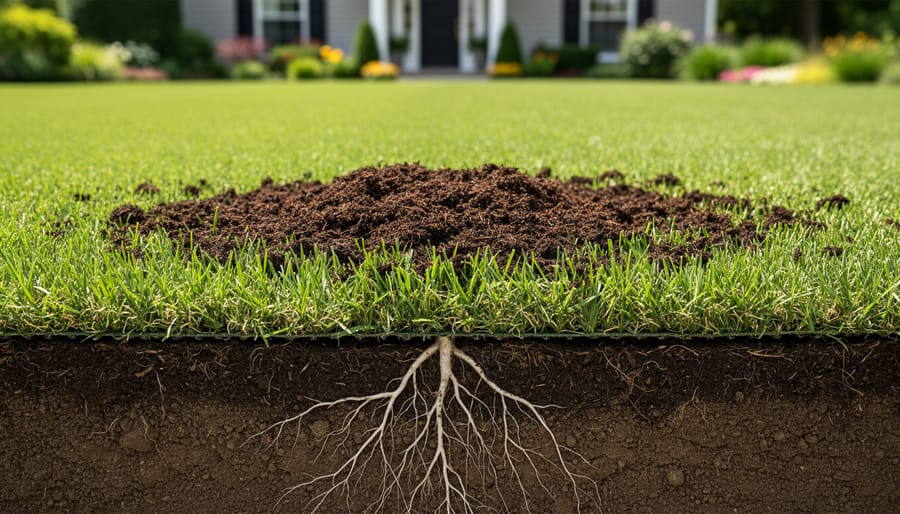
When you spread a thin layer of compost across your lawn, you’re essentially feeding the soil itself, not just the grass. This matters more than you might think. The compost slowly integrates with your existing soil, improving its physical structure. Clay soils become better drained and easier for roots to penetrate, while sandy soils gain better water-holding capacity. It’s like upgrading your lawn’s foundation without tearing anything up.
Here’s where it gets really interesting: compost is teeming with beneficial microorganisms that continue working long after you’ve applied it. These microscopic helpers break down thatch (that spongy layer of dead grass), cycle nutrients, and actually protect grass roots from disease. They’re the unsung heroes of lawn care, and compost is how you invite them to the party.
The water retention benefits are particularly valuable if you’ve ever watched your lawn turn brown during summer droughts. Compost acts like tiny sponges in your soil, holding moisture near the roots where it’s needed. This means less frequent watering and a lawn that stays greener longer during dry spells.
Unlike fertilizers that deliver a nitrogen spike and then disappear, compost gradually releases nutrients over months. It contains not just nitrogen, phosphorus, and potassium, but also micronutrients and organic matter that contribute to long-term soil health. You’re building fertility that compounds year after year rather than renting green color for a few weeks.
This is the fundamental difference between treating symptoms and addressing root causes. Fertilizers are Band-Aids; compost topdressing is preventive medicine. Your lawn becomes more resilient, self-sustaining, and less dependent on constant interventions. It’s a patient approach, but one that pays dividends season after season.
Choosing the Right Compost for Your Turf
The Particle Size Problem Most Beginners Miss
Here’s something I wish someone had told me years ago: not all compost is created equal when it comes to topdressing your lawn. I learned this the hard way when I spread my beautiful garden compost across my lawn, only to find clumps sitting on top of the grass like little brown islands for weeks. The problem? Particle size.
For topdressing lawns, you need finely screened compost that’s passed through a 1/4 to 1/2 inch mesh. This fine texture is crucial because it needs to settle down between your grass blades to reach the soil surface, not sit on top smothering your turf. Think of it like the difference between spreading beach sand versus river rocks across your lawn – one integrates, the other just sits there looking awkward.
Garden bed compost, on the other hand, can be much chunkier since you’re working it into the soil or using it as mulch. Those larger pieces are actually beneficial for beds, providing structure and breaking down slowly.
If you’re making your own compost, screening is easier than you think. You can build a simple frame using 1/4 or 1/2 inch hardware cloth stapled to wooden sides, angled over a wheelbarrow. Shovel your finished compost onto the screen, shake it gently, and the fine material falls through while twigs and chunks stay on top. It takes maybe 20 minutes to screen enough for an average lawn, and the texture difference is absolutely worth the effort for achieving that professional, seamless finish.
Red Flags: When Compost Will Harm Your Grass
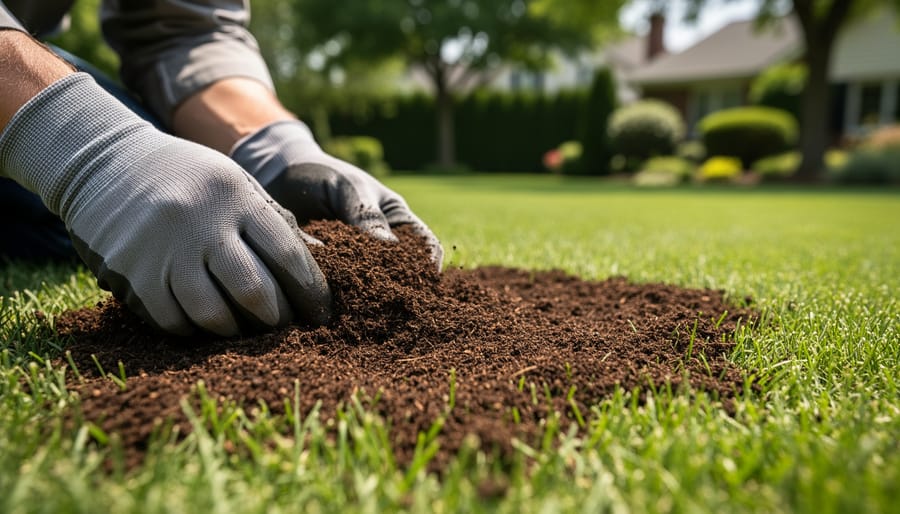
Not all compost is created equal, and using the wrong type can actually set your lawn back rather than helping it thrive. Think of compost quality like baking ingredients—using spoiled milk won’t give you a great cake, no matter how perfect your recipe is.
The biggest culprit is immature compost that hasn’t fully broken down. You’ll recognize it by large, identifiable chunks of organic matter and an ammonia-like smell. This unfinished compost is still actively decomposing, which means it’s generating heat and tying up nitrogen that your grass desperately needs. Applying it to your lawn can literally burn your grass and leave yellow, dead patches.
Here’s a simple maturity test: squeeze a handful of compost. It should smell earthy and pleasant, not sour or rotten. The texture should be crumbly and uniform, with few recognizable materials remaining. If it’s slimy, smells off, or you can still clearly identify vegetable peels or wood chips, give it more time to cure.
Watch out for excessive salt content too, especially in compost made from manure or food waste. Salt accumulation damages grass roots over time. A quick home test involves mixing one part compost with five parts water, letting it sit overnight, then tasting the strained liquid. If it tastes noticeably salty, that compost needs diluting or should be avoided entirely.
Finally, steer clear of compost that might contain herbicide residues, particularly from grass clippings treated with broadleaf weed killers. These persistent chemicals can damage your lawn months after application. When sourcing compost, always ask about the original materials and any chemical treatments they may have received.
How to Apply Compost Topdressing Like a Pro
The Right Time Makes All the Difference
Timing your topdressing application can mean the difference between a thriving lawn and a stressed one. The best windows are spring and fall when your grass is actively growing and can quickly recover from the temporary disruption. Spring topdressing, applied after your lawn greens up but before summer heat arrives, gives grass a nutritional boost heading into the growing season. Fall applications are equally effective, helping your lawn recover from summer stress while preparing it for winter dormancy.
Why does timing matter so much? Active growth means grass roots can penetrate the compost layer faster, integrating those valuable nutrients and microorganisms into your soil ecosystem. Applying compost during extreme heat or cold puts unnecessary stress on grass that’s already struggling to survive.
Different grass types have different preferences. Cool-season grasses like fescue and bluegrass thrive with early spring or early fall applications when temperatures hover between 60-75 degrees. Warm-season varieties including bermuda and zoysia prefer late spring through early summer when soil temperatures consistently reach 65 degrees or higher.
Your climate zone also influences timing. Northern gardeners should avoid late fall applications that don’t allow sufficient recovery time before winter, while southern gardeners can often topdress later into autumn without concern.
Preparation Steps You Can’t Skip
Before you spread that beautiful compost, a little prep work makes all the difference between okay results and a truly transformed lawn. Trust me, skipping these steps is like trying to paint without priming—you’ll regret it later!
Start by mowing your grass lower than usual, around 1 to 1.5 inches. This allows the compost to settle down to the soil level where it belongs, rather than sitting on top of your grass blades. Think of it as clearing a path for nutrients to reach their destination.
Next up is aeration, especially if your lawn feels more like concrete than earth. Compacted soil prevents water, air, and nutrients from penetrating deep. Those little plugs you pull out create perfect pockets for compost to nestle into, dramatically improving its effectiveness.
Take a few minutes to rake away leaves, sticks, and debris. You want compost touching soil, not sitting on top of yesterday’s fallen foliage.
Finally, check your soil moisture. It should be slightly damp but not soggy—like a wrung-out sponge. Too dry and the compost won’t integrate well; too wet and you’ll create a muddy mess. Water a day or two before if needed. These simple preparations set your lawn up for composting success.
Application Techniques for Different Lawn Sizes
The method you choose for applying compost depends largely on your lawn’s size, but regardless of the technique, the golden rule remains the same: less is more. You’re aiming for a light dusting, not a heavy blanket that could suffocate your grass.
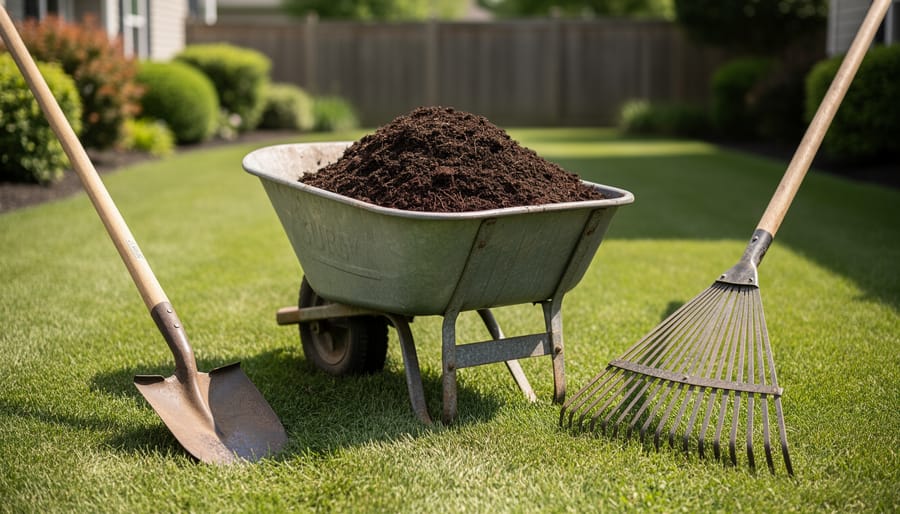
For smaller lawns up to about 1,000 square feet, good old-fashioned manual spreading works wonderfully. Grab a shovel and wheelbarrow, then scatter small piles of compost across your lawn. Using a landscaping rake or the back of a bow rake, spread these piles in a thin, even layer. Think of it like buttering toast – you want just enough to barely see the grass blades poking through. This hands-on approach gives you excellent control and lets you feel the texture of the compost as you work, which helps you gauge proper depth.
Medium-sized lawns between 1,000 and 5,000 square feet benefit from a drop spreader designed for compost. These tools require slightly screened compost but dramatically speed up the process while maintaining even coverage. You’ll make several passes in different directions to ensure uniformity.
For expansive lawns exceeding 5,000 square feet, consider renting professional topdressing equipment or hiring a lawn service with specialized machinery. These tools distribute compost efficiently across large areas.
Regardless of your method, maintain that critical depth of one-quarter to one-half inch maximum. A simple test: after spreading, you should still see at least 75 percent of your grass blades visible. If you’ve buried the grass completely, you’ve applied too much. Use a rake to redistribute excess compost, or remove it to avoid smothering your lawn and creating bare patches.
Working It In Without Damaging Your Turf
The trick to successful topdressing isn’t just spreading the compost—it’s working it down into the grass canopy where it can do its magic. Think of it like tucking a blanket between cushions rather than just draping it on top.
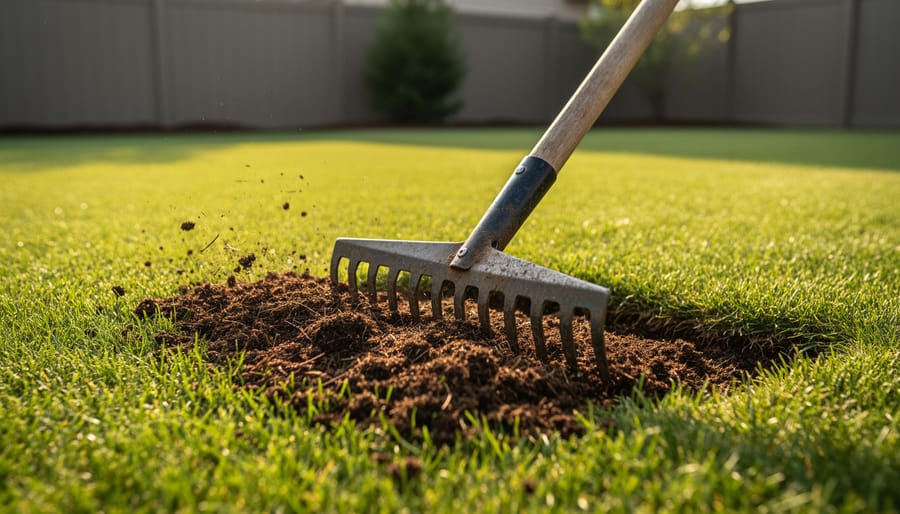
Start with a drag mat or the back of a landscape rake, moving in overlapping passes across your lawn. You’re aiming to settle the compost between the grass blades, not smother them. A stiff-bristled broom works beautifully for smaller areas or tight spots, using a sweeping motion that pushes the material downward. If you notice grass blades completely buried after working it in, you’ve applied too much in that spot—simply rake off the excess and redistribute it to thinner areas.
The grass should still be visible after you’re done. Picture about 50-75% of each blade poking through the compost layer. This lets your lawn breathe and photosynthesize while getting all those lovely nutrients.
Once you’ve worked everything in, give your lawn a gentle watering. This helps settle the compost further and begins activating those beneficial microorganisms. You’re not trying to create puddles—just enough moisture to dampen the compost layer, roughly a quarter-inch of water. Over the next few days, water lightly if conditions are dry, allowing the compost to integrate naturally with your soil ecosystem.
How Much Compost Your Lawn Really Needs
Here’s the thing about topdressing: a little goes a long way, but getting the measurements right makes all the difference between a thriving lawn and wasted effort. Let’s break down exactly how much compost you actually need.
The golden rule for topdressing is applying a layer between one-quarter to one-half inch thick across your entire lawn. Any thicker and you risk smothering your grass, any thinner and the benefits diminish significantly. I learned this the hard way when I enthusiastically dumped two inches of beautiful compost on my backyard and watched my grass struggle to breathe through it!
For practical calculations, one cubic yard of compost will cover approximately 1,000 square feet at a quarter-inch depth, or 500 square feet at a half-inch depth. So if you have a 2,000 square foot lawn and want that ideal quarter-inch layer, you’ll need roughly two cubic yards of compost. A standard pickup truck bed holds about two cubic yards, which gives you a helpful reference point when ordering.
Your lawn’s current condition determines how much you should apply. Struggling lawns with compacted soil, bare patches, or poor drainage benefit from the thicker half-inch application. Healthy lawns maintaining their condition do fine with the lighter quarter-inch treatment. Think of it like skincare: problem areas need more intensive treatment than maintenance routines.
As for frequency, most lawns thrive with annual topdressing in either spring or fall. Those facing challenging conditions like heavy clay soil, high traffic, or persistent thatch issues might benefit from biannual applications, doing lighter quarter-inch treatments in both spring and fall. This approach spreads the benefits throughout the growing season without overwhelming your grass.
Remember, consistency matters more than quantity. A modest annual application builds soil health gradually and sustainably, creating lasting improvements rather than temporary fixes. Start conservative if you’re uncertain—you can always add more next season based on your lawn’s response.
Common Mistakes That Waste Your Time and Money
I’ve learned over the years that enthusiasm can sometimes lead to expensive mistakes with compost topdressing. Let me share the most common pitfalls I see homeowners make, so you can avoid them and get better results faster.
The biggest mistake? Applying compost too thickly. I know it’s tempting to think more is better, but burying your grass under a half-inch or more of compost will literally suffocate it. Your lawn needs light to photosynthesize, and those grass blades can’t punch through a heavy blanket of organic matter. Stick to that quarter-inch sweet spot. It might look like you’re barely doing anything, but trust me, your lawn will respond beautifully to this thinner application. Think of it as feeding, not frosting a cake.
Using the wrong compost type is another costly error. That cheap, woody mulch labeled as compost at the big box store isn’t what you need. Lawn topdressing requires finely screened, well-decomposed compost that won’t introduce weed seeds or slow down nutrient availability. If you grab your compost and see large chunks of bark or uncomposted materials, keep shopping. Quality matters here because you’re investing time and effort in this project.
Timing mistakes waste both resources and potential. Topdressing during summer heat stresses your lawn when it’s already struggling. Similarly, applying compost right before winter in cold climates means those beneficial microbes go dormant before they can work their magic. Spring and early fall are your golden windows when soil temperatures support microbial activity and grass growth.
Here’s another common oversight: skipping aeration on compacted soils. If your lawn feels like concrete and water puddles after rain, spreading compost on top won’t solve your problems. The nutrients simply can’t penetrate the compacted layer below. Aerate first, then topdress for maximum benefit.
Finally, expecting overnight miracles sets you up for disappointment. Compost topdressing is a sustainable, long-term strategy, not a quick fix. You’ll notice improved color within three to four weeks, but significant changes in soil structure and drought resistance develop over multiple seasons. Plan on topdressing annually for two to three years to transform truly struggling lawns. Patience pays off with healthier, more resilient grass that needs less intervention over time.
Sustainable Topdressing: Making Your Own Compost Work
Making your own compost for lawn topdressing is one of the most rewarding ways to create a healthier lawn while closing the loop on yard waste. I’ve been doing this for years, and honestly, there’s something deeply satisfying about spreading material you’ve created yourself across your grass.
The key to lawn-grade compost is producing finely textured, fully decomposed material. Start with a good mix of green materials like grass clippings and kitchen scraps combined with brown materials such as shredded leaves and cardboard. The magic ratio is roughly 3 parts brown to 1 part green, though don’t stress too much about perfection. Your compost pile needs regular turning every few weeks to maintain oxygen flow and speed decomposition.
Here’s what separates lawn compost from garden compost: it needs to be completely finished. Partially decomposed material can actually harm your grass by creating hot spots or introducing unwanted seeds. Test maturity by checking the temperature. If your pile has cooled to ambient temperature and the original materials are unrecognizable, you’re getting close. The smell test works too. Finished compost should smell earthy and pleasant, never sour or ammonia-like.
Screening is the game-changer for lawn applications. I use a simple frame with half-inch hardware cloth stretched across it. Just shovel your finished compost onto the screen and shake it over a wheelbarrow. What passes through is perfect for topdressing, while larger chunks go back into your active pile for further breakdown. This step takes maybe twenty minutes but makes spreading so much easier and ensures uniform coverage.
For best results, aim to produce compost that’s dark, crumbly, and holds together loosely when squeezed. This texture allows it to settle between grass blades effectively while still providing all those beneficial microorganisms your lawn craves. Starting your compost pile in spring means you’ll have beautiful material ready for fall application, creating a perfect sustainable cycle.
Compost topdressing isn’t a magic wand that transforms your lawn overnight, and that’s actually a good thing. Think of it as making a long-term investment in your soil’s health rather than reaching for a quick cosmetic fix. The benefits compound over time, building resilient turf that requires less intervention, fewer chemicals, and less water. Every application you make is contributing to a living ecosystem beneath your feet that will reward you season after season.
If you’re new to this practice, start small. Choose a manageable area of your lawn, perhaps 500 square feet, and see how it responds. Be patient with the results. You might notice improved color within a few weeks, but the real transformation in soil structure and microbial activity happens gradually over months and years. This is part of a holistic approach to lawn care that prioritizes sustainability and working with nature rather than against it.
Your actionable first step? Source quality compost this week and mark your calendar for application during your region’s ideal window. Remember, even experienced gardeners started as beginners. The simple act of spreading a thin layer of compost is more forgiving than you might think, and your lawn will appreciate the effort.