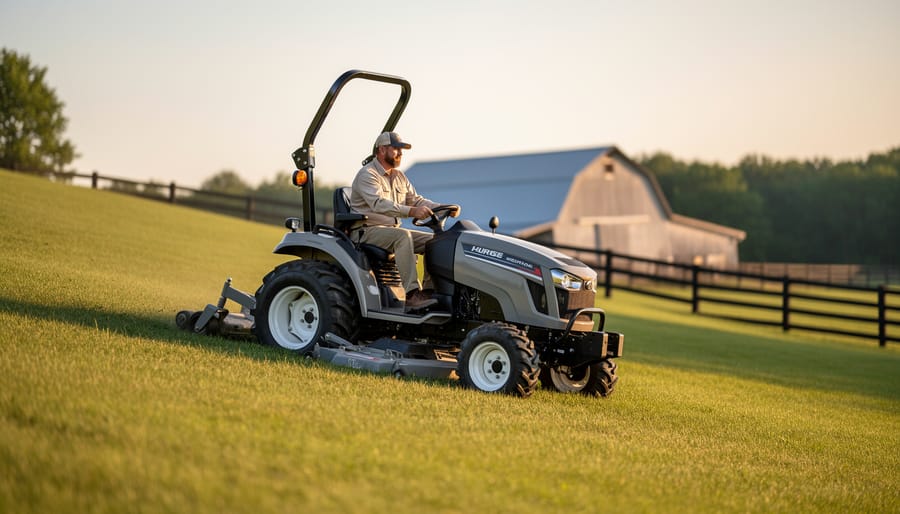
Transform your tractor into a multi-season powerhouse by selecting attachments that match your specific terrain and climate needs. Start by assessing your property’s unique challenges—steep slopes require different solutions than flat lawns, while clay-heavy soil demands more robust equipment than sandy terrain. Match attachment width to your tractor’s horsepower, ensuring you have at least 2-3 horsepower per foot of cutting deck to prevent engine strain and deliver clean cuts.
Prioritize Universal Three-Point Hitch compatibility when shopping, as this standardized system allows you to swap between mowing decks, aerators, and snow blades without investing in brand-specific equipment. Most modern tractors use Category 1 hitches, but verify your specifications before purchasing any attachment to avoid costly compatibility issues.
Consider how year-round riding mower attachments extend your equipment’s value beyond the growing season. A finish mower creates pristine lawns during summer, while a dethatcher restores compacted soil in spring, and a blade attachment clears winter snow from driveways. This versatility transforms a single equipment investment into a complete property management system.
Focus on attachments that support sustainable lawn care practices. Mulching kits return nutrients to your soil, reducing fertilizer dependency, while precise aerators improve water absorption without chemical treatments. Select durable, repairable attachments over disposable options—quality implements last decades when properly maintained, reducing waste and long-term costs while delivering consistently superior results across your entire property.
Why Your Lawn Tractor Deserves More Than Just Mowing
If you’re like most lawn tractor owners, you probably fire up your machine for one purpose: cutting grass. But here’s something worth considering—that trusty tractor sitting in your garage has far more potential than you might realize. Understanding the full scope of lawn tractor capabilities opens up a world of possibilities that can transform how you manage your property throughout the year.
Think about it this way: buying a lawn tractor represents a significant investment, typically ranging from $1,500 to $4,000 or more. Yet for most homeowners, that machine sits idle for much of the year or gets used for just an hour or two each week during growing season. Meanwhile, you’re either tackling yard tasks by hand, renting equipment, or buying additional single-purpose machines that clutter your storage space. There’s a better approach.
Attachments allow you to maximize your existing investment rather than accumulating separate pieces of equipment. Instead of purchasing a dedicated aerator, dethatcher, spreader, and snow blower—each costing hundreds or thousands of dollars—you can add attachment capabilities for a fraction of the price. This isn’t just smart economics; it’s practical sustainability. Fewer machines mean less manufacturing impact, reduced fuel consumption, and less equipment eventually ending up in landfills.
From an environmental perspective, multi-use machinery simply makes sense. Your tractor’s engine, which you’re already maintaining and fueling, can power numerous tasks without requiring additional motors, batteries, or power sources. This consolidation reduces your overall carbon footprint while keeping your property in top shape year-round.
Perhaps most importantly, quality attachments actually extend your tractor’s useful life. Regular, varied use keeps mechanical components working smoothly, and when your tractor becomes genuinely indispensable across all seasons, you’re more likely to maintain it properly. That means your investment pays dividends for many more years than if it were just a seasonal mowing machine.

Essential Mowing Deck Attachments That Change Everything

Mid-Mount vs. Front-Mount vs. Rear-Mount Decks
When you’re choosing a mower deck for your tractor, understanding the mounting position can make a real difference in how well it handles your lawn’s unique challenges. Most popular lawn tractors accommodate different mounting styles, each with distinct advantages.
Mid-mount decks sit directly beneath the tractor between the front and rear wheels. This is the most common configuration you’ll find, and for good reason. They offer excellent visibility since you can see exactly where you’re cutting, making it easier to navigate around flowerbeds and ornamental features. The balanced weight distribution provides stable operation on moderate slopes and uneven terrain. From a sustainability perspective, mid-mounts excel at delivering clean, even cuts that promote healthier grass growth, reducing the need for additional lawn treatments. They’re ideal for residential properties with obstacles to navigate.
Front-mount decks attach ahead of the tractor’s front wheels, giving you unmatched maneuverability. If you have lots of trees, shrubs, or garden borders, you’ll appreciate how easily you can trim right up to obstacles without backing up repeatedly. The tradeoff is they can be harder to control on steep slopes since the weight sits forward, and they typically cost more upfront.
Rear-mount decks trail behind the tractor, making them perfect for rough, uneven terrain where you need the tractor’s full weight for stability. They handle tall grass and overgrown areas beautifully, though visibility becomes more challenging since you’re looking backward.
Consider your property’s topography and obstacles when deciding. Flat lawns with minimal landscaping work great with any style, while hilly properties benefit from mid or rear configurations for better traction and control.
Mulching Kits and Bagging Systems
If you’re committed to sustainable lawn care, mulching kits and bagging systems are game-changers that transform how you manage grass clippings while benefiting your lawn’s health. Let me share why these attachments deserve serious consideration for your tractor mower setup.
Mulching kits are my personal favorite for everyday mowing. These attachments modify your mower deck by adding specialized blades and blocking the discharge chute, forcing clippings to circulate under the deck where they’re chopped into fine pieces. The result? Those nutrient-rich clippings drop back onto your lawn, decomposing quickly to feed your grass naturally. Think of it as free fertilizer that you’re creating with every mow. You’ll reduce your fertilizer needs by up to 25 percent while keeping grass clippings out of landfills where they contribute to methane emissions.
Most quality mulching kits designed for tractor mowers range from $150 to $400, depending on your deck size. Look for kits with high-lift mulching blades that create strong airflow to achieve that fine chop. The John Deere MulchControl system is particularly impressive, allowing you to switch between mulching and side-discharge without leaving your seat.
Bagging systems become essential during spring’s heavy growth periods or fall leaf cleanup. Modern three-bin baggers can hold 6 to 8 bushels, minimizing trips to your compost pile. The collected material makes exceptional compost when you have time to manage it properly. I recommend bagging systems with quick-release frames for easy seasonal installation and removal.
The environmental math is compelling: keeping clippings on your lawn returns vital nitrogen, reduces water needs through improved moisture retention, and eliminates the fuel consumption of hauling yard waste. Choose mulching for routine maintenance and reserve bagging for seasonal cleanup tasks.
Seasonal Attachments That Work as Hard as You Do
Spring and Summer: Aerators and Dethatchers
As your lawn awakens from winter dormancy, it’s time to give it the breathing room it deserves. Spring and summer are prime seasons for lawn rejuvenation, and two attachments that can transform compacted, thatch-laden turf into a thriving green carpet are aerators and dethatchers.
Aerators work by pulling small plugs of soil from your lawn, allowing air, water, and nutrients to penetrate deep into the root zone. For tractor owners, pull-behind spike aerators are the budget-friendly option, typically running between $150-$300. However, core aerators deliver superior results by actually removing soil plugs rather than just punching holes. The Brinly PA-40BH tow-behind plug aerator earns high marks for its 40-inch working width and sturdy construction, handling up to two acres efficiently. Aim to aerate in early spring or early fall when grass is actively growing but not stressed.
Dethatchers, also called power rakes, remove the layer of dead grass and organic debris that accumulates between your lawn’s green blades and soil. This buildup can suffocate your lawn and harbor pests. The Agri-Fab 45-0295 stands out as a reliable mid-range option with adjustable tine depth and a 48-inch working width, perfect for properties up to three acres. Spring dethatching should happen after grass begins greening up but before it enters peak growth.
For best results, dethatch first to remove debris, then aerate to address compaction. This one-two approach, followed by overseeding, creates ideal conditions for thick, healthy grass that naturally crowds out weeds. It’s sustainable lawn care at its finest, reducing your need for chemical interventions while building stronger turf.
Fall Preparation: Lawn Sweepers and Baggers
When autumn arrives and leaves start falling faster than you can rake them, lawn sweepers and baggers become absolute lifesavers for tractor owners. These attachments transform the tedious task of leaf collection into a quick, efficient process that’ll have your yard looking pristine in no time.
Tow-behind lawn sweepers are the workhorses of fall cleanup. These mechanical marvels use rotating brushes powered by the wheels to sweep leaves, grass clippings, and small debris into a large hopper as you drive. Look for models with at least 20-25 cubic feet capacity if you have a larger property – you’ll spend less time emptying and more time actually cleaning. The best sweepers feature adjustable brush height settings, allowing you to work effectively on slightly uneven terrain without missing debris or scalping your lawn.
For heavier-duty collection, consider bagger attachments that connect directly to your mower deck. These systems use airflow to vacuum material into large capacity bags, typically handling both leaves and grass clippings effectively. They’re particularly useful for those committed to composting, as the shredded material breaks down faster than whole leaves.
Durability matters significantly with these attachments. Metal hoppers outlast fabric ones, though they’re heavier. Reinforced seams and rust-resistant coatings extend lifespan considerably. From an environmental standpoint, collecting leaves for composting rather than blowing them into streets supports healthier soil and reduces municipal waste. Quick-release mechanisms for emptying make the whole process more enjoyable, turning what could be a weekend-long chore into a single afternoon’s work.

Winter Warriors: Snow Blades and Blowers
When winter blankets your property in snow, your trusty tractor transforms from a mowing machine into a snow-clearing powerhouse. I learned this the hard way during my first winter as a homeowner, shoveling for hours before a neighbor showed me his tractor setup. Now I wouldn’t face winter without the right attachments.
Snow blades are your budget-friendly entry point into winter clearing. These straight or angled blades mount to your tractor’s front and push snow aside like a miniature road grader. They work beautifully for light to moderate snowfall on flat surfaces and driveways. The key is getting one with adjustable angles so you can direct snow where you want it. For wet, heavy snow or deeper accumulations, however, blades can struggle and sometimes just pack snow down rather than clearing it completely.
Snow plows offer more aggressive clearing power than simple blades. V-shaped or curved designs cut through deeper snow more efficiently, and many models include trip mechanisms that protect your equipment when you hit hidden obstacles. They’re excellent for clearing parking areas and long driveways quickly.
For serious winter warriors dealing with frequent heavy snowfall, snow blowers are worth the investment. These attachments actually throw snow considerable distances, making them perfect when you’ve run out of places to push it. They handle wet, packed snow that would bog down a blade, and newer models are surprisingly fuel-efficient.
Storage tip: Keep these attachments under cover during off-season to prevent rust and extend their lifespan considerably.
Year-Round Utility: Carts, Spreaders, and Sprayers
Here’s where your tractor truly becomes a year-round workhorse. These utility attachments transform seasonal lawn care into an efficient, sustainable practice that keeps your property thriving through every month.
Dump carts are the unsung heroes of yard work. I’ve hauled everything from autumn leaves to spring mulch in mine, and the time saved compared to wheelbarrowing is remarkable. Look for carts with 600-pound minimum capacity and a reliable dump mechanism. Steel construction outlasts plastic, though it’s heavier. The best models feature quick-release pins for easy attachment and swivel dumping for precise material placement. They’re perfect for distributing compost, clearing debris, or even hauling tools around larger properties.
Fertilizer spreaders deserve special attention for anyone committed to sustainable lawn care. Broadcast spreaders offer the most versatility, handling everything from organic fertilizers to grass seed. The key is finding one with adjustable spread width and flow control, which prevents over-application and nutrient runoff. I recommend calibrating your spreader before each season using the manufacturer’s guidelines. This practice ensures you’re applying only what your lawn needs, protecting both your wallet and local waterways.
Sprayer systems complete the utility trio, though choosing wisely matters here. Tank sprayers with 15 to 25-gallon capacity handle most residential needs. Opt for models with adjustable nozzles and boom width options. These allow you to apply organic pest controls, liquid fertilizers, or even just water where needed. The precision reduces waste and environmental impact while keeping your lawn healthy and resilient throughout the growing season.
Specialty Attachments for Advanced Lawn Care
Landscaping Tools: Graders, Plows, and Tillers
When you’re ready to tackle more ambitious landscape projects, ground preparation attachments transform your tractor into a serious earth-moving tool. Understanding which attachment suits your needs while respecting your soil’s health makes all the difference.
Box blade graders are the workhorses of driveway maintenance and property leveling. These versatile attachments feature adjustable scarifiers that break up compacted soil and angled blades that redistribute material evenly. They’re perfect for smoothing gravel driveways after winter or creating level building sites. The key is working gradually—aggressive grading can severely disrupt soil structure and beneficial microorganism communities.
Plows come in several configurations, with moldboard plows being most common for garden preparation. While they’re excellent for turning under cover crops or breaking new ground, consider tractor weight considerations before plowing—lighter tractors struggle with deep tillage and may lack sufficient traction. Modern sustainable practices often favor minimal tillage to preserve soil ecosystems, so reserve plowing for necessary situations like incorporating significant organic matter or establishing new garden beds.
Rotary tillers attach via three-point hitches and pulverize soil using rotating tines. They’re ideal for preparing seedbeds or mixing amendments into the top soil layer. However, overuse creates hardpan layers and destroys beneficial fungal networks. Limit tilling to spring preparation and consider no-till methods for established gardens.
Environmental responsibility means timing these activities when soil moisture levels are appropriate—never work waterlogged soil, which causes compaction and structural damage. Also, minimize bare soil exposure to prevent erosion by immediately planting or mulching disturbed areas. These powerful attachments serve important purposes, but thoughtful application protects your soil’s long-term health and productivity.
Precision Equipment: Edgers and Trimmers
There’s something deeply satisfying about crisp, clean lawn edges that frame your property like a picture. While your tractor mower handles the bulk of cutting, achieving those professional-looking finishing touches requires specialized precision equipment.
Edger attachments transform your tractor into a complete lawn care machine. These attachments typically mount to the side or front of your mower deck, creating defined borders along sidewalks, driveways, and garden beds. The best models feature adjustable cutting depths and angles, letting you customize the edge profile to your preference. I’ve found that vertical edgers work particularly well for establishing new borders, while blade-style attachments excel at maintaining existing edges with minimal turf disruption, which is better for your lawn’s overall health.
When evaluating edgers, compatibility is crucial. Most quality attachments connect through universal mounting systems, but always verify the specifications match your tractor’s make and model. Look for models with adjustable positioning brackets that accommodate different mower deck sizes.
String trimmer attachments offer even more versatility for detail work around obstacles like trees, fence posts, and flower beds. These typically mount to your tractor’s front or side and use heavy-duty trimmer heads designed for commercial applications. The key advantage over handheld trimmers is consistent cutting height and reduced operator fatigue during extended sessions.
Performance-wise, hydraulically-powered edgers and trimmers outperform mechanical drive systems, providing smoother operation and better torque control. While they represent a larger investment, the improved results and reduced maintenance make them worthwhile for properties exceeding one acre. For smaller yards, mechanical systems offer excellent value and surprising reliability.
Making the Right Choice: Compatibility and Connection Systems
Before you invest in that tempting collection of lawn mower attachments, let’s talk about something that’ll save you both money and frustration: making sure everything actually works together. I learned this lesson the hard way when I excitedly purchased a beautiful aerator attachment, only to discover it required hydraulic connections my tractor simply didn’t have. Don’t be like me!
The first thing you’ll want to check is your tractor’s hitch system. Most modern garden tractors use either a standard rear hitch or 3-point hitch systems. Three-point hitches offer superior weight distribution and control, making them ideal for heavier implements like tillers and box blades. If you’re working with a simpler rear hitch, you’ll be limited to pull-behind attachments, which still covers plenty of useful equipment but won’t give you the same versatility.
Next up is the Power Take-Off (PTO) system. This is essentially how your tractor’s engine powers certain attachments. Check whether your tractor has a PTO and what type it is. Some attachments require manual engagement, while others work with electric PTO systems. The shaft diameter and rotation speed matter too, typically measured in RPMs. Most residential tractors run at 540 RPM, but always verify before purchasing powered attachments like rotary tillers or spreaders.
Hydraulic requirements often catch people by surprise. Attachments like snow plows with angling features or sophisticated loader buckets may need hydraulic power. Review your tractor’s manual to see if it has hydraulic outlets and what pressure capacity it provides. Some compatible tractor models offer hydraulic kits as add-ons, which can expand your attachment options considerably.
Weight distribution is another crucial consideration for both safety and effectiveness. Your tractor’s weight capacity includes you, the fuel, and the attachment. Front-mount attachments can affect steering, while heavy rear implements might lift your front wheels off the ground. Adding wheel weights or fluid-filled tires can help balance heavier attachments.
Finally, measure twice, buy once. Check the specific model numbers for both your tractor and potential attachments, and consult compatibility charts from manufacturers. Most reputable brands provide detailed compatibility information online, and their customer service teams can answer specific questions before you commit to a purchase.

What to Look for When Buying Tractor Attachments
Investing in quality tractor attachments is a lot like choosing the right garden tools – you want equipment that’ll serve you reliably for years, not leave you frustrated after a season or two. Let me share what I’ve learned about making smart buying decisions that balance your budget with long-term value.
Start by examining build quality closely. Look for attachments with heavy-gauge steel construction and reinforced stress points, especially where the attachment connects to your tractor. Quality welds should appear smooth and consistent, not lumpy or irregular. Moving parts need sealed bearings rather than cheap bushings, and any adjustable components should feel solid, not wobbly. I’ve seen too many gardeners attracted to budget attachments only to deal with bent frames or stripped adjustment mechanisms within months.
Warranty coverage tells you volumes about manufacturer confidence. Reputable brands typically offer at least a two-year warranty on structural components, with some extending coverage to five years. Be wary of companies offering minimal or vague warranty terms – they’re often signaling that durability isn’t their priority. Read the fine print about what’s actually covered and what requires registration or maintenance documentation.
Brand reputation matters tremendously in this market. Established names like Land Pride, King Kutter, and Frontier consistently deliver attachments that withstand heavy use. These companies also maintain parts availability and customer support networks, which becomes crucial when you need repairs down the road. Research user reviews focusing on long-term performance rather than just initial impressions.
When considering used attachments, inspect them as thoroughly as you would new ones. Surface rust is manageable, but deep corrosion, cracked welds, or severely worn components mean trouble. Ask about maintenance history and why they’re selling. Often, you’ll find excellent deals from homeowners upgrading equipment.
Remember, sustainable gardening extends to your equipment choices. A durable attachment that lasts fifteen years ultimately creates less waste and saves more money than replacing cheap alternatives every few years.
Caring for Your Attachments: Maintenance That Matters
Here’s the truth about lawn mower attachments: they’ll only serve you well if you return the favor. Think of maintenance as an investment rather than a chore, because a well-maintained attachment can last decades instead of becoming landfill fodder after just a few seasons.
Start with the basics. After each use, take five minutes to brush off grass clippings, dirt, and debris. This simple habit prevents corrosion and keeps moving parts functioning smoothly. For attachments with blades like finishing mowers or brush hogs, check the sharpness regularly. Dull blades tear grass rather than cutting it cleanly, stressing your lawn and wasting fuel as your tractor works harder.
Lubrication is your secret weapon against premature replacement. Grease all fittings before each season and apply a quality oil to pivot points. This creates a protective barrier that prevents rust and reduces friction. Your attachment’s manual will specify lubrication points, but if you’ve acquired something secondhand without documentation, look for grease zerks and any visible joints that move.
When storing attachments between seasons, elevate them off bare ground using pallets or blocks. This prevents moisture damage and discourages rust. A light coating of oil on metal surfaces provides additional protection. For attachments with hydraulic components, store them with cylinders retracted to protect seals from weather exposure.
Before each season, perform a thorough inspection. Tighten loose bolts, replace worn pins, and check hydraulic hoses for cracks or leaks. Addressing small issues now prevents breakdowns during peak use times. This proactive approach embodies sustainable gardening by maximizing equipment lifespan and minimizing waste, while ensuring your attachments are ready when you need them most.
Transforming your lawn tractor from a simple mowing machine into a year-round workhorse is easier than you might think. With the right attachments, you’ll not only save money by eliminating the need for multiple specialized machines, but you’ll also reduce your environmental footprint by maximizing the use of equipment you already own. The beauty of this approach is that you don’t need to invest in everything at once.
Start by identifying your most pressing needs. If spring cleanup overwhelms you, a dethatcher or aerator might be your first purchase. For those battling autumn leaves, a bagger system could be transformative. Winter challenges? A snow blade attachment pays for itself in just a few seasons compared to hiring plow services.
As you expand your collection, you’ll discover the satisfaction of handling diverse lawn care tasks with professional-level results, all while working at your own pace. The versatility these attachments provide means less reliance on gas-powered single-use tools and more control over your property’s maintenance schedule. Remember, even professional landscapers started with basic equipment and built their capabilities over time. With patience and the right attachments, you’ll achieve that same polished, well-maintained landscape you’ve always admired.