Yes, you can fertilize your lawn during hot weather, but timing and product selection make the difference between a thriving yard and scorched grass. The safest approach is applying a slow-release, low-nitrogen fertilizer in early morning when temperatures are below 85°F, paired with deep watering immediately after application. Skip fertilizing entirely during heat waves above 90°F or during drought stress.
Summer fertilization carries real risks. When temperatures spike, grass enters a semi-dormant state to conserve energy. Pushing growth with the wrong fertilizer forces your lawn to work harder during its most vulnerable period, often resulting in fertilizer burn, brown patches, or disease susceptibility. Yet feeding your lawn properly during summer maintains root strength and prepares it for fall recovery, especially for warm-season grasses like Bermuda and St. Augustine that actively grow through heat.
The key is understanding what your grass needs right now versus what typical spring lawn care basics recommend. Summer feeding isn’t about explosive green growth. It’s about gentle support that keeps roots healthy without stressing the plant. Think of it as maintenance nutrition rather than performance fuel.
This guide walks you through the complete process: choosing heat-safe formulas, testing soil temperature, applying at the right time of day, and recognizing when your lawn is too stressed to accept any fertilizer. You’ll also learn recovery steps if things go wrong, because even experienced gardeners occasionally misjudge conditions. With proper hot weather lawn care techniques, summer feeding becomes a sustainable practice rather than a gamble.
Understanding Why Hot Weather Changes Fertilizer Rules
When temperatures climb above 85°F, your lawn enters survival mode rather than growth mode, and this fundamental shift completely changes how grass responds to fertilizer. During peak summer heat, most cool-season grasses naturally slow their growth by 50% or more, directing energy away from blade production and toward protecting their root systems. Warm-season grasses handle heat better but still experience reduced metabolic activity compared to their spring peak. This slowdown means your lawn simply can’t process nutrients as efficiently as it does during cooler months.
The combination of heat stress slows turf growth and makes roots more vulnerable to damage at precisely the wrong time. As soil temperatures rise, root development stalls and existing roots retreat deeper seeking moisture and cooler conditions. These stressed roots lose their ability to absorb nutrients effectively, leaving applied fertilizer sitting on the surface rather than being taken up by the plant. That’s when problems start.
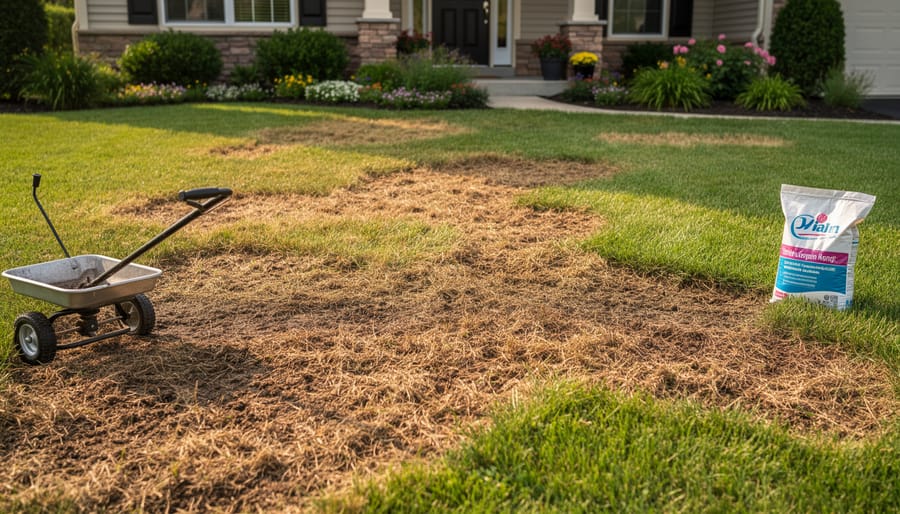
Nitrogen becomes especially problematic in summer heat. When you apply standard-rate nitrogen fertilizer to hot, dry grass, it doesn’t dissolve and move into the soil as it would in spring. Instead, high temperatures cause rapid water evaporation, concentrating the nitrogen salts on grass blades and at the soil surface. This concentrated nitrogen pulls moisture out of plant tissue through a process called salt burn, creating the familiar brown, crispy patches you’re trying to avoid. Even worse, heat-stressed grass lacks the energy reserves to flush excess salts from its system, making recovery slow and difficult.
Traditional cool-season feeding schedules that work beautifully in April will torch your lawn in July because they don’t account for this reduced processing capacity. Your grass isn’t lazy in summer; it’s protecting itself, and you need to adjust your fertilization approach accordingly.
What You’ll Need: Tools and Materials for Safe Summer Fertilizing
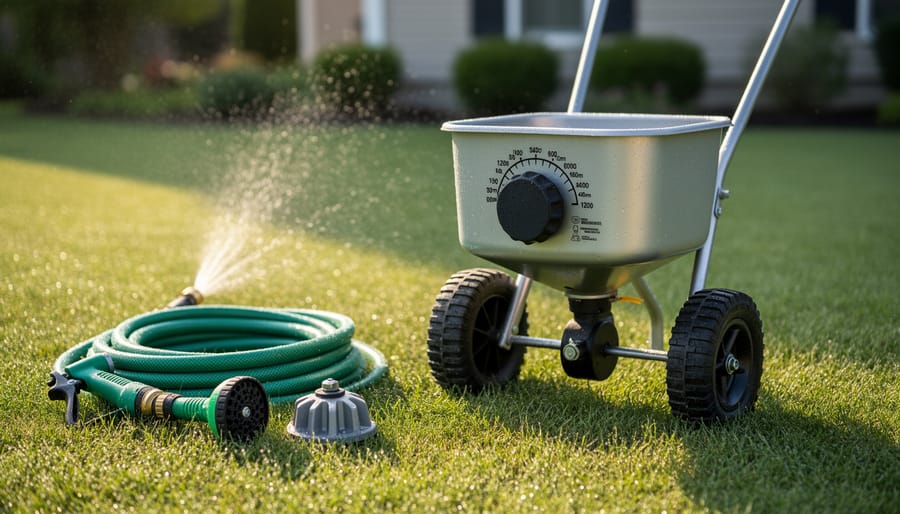
Before you head outside with fertilizer bag in hand, gather everything you need to do the job safely and effectively. Having the right equipment ready prevents interruptions once you start and ensures you can complete the critical watering step immediately after application.
Essential Equipment and Materials
- Spreader: broadcast spreader for large lawns (1,000+ sq ft) or drop spreader for smaller areas and precise edges
- Summer-formulated fertilizer: slow-release granular with low nitrogen content (5-10% N maximum)
- Garden hose with adjustable nozzle or sprinkler system for immediate post-application watering
- Protective gear: gloves, closed-toe shoes, and long pants to avoid skin contact
- Measuring wheel or pace counter to calculate coverage area accurately
- Sweep or leaf blower to remove fertilizer from hard surfaces before watering
- Optional: soil testing kit to determine actual nutrient needs rather than guessing
Your spreader choice matters more in summer than other seasons. Broadcast spreaders cover ground quickly but require skill to avoid overlap, which causes burn spots in hot weather. Drop spreaders deliver precise application with zero overlap risk, making them safer for beginners fertilizing stressed lawns. Whichever you choose, calibration is non-negotiable. An improperly calibrated spreader can double or triple the intended application rate, turning a safe feeding into a disaster.
For sustainable options, consider renting a quality spreader rather than buying a cheap model that distributes unevenly. Look for fertilizers with organic slow-release nitrogen sources like feather meal or composted manure rather than synthetic urea, which releases too quickly in heat. A simple soil test kit (available at most garden centers) prevents unnecessary applications. Your lawn might not even need nitrogen in summer, saving you money and reducing environmental impact from excess runoff.
Choosing the Right Hot Weather Fertilizer Formula
The fertilizer that works wonders in spring can wreak havoc on your lawn in summer. Hot weather demands a completely different formula, one that feeds without overwhelming already-stressed grass.
Start by understanding NPK ratios, the three numbers on every fertilizer bag representing nitrogen, phosphorus, and potassium. For summer application, you want a lower first number (nitrogen) and a higher third number (potassium). A 10-0-10 or 15-0-15 ratio works well for most warm-season grasses during heat, while cool-season lawns do best with formulas around 5-0-20. High nitrogen content, which drives rapid green growth in spring, forces your grass to work harder when it’s already struggling with heat stress. Potassium, on the other hand, strengthens cell walls and improves drought tolerance, exactly what your lawn needs when temperatures soar.
Slow-release formulations are non-negotiable for summer feeding. These products, often labeled as “controlled-release” or “time-release,” coat nutrients in a polymer shell that breaks down gradually over six to twelve weeks. This prevents the nutrient surge that causes fertilizer burn and reduces the risk of runoff during summer thunderstorms. Look for terms like “sulfur-coated urea” or “polymer-coated” on the label.
The organic versus synthetic debate takes on new importance in hot weather. Organic fertilizers like composted manure, bone meal, or fish emulsion release nutrients more slowly and improve soil structure, making them inherently safer for summer application. They won’t burn your lawn even if you slightly overapply. Synthetic fertilizers work faster and offer precise nutrient ratios, but they carry higher burn risk if not applied perfectly.
Many manufacturers now offer specialized summer blends designed for 2026’s increasingly hot growing seasons. These formulas typically combine low nitrogen content with added iron for color, micronutrients for stress resistance, and sometimes beneficial microbes to support soil health. When reading labels, check the guaranteed analysis panel for the nitrogen source, water-insoluble nitrogen (WIN) is your friend in summer, as it releases slowly and safely.
Choose products with at least fifty percent of nitrogen in slow-release form. Your lawn will thank you when the heat arrives.
Safety Warnings and When NOT to Fertilize
Some conditions make fertilizing your lawn not just ineffective, but actively harmful. Before you break out the spreader, check these critical safety thresholds and warning signs.
Temperature is Your First Hard Stop
Don’t fertilize when daytime temperatures consistently exceed 85-90°F, especially if your grass is already showing heat stress. At these temperatures, grass enters survival mode rather than growth mode. Adding fertilizer forces the plant to process nutrients it can’t use, which diverts energy from heat protection and root maintenance. The result? Chemical burn that looks like brown, crispy blade tips and patches that spread quickly. If your forecast shows a heat wave approaching within three days, postpone fertilization until temperatures moderate.
Recognizing a Drought-Stressed Lawn
Never fertilize a lawn suffering from drought stress. Warning signs include grass that stays flattened after you walk on it, blades that fold or curl inward, and a blue-gray tint replacing the normal green color. Drought-stressed grass has already reduced its metabolic activity to conserve moisture. Fertilizer applied to a thirsty lawn sits on the surface, concentrating into salt-like compounds that burn on contact once you finally water. Water deeply for at least a week before considering fertilization, and only proceed once grass springs back quickly when stepped on.
Environmental and Safety Precautions
Keep children and pets off treated areas until you’ve watered thoroughly and the grass has dried completely, typically 24-48 hours. Store unused fertilizer in sealed, waterproof containers away from heat sources. If rain arrives within 24 hours of application, excess nutrients wash into waterways, wasting your money and harming local ecosystems. Check your weather forecast and reschedule if significant rainfall is predicted.
Your lawn will tell you when it’s too stressed to fertilize: wilting that doesn’t recover overnight, brown patches that appeared during recent heat, or grass that hasn’t grown noticeably in two weeks. Trust these signals. Waiting a few weeks beats repairing fertilizer burn that can take months to recover.
Step-by-Step: How to Apply Fertilizer in Hot Weather
Timing Your Application for Maximum Safety
Apply fertilizer between 6 and 8 a.m. when grass blades are still damp with dew and temperatures haven’t climbed. This narrow window lets granules stick to moist leaves before watering washes them into the soil, and you avoid the mid-morning heat spike that amplifies burn risk. Evening application (after 6 p.m.) works if morning isn’t possible, but skip it if dew stays heavy overnight, which can cause granules to clump.
Check your five-day forecast before opening the bag. You want calm, overcast conditions with temperatures below 85°F and no rain for 24 hours after application, giving you time to water in the fertilizer yourself. Never fertilize before a thunderstorm, which creates runoff, or ahead of a heat wave, wait until the pattern breaks. If high temperatures have kept you from following your usual mowing methods or pushed past the safe temperature to mow delay fertilizing too. Stressed grass can’t process nutrients safely, and the extra nitrogen load during peak heat does more harm than waiting a week for cooler weather.
Proper Application Technique
Start at a lawn edge and work in straight, parallel passes across your yard, keeping your spreader speed steady, rushing causes uneven distribution, while going too slow dumps too much fertilizer in one spot. Overlap your passes by about 6 inches at the wheels (not the full spread width, which extends several feet beyond), and physically mark where each pass ends if your lawn lacks clear reference points like sidewalk seams or flower beds.
On slopes, always walk across the incline rather than up and down it. Moving perpendicular to the slope prevents fertilizer from sliding downhill and concentrating at the bottom, which creates burn strips in the low areas while starving the crest. For steep grades, consider using a drop spreader instead of broadcast style, it confines the fertilizer directly beneath the unit rather than flinging it sideways where gravity takes over.
Edges near driveways, patios, and garden beds need special attention. Close your spreader completely before you turn around, then reopen it only after you’re moving forward again on the next pass. This prevents the double-dosing that happens when you pivot with the spreader still dispensing. For precision along landscape borders, make your first pass several feet inside the edge, then come back with a reduced setting to carefully fill the perimeter.
The Critical Watering Step
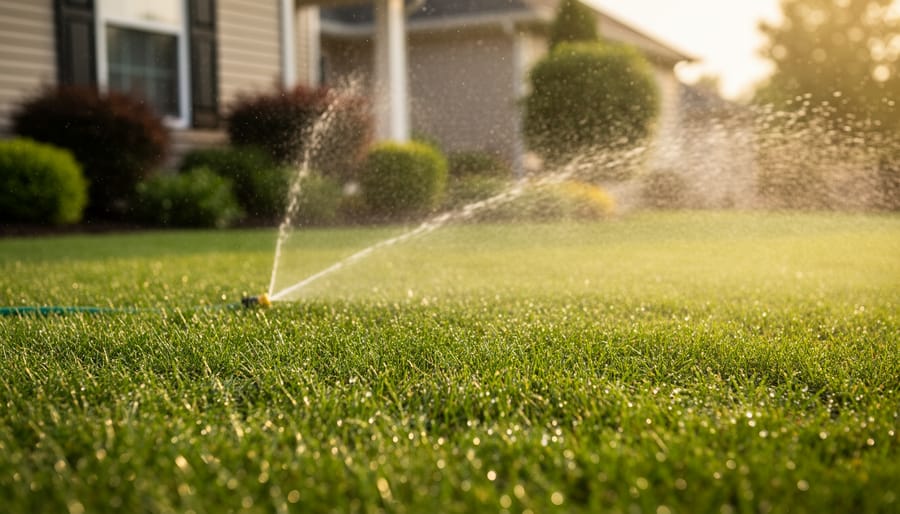
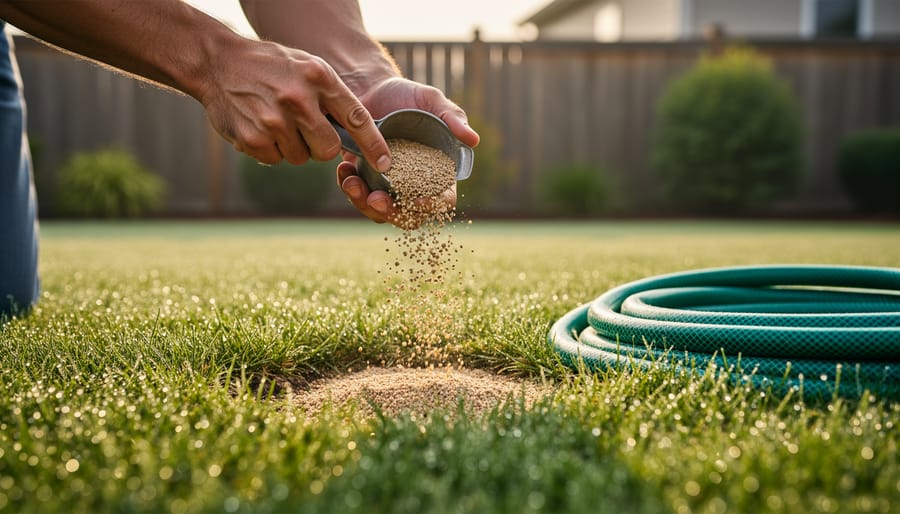
Watering immediately after fertilizing isn’t optional in hot weather, it’s the difference between feeding your lawn and scorching it. You need to apply at least half an inch of water within 24 hours of application, preferably within the first few hours. This dissolves the granules and carries nutrients down to root level while preventing salt buildup on grass blades.
For cool-season grasses like fescue or Kentucky bluegrass, aim for that half-inch minimum. Warm-season varieties such as Bermuda or St. Augustine can tolerate slightly less but still need thorough saturation. Set out empty tuna cans across your lawn as measuring guides, when they’ve collected half an inch, you’re done.
Sandy soils drain quickly and need slower, longer watering sessions to prevent nutrients washing below root depth. Clay soils require multiple shorter cycles to avoid runoff, letting water soak in between applications.
Water in early morning if possible. Evening watering works too, but it increases disease risk. Never water at midday during heat, you’ll lose most moisture to evaporation before it reaches roots. If your lawn shows any signs of wilt or stress after fertilizing, add another quarter-inch of water immediately.
How to Tell If Your Fertilization Worked (Verification and Next Steps)
Success after summer fertilization looks different than spring feeding. In hot weather, you won’t see a dramatic green-up overnight. Instead, expect gradual improvement over two to three weeks as the slow-release nutrients work their way into the soil and roots. Your lawn will maintain its colour better, show slightly improved vigour, and develop better drought resistance rather than the explosive growth you might see in cooler months.
Within the first week to ten days, watch for these indicators:
- Positive signs: Even, consistent colour across the lawn; grass maintains firmness when walked on; no wilting during afternoon heat; gradual deepening of green tone
- Warning signs: Yellow or brown patches appearing 2-5 days after application; white or grey streaks following spreader patterns; crispy leaf tips; grass blades lying flat or appearing water-stressed despite adequate moisture
If you notice yellowing or browning, act quickly. Water the affected areas deeply to dilute and flush excess fertilizer away from the root zone. Apply at least one inch of water over the next two days, preferably in early morning. Most mild fertilizer burn will recover within two weeks if you catch it early and provide consistent moisture.
For uneven growth or patchy greening, the issue is usually application inconsistency rather than burn. This will even out over the next few weeks as the fertilizer continues to break down. Just maintain your regular watering schedule.
Plan your next summer feeding based on the product you used. Slow-release formulas typically last 8-12 weeks, so if you fertilized in early June, you might apply again in late August as temperatures start moderating. However, if your lawn still looks healthy and green at the eight-week mark, you can skip the second application. Summer is one season where less is genuinely more, and a slightly hungry lawn is far better than an overfed, stressed one.
Common Questions About Hot Weather Lawn Fertilizer
Can I fertilize during a heatwave?
No, wait until temperatures drop below 85°F. Applying fertilizer when your lawn is already heat-stressed significantly increases the risk of burning, and grass can’t effectively absorb nutrients when it’s in survival mode. Hold off until conditions moderate or a good rain cools things down.
Is liquid or granular fertilizer better for summer?
Liquid fertilizers work faster but require more frequent application and careful dilution to avoid burning in heat. Granular slow-release formulas are generally safer for summer because they feed gradually and are less likely to overwhelm stressed grass, making them the better choice for most homeowners.
How often should I fertilize in hot weather?
Once during summer is usually enough, applied in early summer before peak heat arrives. Cool-season grasses often don’t need any summer feeding at all, while warm-season varieties can handle light feeding every 6-8 weeks if conditions allow and you’re using a low-nitrogen formula.
What if I accidentally applied too much fertilizer?
Water immediately and deeply to dilute the excess and push it past the root zone. Continue watering daily for several days, and if you see browning within 48 hours, you may need to apply up to an inch of water to flush salts through the soil and minimize damage.
These questions pop up constantly because summer fertilization feels risky, and honestly, your instinct to be cautious is smart. The thread connecting all these answers is patience. Your lawn isn’t going to transform overnight in July, and pushing it with aggressive feeding schedules almost always backfires.
One question we see less often but should address: can you use the same fertilizer year-round? Technically yes, but it’s not ideal. Spring formulas typically pack higher nitrogen for rapid green-up, which is exactly what you don’t want when grass is already stressed by heat. Summer-specific or slow-release blends with balanced ratios work far better during hot months. If you’ve only got one bag in the shed, cut your application rate in half rather than following the spring guidelines.
The bigger picture here is that summer fertilization shouldn’t feel like you’re gambling with your lawn’s health. If you’re second-guessing the timing, the temperature, or whether your grass looks strong enough, that hesitation is valuable information. Wait a week, let conditions improve, and you’ll get better results with far less worry.
Fertilizing your lawn during hot weather doesn’t have to be intimidating. With proper timing, the right formula, and careful watering, you can feed your grass without risking damage. The key is patience and restraint, your lawn needs less during summer, not more.
Remember that a slightly slower-growing, slightly less vibrant lawn in July is perfectly normal and healthy. Resist the urge to overfeed when you see stress. Those brown patches aren’t always asking for nutrients; sometimes they’re asking for water, shade, or simply time to rest.
The sustainable approach wins every time: slow-release fertilizers, thoughtful application timing, and listening to what your grass actually needs. Less truly is more when temperatures climb.
Your lawn’s summer survival depends on a complete care strategy. Fertilization is just one piece alongside proper mowing height, smart watering practices, and heat stress management. Each element supports the others.
You’ve got this. Armed with the right knowledge and a patient approach, you can maintain a healthy, resilient lawn all summer long. Your grass will thank you when cooler weather returns and it bounces back stronger than ever.