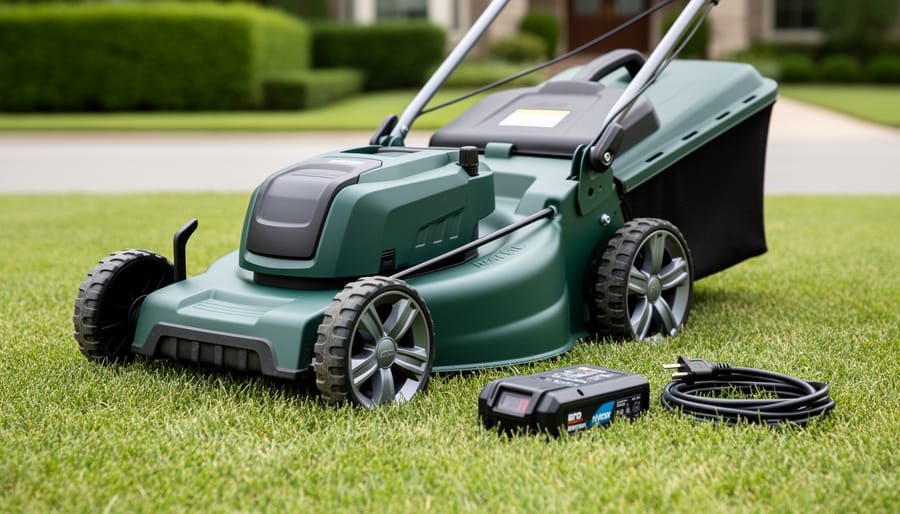
Electric lawn mower brands have multiplied dramatically over the past few years, and choosing between them involves more than just comparing price tags. Start by identifying whether you need a corded model for smaller yards under 5,000 square feet or a battery-powered option for more flexibility. Research each brand’s battery ecosystem if you’re going cordless, since proprietary systems mean you’ll be locked into one manufacturer’s lineup for future tool purchases. Check the actual cut width and battery runtime specifications rather than marketing claims, and verify warranty coverage since some brands offer three years while others cap at one.
The battery mower truth is that not all brands deliver on their promises equally. Some established power tool manufacturers entered the lawn care space with impressive engineering, while traditional lawn equipment companies adapted their expertise to electric platforms. The result? A market where a brand famous for drills might outperform a century-old mower company in battery efficiency.
For 2026, the landscape includes heritage brands that pivoted to electric, tech-forward newcomers prioritizing innovation, and budget-conscious options that sacrifice durability for affordability. Your ideal brand depends on your yard size, terrain complexity, environmental priorities, and whether you already own compatible battery systems.
This guide breaks down the major players, what separates premium brands from budget alternatives, and which manufacturers actually back their sustainability claims with transparent practices. We’ll also match specific brands to common yard scenarios so you can skip the guesswork and find your best fit. The right brand isn’t always the most expensive or the most advertised, it’s the one that aligns with how you actually use your mower and what matters most in your lawn care routine.
What Sets Quality Electric Mower Brands Apart
Not all electric mower brands are created equal, and the gap between a quality performer and a disappointing purchase often comes down to five core factors that matter far more than clever marketing copy.
Battery technology sits at the heart of what separates exceptional brands from the rest. The best manufacturers invest in lithium-ion cells with intelligent management systems that prevent overheating, balance charge distribution across cells, and deliver consistent power even as the battery depletes. Runtime isn’t just about capacity measured in amp-hours; it’s about how efficiently the system converts stored energy into cutting power. Quality brands publish realistic runtime estimates based on actual cutting conditions rather than ideal laboratory scenarios, and they back those claims with batteries that maintain 80% capacity after hundreds of charge cycles instead of degrading rapidly after a single season.
Motor design reveals a brand’s engineering priorities. Brushless motors have become the gold standard because they generate more torque with less friction, run cooler, and last significantly longer than their brushed counterparts. The difference shows up immediately in thick grass or slightly damp conditions, where underpowered motors bog down while robust systems maintain blade speed without hesitation. Some innovative brands incorporate features like X-Blade technology that enhance cutting efficiency through improved aerodynamics and blade geometry, reducing the motor load while improving results.
Build quality differences become obvious after a season or two of regular use. Premium brands use impact-resistant composite decks or powder-coated steel that withstands years of bumps, weather exposure, and storage without cracking or rusting. Wheels with sealed bearings roll smoothly for years instead of seizing up, and deck construction prevents grass buildup that reduces cutting efficiency. The handle assemblies on quality mowers feature metal reinforcements at stress points rather than all-plastic connections that crack under torque.
What distinguishes thoughtful brands from the pack:
- Warranties extending 3-5 years on the mower body and batteries, not just 1-2 years
- Readily available replacement parts and service centers within reasonable distance
- Responsive customer support with real product knowledge and resolution authority
- Transparent specifications including actual tested performance metrics
- Backward compatibility with previous battery generations within their ecosystem
Innovation matters when it solves real problems rather than adding complexity. Self-propulsion systems that adjust to your walking pace, deck designs that reduce clogging on mulching cuts, and quick-adjust height levers that work with one hand all represent meaningful improvements. Gimmicky smartphone apps or LED displays that add cost without practical benefit signal a brand prioritizing novelty over substance.
The brands worth your investment demonstrate their commitment through engineering choices, not just marketing promises.
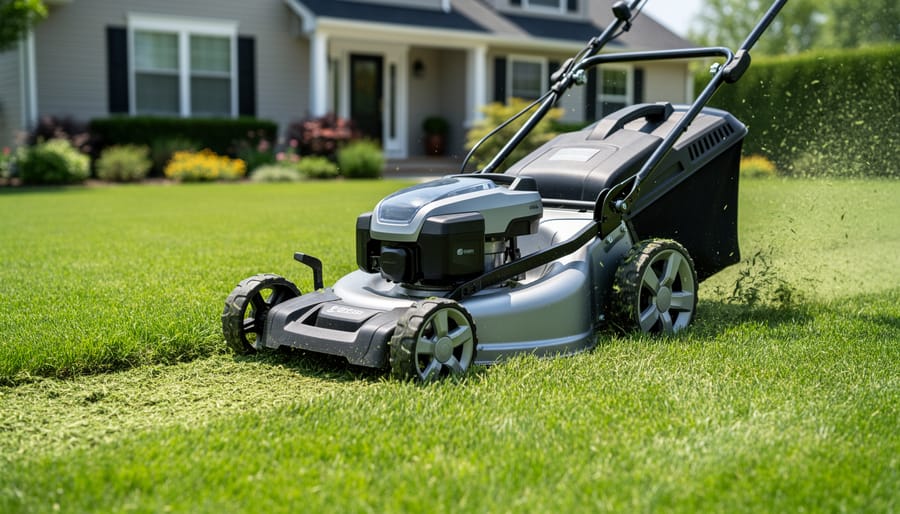
Leading Electric Lawn Mower Brands in 2026
Premium Performance Brands
EGO Power+ stands at the forefront of premium electric mowers, built around its proprietary 56V ARC Lithium battery platform. Their self-propelled models deliver cutting performance that rivals gas mowers, with blade tip speeds exceeding 18,000 feet per minute. The brand’s Peak Power technology combines multiple batteries for surge capacity during demanding conditions like thick, wet grass. EGO consistently earns top marks for runtime and power delivery, though you’ll pay £400-£800 for their mowers depending on the model and battery configuration.
- Exceptional battery runtime with 56V platform offering 45-90 minutes on typical lawns.
- Professional-grade cutting power that handles challenging conditions without bogging down.
- Industry-leading five-year tool and three-year battery warranties demonstrate manufacturer confidence.
- Weather-resistant construction allows mowing in light rain without damage concerns.
- Premium pricing places these brands 40-60% higher than value alternatives.
- Proprietary battery systems lock you into a single brand ecosystem.
- Heavier weight due to robust construction can make manoeuvrability more challenging on slopes.
- Replacement batteries represent a significant ongoing investment at £150-£300 each.
The Greenworks 80V line targets serious homeowners and semi-professional users who need maximum power density. Their 80-volt system generates comparable torque to 160cc gas engines, making it ideal for properties over half an acre or challenging terrain. Greenworks Pro models feature steel cutting decks and brushless motors rated for 2,000+ hours of operation. The brand’s key advantage lies in cross-compatibility: the same batteries power over 75 outdoor tools, from chainsaws to pressure washers.
Milwaukee Tool entered the residential mowing market leveraging decades of professional power tool expertise. Their M18 FUEL mowers use the same battery platform trusted by tradespeople, offering unmatched ecosystem integration if you already own Milwaukee cordless tools. The brushless motors deliver consistent power output regardless of battery charge level, eliminating the gradual fade common in lesser brands. Milwaukee backs their mowers with a three-year warranty and maintains an extensive service network, though their mowers typically cost 15-20% more than comparable EGO models.
Value-Driven Reliable Brands
For homeowners who want dependable electric mowing without the premium price tag, three brands consistently deliver value that exceeds their cost: Ryobi, Sun Joe, and Black+Decker. These manufacturers have mastered the art of balancing quality with affordability, making electric lawn care accessible to budget-conscious gardeners.
Ryobi occupies the sweet spot in this category. Their 40V battery platform powers a range of mowers suited to quarter-acre to half-acre lawns, typically priced between $300 and $500. What sets Ryobi apart is their focus on practical features rather than bells and whistles: adjustable cutting heights, decent runtime with their standard 5.0Ah batteries, and a surprising amount of cutting power for the price point. Homeowners appreciate that Ryobi’s build quality feels substantial rather than flimsy, and their widespread availability through major retailers means parts and support are easy to access.
Sun Joe targets the truly budget-conscious segment, with models starting around $250. While they sacrifice some power and runtime compared to pricier options, Sun Joe mowers handle typical residential lawns admirably. Their lightweight designs make them perfect for homeowners with smaller yards or those who value easy maneuverability over raw cutting capacity. Don’t expect professional-grade durability, but for regular suburban lawns, Sun Joe delivers years of reliable service.
Black+Decker brings name recognition and established reliability to the value segment. Their electric mowers range from $280 to $450 and share the brand’s reputation for straightforward functionality. The standout feature is their AutoSense technology on higher-end models, which adjusts power based on grass thickness. Black+Decker’s customer service network is extensive, giving buyers confidence they can get help if issues arise.
All three brands prove that going electric doesn’t require a massive investment. For typical lawn care needs, they offer perfectly adequate performance wrapped in reliable packages.
Innovation-Focused Brands
Some brands stand out by pushing the boundaries of what an electric mower can do. These innovation leaders often come from established power tool backgrounds, bringing fresh thinking and surprising features to lawn care.
**Makita** earns its place here through precision engineering and commercial-grade reliability. Their Makita CML01 demonstrates their attention to detail, with brushless motors that maximize battery efficiency and a self-propelled system that adapts to your walking pace. Makita’s advantage lies in their professional tool heritage, mowers built to the same exacting standards as contractor-grade equipment. If you already own Makita 18V tools, their dual-battery system turns existing batteries into extended runtime for larger properties.
**DeWalt** takes a different approach, focusing on raw power and jobsite durability. Their mowers feature oversized cutting decks and reinforced chassis design that handles rough terrain better than typical residential models. The brand’s FlexVolt battery system offers genuine innovation: batteries that automatically switch voltage depending on the tool, giving you flexibility across their entire lineup. It’s overkill for a pristine suburban lawn, but perfect for homeowners tackling uneven ground or tall grass.
**Worx** champions clever design over brute force. Their signature innovations include the Intellicut technology that automatically adjusts power based on grass thickness, conserving battery when possible. They’ve also pioneered modular battery systems where multiple smaller batteries combine for customized runtime, plus robotic mower options that integrate with their standard battery platform. Worx appeals to tech-enthusiasts who appreciate thoughtful features and space-saving designs for smaller properties.
Battery Platform Ecosystems: Why They Matter
When you buy an electric lawn mower, you’re not just purchasing a single tool, you’re potentially entering a battery ecosystem that can power dozens of other devices around your home and garden. This decision carries far more weight than most homeowners initially realise.
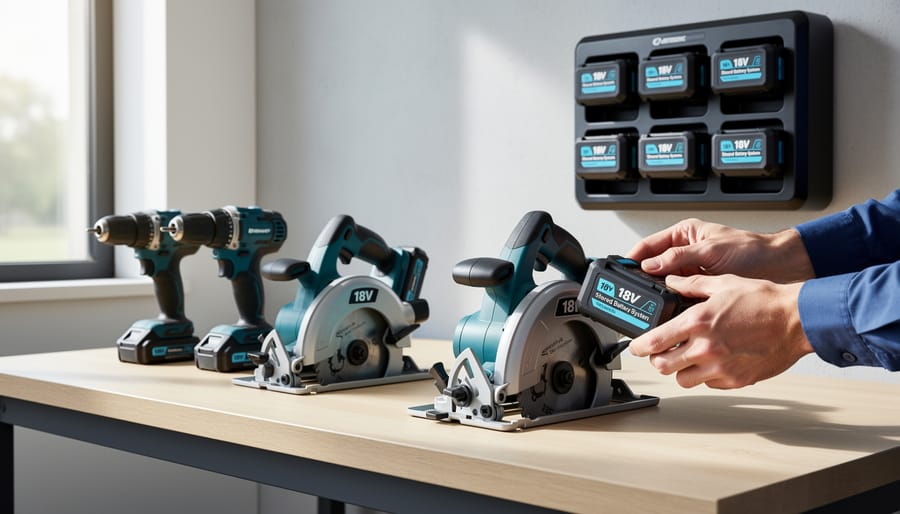
Battery platform ecosystems work on a simple premise: one battery platform fits multiple tools from the same manufacturer. The 40V battery that runs your EGO mower also powers their string trimmer, leaf blower, chainsaw, and snow blower. The same goes for Ryobi’s 40V system, Greenworks’ lineup, and Milwaukee’s M18 Fuel range. Once you’ve invested in batteries and a charger for one tool, adding another device to your collection becomes dramatically cheaper because you’re only buying the bare tool.
The financial advantage compounds quickly. A complete electric mower package might cost £400, but if you already own two batteries and a charger from the same brand, you can purchase the bare mower for perhaps £250. Scale this across five or six garden tools, and you’ve saved hundreds of pounds whilst avoiding the clutter of multiple incompatible charging stations in your garage.
Beyond cost, there’s genuine convenience in standardisation. You can swap a battery from your hedge trimmer straight into your mower if you underestimated how much charge you’d need. No hunting for the right charger or managing different voltage systems. For weekend warriors tackling multiple garden tasks, this interoperability transforms how efficiently you can work through your to-do list.
The major brands differ significantly in ecosystem breadth. Ryobi leads with over 175 tools on their 40V platform, making them ideal if you anticipate expanding your cordless collection. EGO offers fewer tools but higher performance across their range. Milwaukee and DeWalt excel if you already own their power tool systems, as their garden tools share the same batteries as drills and saws, perfect for homeowners who prioritise workshop-to-garden battery flexibility.
This ecosystem lock-in isn’t inherently negative, but it does mean your first purchase establishes a trajectory. Choose a brand with staying power and a robust tool lineup that matches your current and anticipated needs.
Sustainability and Environmental Credentials by Brand
Switching to electric eliminates exhaust emissions, but not all brands approach sustainability with the same seriousness. Some manufacturers treat environmental responsibility as core to their mission, while others see it primarily as marketing. The differences show up in manufacturing processes, material choices, battery programs, and transparency.
EGO leads with carbon-neutral shipping and has committed to using recycled plastics in select components since 2024. Their batteries contain no cobalt, reducing mining impact, and the company provides clear recycling instructions with prepaid return labels. Greenworks has partnered with Call2Recycle for nationwide battery drop-off locations and publishes annual sustainability reports detailing energy use in production facilities. Stihl battery mowers benefit from the company’s long-standing forestry conservation programs and certified sustainable packaging across their product lines.
| Brand | Battery Recycling Program | Manufacturing Initiatives | Sustainability Commitment |
|---|---|---|---|
| EGO | Prepaid mail-in, retail partners | Recycled plastics, carbon-neutral shipping | Strong, published targets |
| Greenworks | Call2Recycle network | Energy-efficient facilities, annual reports | Transparent, documented |
| Ryobi | Home Depot take-back | Limited public disclosure | Basic compliance |
| Milwaukee | Retail drop-off locations | Focuses on tool longevity | Moderate, product-focused |
The most meaningful environmental credential is product longevity. A mower that lasts fifteen years with a repairable design beats one that needs replacing after five, regardless of the manufacturer’s green branding. Look for brands offering replaceable parts, long warranty coverage, and motors designed for extended service life. Milwaukee and Makita excel here because their professional tool heritage demands durability.
Battery recycling matters immensely since lithium-ion cells contain materials that should not end up in landfills. Brands that partner with established recycling networks like Call2Recycle or offer take-back programs demonstrate accountability beyond the initial sale. Some budget brands provide no guidance whatsoever, leaving disposal entirely to the consumer.
Energy efficiency varies less between electric mower brands than you might expect because brushless motor technology has become standard. The real efficiency gains come from smart features like load-sensing that adjusts power based on grass thickness, found on higher-end EGO and Greenworks models. These systems extend battery life per charge and reduce electricity consumption over the mower’s lifetime, compounding environmental benefits across thousands of mowing sessions.
Brand Reliability: What Real Users Experience
When you strip away the marketing polish, brand reliability comes down to three things: how long the mower lasts, how quickly problems get resolved, and whether you can actually get replacement parts when you need them.
EGO consistently ranks at the top for customer satisfaction, with users reporting five-plus years of trouble-free operation. Their customer service responds within 24 hours on average, and their five-year warranty actually gets honored without the runaround many brands put customers through. Replacement batteries and parts ship quickly, and their network of service centers means you’re not mailing your mower across the country for repairs.
Ryobi occupies an interesting middle ground. The mowers themselves prove remarkably durable for the price point, but battery longevity varies more than premium brands. Their customer service can be hit-or-miss depending on whether you reach the home division or the tool division team. The big advantage: Home Depot stocks most replacement parts, so you can often fix issues same-day rather than waiting for shipping.
Greenworks presents a mixed picture. Their Pro line matches EGO for reliability, but their consumer-grade models see higher failure rates in the second and third years. Customer service quality has improved significantly since 2024, though response times still lag behind EGO. Parts availability remains their weakest point, with common items frequently backordered.
Black+Decker and Sun Joe occupy the budget tier, where expectations need adjusting. These mowers typically last three to four years with normal use. When issues arise, replacement often makes more sense than repair given the low initial cost. Customer service exists primarily to process warranty claims rather than troubleshoot problems.
Milwaukee tool owners report excellent experiences, but their lawn mower line remains too new for long-term reliability data. Early indicators suggest they’ll match their power tool reputation, and their existing service infrastructure gives them an advantage over lawn-care-only brands.
Matching Brand to Your Lawn Care Needs
Choosing the right electric mower brand isn’t about finding the “best” one, it’s about finding the best match for your specific situation. A brand that excels for a quarter-acre suburban lawn might frustrate someone managing a sprawling country property, and vice versa.
Start with your lawn’s physical reality. If you’re maintaining less than a third of an acre with relatively flat terrain, value-driven brands like Ryobi or Sun Joe will handle your needs beautifully without the premium price tag. These brands shine in straightforward mowing scenarios where you don’t need industrial-grade power. For lawns between a third and half an acre, especially with slopes or obstacles, step up to brands with stronger batteries and better traction systems, Greenworks and EGO offer that middle ground of capability without breaking into professional pricing.
Larger properties over half an acre demand brands with robust battery platforms and genuine stamina. Milwaukee, EGO’s top-tier models, and Greenworks Pro series become your realistic options here. You’ll also want to factor in how often you mow: weekly mowers can get away with smaller battery reserves, but if you’re the twice-weekly type chasing that golf-course look, invest in brands offering fast-charging systems and multiple battery compatibility.
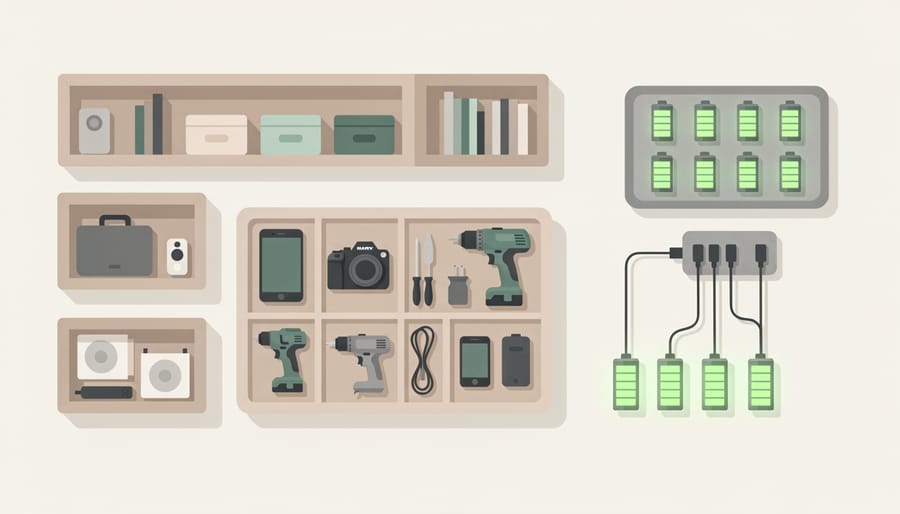
Your existing tool ecosystem matters more than many realize. If your garage already houses Ryobi, DeWalt, or Makita cordless tools, staying within that brand family means sharing batteries across your entire toolkit. That single decision can save hundreds over time and eliminate the hassle of managing multiple charging stations. Just remember that proper battery terminal care extends the life of these shared power sources across all your tools.
Consider these scenario-based recommendations:
- Small urban yards (under 2,000 sq ft): Sun Joe or Black+Decker for budget-conscious simplicity
- Typical suburban lots with existing tool investments: Match your current cordless platform (Ryobi, DeWalt, Makita)
- Hilly or challenging terrain: EGO or Greenworks Pro for superior torque and self-propulsion
- Large properties requiring extended runtime: Premium brands with expandable battery systems like Milwaukee or EGO’s dual-battery models
- Eco-conscious buyers prioritizing sustainability: Greenworks for transparent environmental commitments
Budget flexibility shapes everything else. Set your ceiling before falling for features you don’t need. A $300 mower that perfectly suits your lawn beats a $600 model with capabilities you’ll never use.
Choosing the right electric lawn mower brand isn’t about finding a universal winner. It’s about matching your specific lawn care reality with a brand that delivers on the promises that matter most to you. A homeowner with a quarter-acre suburban lot has different needs than someone managing a sprawling property with varied terrain, and the best brand for one might be overkill or inadequate for the other.
Throughout this guide, we’ve seen that reliability and sustainability consistently outperform flashy marketing. The brands that earn long-term loyalty are those that build durable machines, stand behind their products with solid warranties, and make replacement parts available years down the line. Battery longevity, motor efficiency, and thoughtful design create more value than gimmicky features you’ll rarely use.
Your buying decision should start with honest questions: What’s your actual lawn size? How often will you realistically mow? Do you already own cordless tools from a particular brand? What’s your genuine budget, including long-term battery replacement costs? The answers point you toward brands that fit your life, not just your wishlist.
When you choose wisely, you’re investing in years of quiet, emission-free mowing that aligns with sustainable gardening practices. You’re supporting brands that prioritize environmental responsibility while giving yourself a reliable tool that makes lawn care genuinely satisfying. That’s a decision your lawn, your wallet, and the planet will thank you for.