Mowing hills with the wrong riding mower puts you at serious risk of rollovers, loss of control, and equipment damage. Prioritize a low center of gravity design—specifically rear-engine or zero-turn models with wide wheelbases that distribute weight evenly and prevent tipping on slopes up to 15 degrees. Look for mowers with hydrostatic transmissions rather than manual gear systems, as they give you precise speed control on descents without having to shift gears mid-slope, keeping both hands safely on the wheel. Choose models with traction-enhancing features like differential locks, aggressive turf tires, or four-wheel drive capabilities that prevent wheel spin on dewy morning grass or after rainfall.
Understanding your actual slope percentage is essential before making any purchase. Walk your property with an inclinometer app or simple angle finder—most standard riding mowers max out safely at 10-15 degree slopes, while specialized hill mowers handle up to 20 degrees. Beyond these limits, you’re looking at walk-behind mowers or professional-grade equipment. The best mower for hills balances safety engineering with cutting performance, and this decision directly impacts both your wellbeing and how effectively you maintain your sloped lawn. This guide examines specific models that excel on inclines, breaks down the technical features that actually matter for hill stability, and provides honest assessments about when slopes become too dangerous for riding equipment.
Why Hills Demand Different Mower Features
Mowing a flat lawn and tackling slopes are two completely different challenges, and understanding why makes all the difference in choosing the right equipment. When your mower climbs even a modest incline, gravity starts working against you in ways that might surprise you.
The most immediate concern is traction loss. On level ground, your mower’s weight distributes evenly across all wheels, but on a slope, that weight shifts dramatically. The uphill wheels bear less weight, which means less grip, while the downhill side carries more load. This imbalance can cause your mower to slip sideways, especially on damp grass or loose soil. I’ve talked with countless homeowners who thought their trusty flat-terrain mower would handle their sloped yard, only to find themselves sliding helplessly toward flower beds or fences.
Rollover risk is the more frightening reality. Standard riding mowers have higher centers of gravity designed for comfortable seating on flat ground. Take that same design onto a 15-degree slope, add a sharp turn, and physics takes over. The mower becomes top-heavy and unstable, creating genuine danger for the operator.
Then there’s the quality issue. When a mower tilts, the deck angle changes, causing uneven cutting. You’ll notice scalped patches on the uphill side and missed grass on the downhill edge. This creates the frustrating need for multiple passes, which increases your time, fuel consumption, and wear on both you and the machine.
Operator fatigue deserves mention too. Constantly fighting to control a mower that wasn’t built for slopes turns a routine task into an exhausting, white-knuckle experience. Your legs strain to brace yourself, your arms tire from steering corrections, and the mental stress of managing an unstable machine wears you down quickly. That’s precisely why hill-specific features aren’t luxury additions but genuine necessities for safe, effective lawn care.
The Make-or-Break Features for Hill Performance
Low Center of Gravity and Weight Distribution
When you’re tackling slopes, understanding your mower’s center of gravity becomes absolutely crucial for your safety. Think of it like this: a lower center of gravity means your mower is less likely to tip, much like how sports cars hug the road better than top-heavy SUVs.
The debate between zero-turn versus traditional riding mowers really comes into focus on hills. Traditional riding mowers typically win this stability contest. Their weight sits lower and more centrally, with the engine positioned in front. This forward weight distribution actually helps grip the slope, especially when climbing uphill. Zero-turn mowers, while incredibly maneuverable on flat terrain, have a higher center of gravity and wider turning radius that can make them trickier on significant inclines.
Rear-engine riding mowers deserve special mention here. These compact models position their engine behind the operator, creating excellent balance and visibility. They’re often lighter than traditional tractors, which sounds counterintuitive, but their lower profile and well-distributed weight make them surprisingly stable on moderate slopes.
The key takeaway? For serious hill work, look for mowers with wider wheelbases, lower seating positions, and engines that keep weight distributed toward the ground rather than stacked high. Your stability depends on physics working with you, not against you.
Transmission Types: Hydrostatic vs. Automatic
When you’re tackling hills, transmission type becomes your best friend or your biggest frustration. Let me share why this matters so much for slope mowing.
Hydrostatic transmissions are the gold standard for hill work, and here’s why: they give you infinitely variable speed control without shifting gears. Think of it like a car’s cruise control that you can adjust instantly with a simple pedal or lever movement. When you’re navigating a tricky slope, this seamless control lets you slow down precisely as you approach a steeper section or speed up gradually on gentler terrain, all without taking your hands off the wheel or risking jerky movements that could compromise stability.
Automatic transmissions, while less expensive, use preset gear ratios that can leave you hunting for the right speed. On a hill, that sudden shift between gears can actually reduce your traction at the worst possible moment.
From a practical standpoint, hydrostatic systems also make downhill mowing safer. You can use the transmission to help brake your descent rather than relying solely on wheel brakes, giving you better control and reducing wear on your braking system. This is particularly valuable for those of us committed to extending our equipment’s lifespan as part of sustainable lawn care practices. The smoother operation also means less soil compaction and turf damage on slopes.
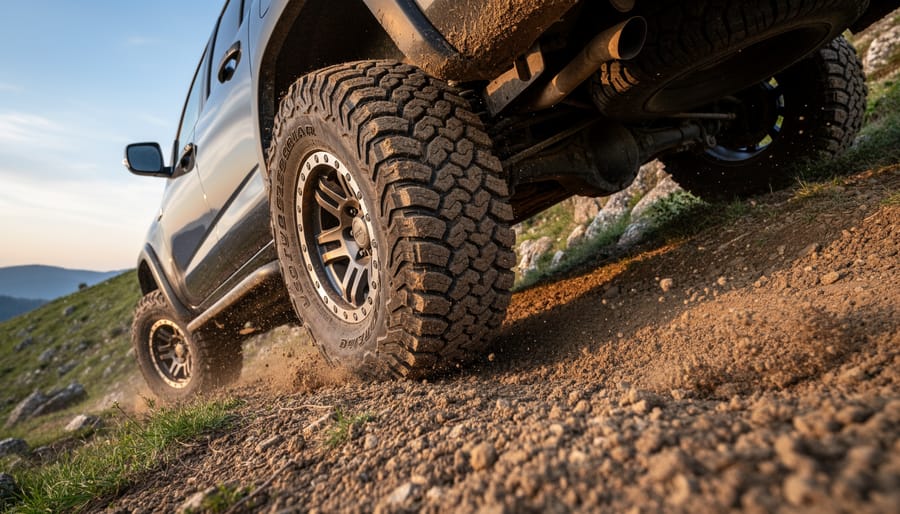
Tire Tread and Traction Systems
When you’re tackling slopes, your mower’s tires become your first line of defense against slipping and sliding. I learned this the hard way when my first riding mower with narrow, smooth tires turned my hillside into a frustrating (and slightly scary) adventure every mowing day.
Look for wider tires first—they distribute weight more evenly and create a larger contact patch with the ground. Tires measuring at least 20 inches in diameter with widths of 8 to 10 inches work best for hilly terrain. The tread pattern matters just as much. Deep, aggressive treads with chevron or lug patterns grip the turf effectively, while still being gentle enough for a healthy lawn when you engage turf-mode settings.
Speaking of features, differential locks are game-changers on slopes. When one wheel starts losing traction, a differential lock ensures both rear wheels maintain power, preventing that dreaded sideways drift. Some mowers offer automatic traction control that adjusts power to individual wheels as needed—think of it as stability control for your lawn.
Turf-mode settings reduce tire slippage by limiting wheel spin, which protects your grass from damage while maintaining control. This is particularly important for those of us committed to sustainable lawn care practices, as excessive wheel spin tears up grass and creates erosion problems on hillsides that take seasons to repair.
Engine Power and Torque for Uphill Climbs
When you’re tackling slopes, engine power becomes your best friend and your safety net. Think of it this way: an underpowered mower on a hill is like trying to ride a bicycle up a mountain in the wrong gear—you’ll struggle, potentially lose control, and put yourself at risk.
For gentle slopes up to 10 degrees, a mower with 15-18 horsepower typically handles the job adequately. However, once you’re dealing with moderate inclines between 10-15 degrees, you’ll want at least 20-24 horsepower to maintain consistent cutting performance. Anything steeper requires serious muscle—25 horsepower or more—along with commercial-grade torque.
Torque matters just as much as horsepower, if not more. While horsepower measures overall power output, torque delivers the actual pulling force that keeps your mower climbing steadily without stalling. High torque at lower RPMs means your engine won’t struggle or overheat when grinding uphill, which extends your mower’s lifespan and reduces fuel consumption—a win for both your wallet and the environment.
Here’s where safety becomes critical: underpowered mowers on hills create genuine hazards. When an engine lacks sufficient power, you might lose momentum mid-climb, causing the mower to roll backward. Alternatively, you’ll overwork the engine, leading to overheating, potential fires, or mechanical failure at the worst possible moment. I’ve heard too many stories of folks getting stranded on slopes because they underestimated their power needs.
Choose a mower with power reserves beyond your minimum requirements. That extra capacity provides the control margin you need for safe, effective hill mowing while supporting sustainable equipment longevity.
Top Riding Mower Types for Hills (With Real Examples)
Garden Tractors: The Traditional Hill Champions
When you’re tackling moderate to steep slopes, garden tractors have earned their reputation as reliable hill champions through decades of proven performance. These workhorses combine thoughtful engineering with practical design to give you confidence on challenging terrain.
The John Deere X350 exemplifies what makes garden tractors so capable on hills. With its lower center of gravity and sturdy build, this machine stays planted where lighter mowers might struggle. The X350’s weight distribution works in your favor here—that substantial frame isn’t just about durability; it’s about keeping all four wheels firmly connected to the ground as you navigate slopes. You’ll appreciate the responsive hydrostatic transmission that lets you adjust speed smoothly without jerky movements that could compromise stability.
The Cub Cadet XT2 brings similar hill-taming capabilities with its own set of strengths. Its wide wheelbase provides excellent side-to-side stability, which becomes crucial when you’re mowing across a slope rather than straight up and down. Both models feature powerful engines that maintain consistent blade speed even when working uphill, ensuring you get an even cut without bogging down.
These garden tractors typically handle slopes up to 15 degrees effectively, though always assess your specific terrain. Their traditional design prioritizes stability over speed, which is exactly what you want when safety matters most. The investment pays dividends in both performance and peace of mind as you maintain your hillside landscape season after season.
Zero-Turn Mowers: Speed vs. Slope Safety
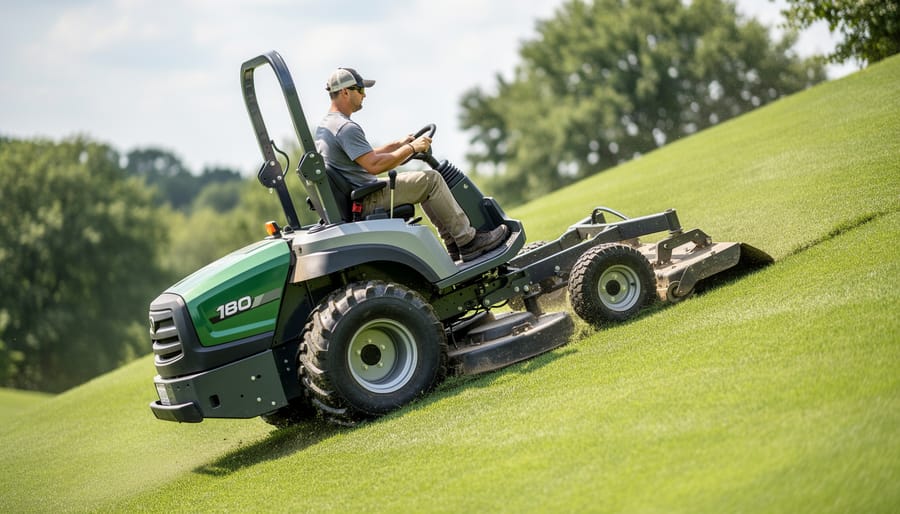
Zero-turn mowers offer incredible efficiency on flat lawns, but their performance on hills remains hotly debated among homeowners. Here’s the truth: traditional zero-turns have a lower center of gravity positioned toward the rear, which can compromise stability on slopes exceeding 15 degrees. Many manufacturers explicitly warn against using standard zero-turns on steep inclines due to rollover risks.
However, some manufacturers have tackled this challenge head-on. Toro’s MyRIDE suspension system, found in their TimeCutter HD models, helps maintain better ground contact on uneven terrain while improving operator control. Hustler has developed their Raptor SD series with a wider stance and enhanced weight distribution specifically for moderate hill work. These models also feature ROPS (rollover protection structures), which provide crucial safety advantages that many entry-level zero-turns lack.
If you’re working with slopes steeper than 15 degrees, consider whether a zero-turn is your best choice. 4WD riding mowers or traditional lawn tractors might serve you better. The speed advantage of zero-turns becomes meaningless if you’re constantly worried about tipping or can’t safely navigate your property.
For moderate hills under 15 degrees, look for zero-turns with wider wheelbases, lower centers of gravity, and integrated ROPS systems. Always mow side-to-side across slopes rather than up and down, regardless of which model you choose. Your safety matters more than shaving minutes off mowing time.
Rear-Engine Riders: Compact Hill Solutions
If you’re working with a smaller property that features gentle to moderate slopes, rear-engine riding mowers deserve your attention. These compact workhorses might not look as impressive as their zero-turn cousins, but they’re specifically designed with a lower center of gravity that makes them surprisingly stable on hills.
The secret lies in their configuration. With the engine positioned at the back and the operator seated toward the front, rear-engine riders create excellent weight distribution that helps prevent tipping on slopes up to 15 degrees. This setup also gives you better visibility of your mowing deck, which is invaluable when navigating uneven terrain or approaching slope transitions.
I’ve found these models particularly shine on properties between half an acre and two acres with rolling hills. They’re nimble enough to handle tighter turns than traditional lawn tractors, yet substantial enough to provide the stability you need on inclines. Models like the Cub Cadet CC30 and Snapper 2911525BVE typically feature cutting decks between 30 and 33 inches, making them perfect for residential properties without overwhelming your storage space.
From a practical standpoint, rear-engine riders are also more fuel-efficient than larger alternatives, which aligns nicely with sustainable lawn care practices. Their smaller engines consume less fuel while still delivering reliable performance on moderate slopes. However, be honest about your terrain. If you’re dealing with steep hills beyond 15 degrees, you’ll want to consider more robust options with enhanced stability features.
Safety Features You Shouldn’t Compromise On
When you’re tackling slopes with a riding mower, safety features aren’t optional extras—they’re absolute necessities. I’ve seen too many folks focus solely on engine power and cutting width while glossing over the features that could literally save their lives. Let’s be clear: no perfectly manicured lawn is worth a trip to the emergency room.
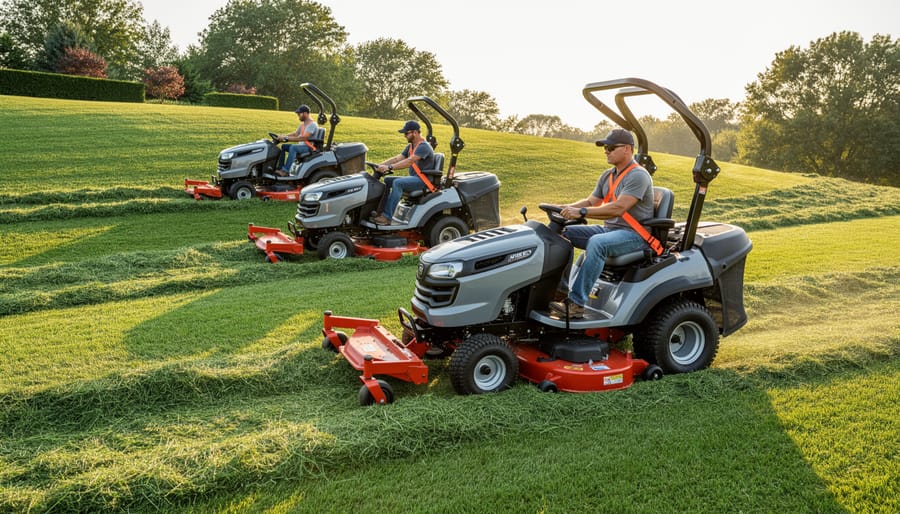
First up is the ROPS, or Rollover Protection System. This sturdy bar structure protects you if your mower tips on a steep incline. Think of it as a roll cage for your riding mower. Yes, it might make you feel like you’re overthinking things, but statistics show that rollover accidents are among the most serious mowing injuries. When shopping, make sure the ROPS is certified and properly installed—and always keep it in the upright position when mowing hills.
Seat belts work hand-in-hand with ROPS. If your mower starts to tip, being strapped in keeps you protected under the rollover bar rather than being thrown from the machine. I know it might seem like overkill for puttering around your property, but it takes two seconds to buckle up.
Automatic blade shut-off is another non-negotiable. This feature immediately stops the blades when you leave the seat, preventing accidents if you need to dismount quickly on an incline. Modern mowers typically include this as standard, but double-check before purchasing.
Finally, hill-hold or brake-assist features prevent your mower from rolling backward on slopes when you stop or change direction, giving you much better control in tricky situations.
Matching Your Mower to Your Slope Grade
Before you invest in any riding mower, let’s talk about something that could literally save your life: knowing your lawn’s actual slope. I’ve seen too many folks underestimate their hills, and it’s honestly not worth the risk.
Measuring your slope is simpler than you’d think. The smartphone method works great – several free apps use your phone’s level to measure angles. Just place it on a board lying flat against your slope for an accurate reading. Alternatively, the classic string-and-level method involves stretching a string from the top of your slope to a level point, then measuring the vertical drop divided by the horizontal distance.
Here’s where reality checks matter: most riding mower manufacturers rate their machines for maximum slopes between 10 and 15 degrees. That sounds like a lot, but 15 degrees is approximately a 27% grade – steeper than many people realize. Anything beyond that rating isn’t manufacturer caution; it’s genuine physics telling you the mower could tip.
Be honest with yourself about your terrain. If you’re consistently mowing slopes above 15 degrees, a walk-behind mower with a low center of gravity is genuinely safer and more effective. There’s no shame in admitting some areas need different equipment or professional help – it’s about being a responsible steward of both your land and your safety. Remember, sustainable lawn care includes keeping yourself healthy enough to enjoy that beautiful grass you’re maintaining.
Sustainable Practices for Hill Mowing
Mowing on slopes presents unique environmental challenges that thoughtful practices can address. When you regularly mow the same hillside paths, you risk creating channels that accelerate water runoff and soil erosion. Combat this by varying your mowing pattern each time—alternating between horizontal passes across the slope and diagonal approaches helps distribute wear evenly and keeps grass roots intact.
Healthy grass is your best defense against erosion on hills. Avoid cutting too short on slopes; maintaining a slightly taller grass height (around 3-4 inches) encourages deeper root systems that anchor soil more effectively. This also reduces stress on grass growing in challenging conditions where water naturally drains away faster.
Consider battery-electric options for a surprisingly practical slope solution. Beyond eliminating emissions, electric mowers offer exceptional low-speed torque control, giving you precise power management on inclines without the noise pollution that disturbs neighbors and wildlife. Their lower center of gravity often improves stability, and you’ll avoid the risk of fuel spilling when operating at angles.
Finally, time your mowing thoughtfully. Avoid cutting wet grass on slopes, which damages turf and increases your safety risks. Early morning dew makes hillsides treacherous, so wait until conditions dry for better traction and cleaner cuts that promote healthier regrowth.
Choosing the right riding mower for hills ultimately comes down to one non-negotiable priority: your safety. While it’s tempting to focus on speed, cutting width, or convenience features, none of those matter if you’re struggling to maintain control on a slope or, worse, risking a rollover. I’ve seen too many gardeners push the limits of what their equipment can safely handle, and it’s simply not worth it.
Take an honest look at your property. Walk your steepest slopes and consider whether you’re dealing with gentle inclines or genuinely challenging terrain. If you have any doubts about a traditional riding mower’s capabilities, zero-turn models with low centers of gravity or even a quality walk-behind mower for the steepest sections might be your best bet.
The best riding mower for hills isn’t necessarily the most powerful or feature-packed model. It’s the one that matches your specific terrain, provides stability through thoughtful design, and gives you confidence every time you tackle that slope. Remember, sustainable lawn care includes keeping yourself safe season after season. Invest in appropriate equipment, respect your property’s limitations, and you’ll enjoy years of effective, worry-free mowing.