Test your soil before selecting grass seed or spending money on fertilizers you might not need. A simple soil test reveals pH levels, nutrient deficiencies, and organic matter content—the three factors that determine whether your turf will thrive or struggle. Whether you’re planning a new lawn or rescuing a patchy existing one, understanding what’s happening beneath the surface saves time, money, and frustration.
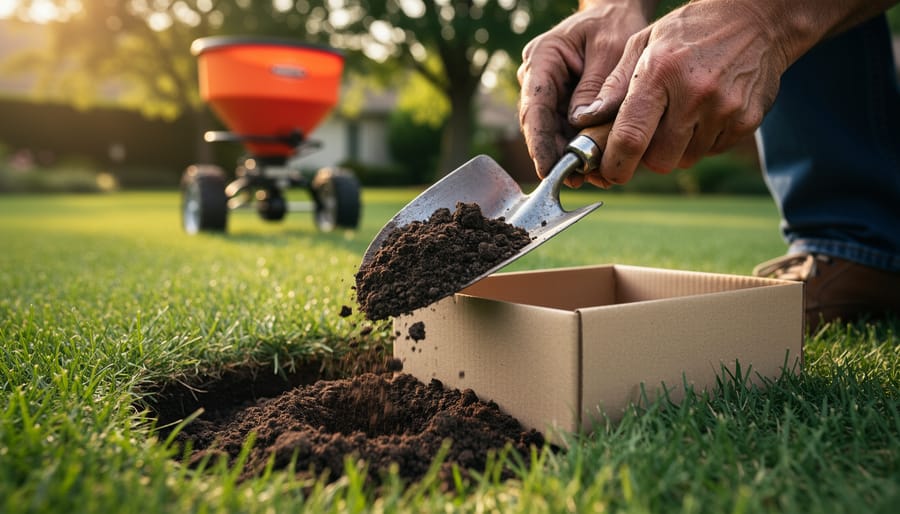
Collect soil samples from multiple spots across your yard at 4-6 inches deep, mixing them together to create a composite sample that represents your entire lawn area. Send this to your local cooperative extension service or a reputable soil testing lab—most charge between $10-30 and return results within two weeks. The report will specify your soil’s pH (most turfgrasses prefer 6.0-7.0), macronutrient levels like nitrogen, phosphorus, and potassium, and provide tailored amendment recommendations.
Use these results to match grass varieties to your actual conditions rather than fighting against your soil’s natural chemistry. Cool-season grasses like fescue tolerate slightly acidic soil, while warm-season bermudagrass thrives in neutral to alkaline conditions. Apply only the amendments your test recommends—over-fertilizing wastes resources and harms the environment through runoff.
Retest every 3-4 years to track changes and adjust your lawn care approach as your soil evolves. This sustainable practice eliminates guesswork and creates the foundation for a naturally resilient, low-maintenance lawn that stays green with minimal intervention.
Why Your Grass Keeps Failing (It’s Not What You Think)
You’ve been watering religiously, mowing at the perfect height, and maybe even splurging on premium fertilizer. Yet your lawn still looks more like a patchwork quilt than the lush carpet you envisioned. Here’s the frustrating truth: the problem likely isn’t your maintenance routine at all.
Most lawn failures happen because of a fundamental mismatch between your grass type and what’s actually happening beneath the surface. Think of it like trying to grow tomatoes in a shady corner or planting cacti in a swamp. No amount of dedicated care can overcome a poor environmental fit.
The common assumption is that grass is grass, and if you just water and fertilize enough, any variety will eventually thrive. Unfortunately, turfgrass is far pickier than most homeowners realize. A Kentucky bluegrass that flourishes in your neighbor’s alkaline clay might struggle miserably in your acidic, sandy soil just across the fence. Cool-season grasses need different pH levels than warm-season varieties. Some grasses demand specific nutrient ratios that your soil simply cannot provide without massive intervention.
This is where soil testing becomes your diagnostic superpower. Rather than guessing why your lawn keeps thinning out or developing mysterious brown patches, a proper soil test reveals exactly what you’re working with: pH levels, nutrient deficiencies, organic matter content, and soil texture. Armed with this information, you can either choose grass varieties perfectly suited to your existing conditions or make targeted amendments that actually address the real problems. It’s the difference between throwing solutions at a wall and hoping something sticks versus implementing a strategic plan based on solid data. This simple step can save you years of frustration and wasted investment.

What Soil Testing Actually Reveals About Your Yard
pH Levels: The Master Controller of Nutrient Availability
Think of soil pH as the gatekeeper to your lawn’s nutrition. Measured on a scale from 0 to 14, most turfgrasses thrive in the slightly acidic to neutral range of 6.0 to 7.0. This sweet spot isn’t arbitrary—it’s where essential nutrients like nitrogen, phosphorus, and potassium become most available to grass roots.
Here’s what’s fascinating: even if your soil is loaded with nutrients, the wrong pH can lock them away where your grass can’t access them. At very acidic levels below 5.5, nutrients like phosphorus become bound to iron and aluminum. Meanwhile, alkaline soils above 7.5 can restrict iron, manganese, and zinc availability, leaving your lawn pale and struggling.
Different grasses have evolved preferences. Cool-season grasses like Kentucky bluegrass and fescues prefer pH 6.0 to 7.0, while warm-season varieties such as bermudagrass and zoysiagrass tolerate slightly more alkaline conditions up to 7.5. This knowledge becomes your secret weapon when selecting grass varieties—why fight your soil’s natural tendencies when you can work with them?
The sustainable approach? Test first, then choose grass varieties suited to your existing pH when possible, reducing the need for constant amendments.
NPK and Essential Nutrients: Reading Your Soil’s Report Card
Your soil test report might look like a chemistry assignment at first glance, but it’s actually telling you exactly what your lawn needs to thrive. Let’s break down the big three nutrients, often called NPK.
Nitrogen (N) is the growth engine for your grass, giving it that lush, green color. If your test shows low nitrogen, you’ll notice pale, slow-growing turf. The good news? Nitrogen is easily supplemented through sustainable practices like grasscycling or compost applications.
Phosphorus (P) powers root development and helps grass establish quickly. Newer lawns need more phosphorus, while established turf typically requires less. Many regions now restrict phosphorus fertilizers to prevent water pollution, so knowing your baseline is especially important.
Potassium (K) acts like your lawn’s immune system, helping grass withstand drought, disease, and temperature extremes. Low potassium levels mean you’ll want hardier grass varieties that can handle stress.
Don’t overlook micronutrients like iron, manganese, and sulfur. Deficiencies often show up as yellowing or stunted growth despite adequate NPK levels. Understanding these numbers helps you choose grass varieties that naturally thrive in your soil conditions rather than constantly fighting nutrient deficiencies with excessive amendments.
Soil Texture and Structure: Why Some Yards Drain While Others Puddle
Ever wonder why your neighbor’s lawn looks lush after a rainstorm while yours resembles a swamp? The answer lies beneath the surface in your soil’s texture and structure. Soil is made up of three primary particles: sand, silt, and clay. Sandy soils have large particles that allow water to drain quickly—sometimes too quickly, leaving roots thirsty. Clay soils have tiny, tightly packed particles that hold water like a sponge, often creating drainage issues and compaction. The sweet spot is loam, a balanced mixture of all three that retains moisture while allowing excess water to drain away.
Understanding your soil texture helps you choose grass varieties that will actually thrive. Cool-season fescues do remarkably well in clay soils, while Bermuda grass tolerates sandy conditions. A simple jar test can reveal your soil composition: mix soil with water, shake it up, and watch the layers settle. This knowledge transforms how you approach lawn care, from adjusting watering schedules to selecting amendments that improve structure. Better soil structure means deeper root development, healthier grass, and a more sustainable lawn that works with nature rather than against it.

Organic Matter Content: The Life Force of Your Soil
Think of organic matter as your soil’s secret weapon—it’s the difference between dirt and truly living soil. When your soil test reveals organic matter levels between 3-5%, you’ve hit the sweet spot for a thriving lawn. This dark, decomposed material acts like a sponge, holding moisture during dry spells while improving drainage in heavy clay soils.
Here’s what makes organic matter so valuable: it feeds the billions of beneficial microbes that keep your grass healthy naturally. These tiny workers break down nutrients, fight off disease, and even help your lawn withstand stress. Low organic matter (under 2%) often explains why some lawns struggle despite regular watering and fertilizing—the soil simply lacks the biological activity to support robust growth.
The good news? You can boost organic matter through sustainable practices. Leave grass clippings on your lawn after mowing—they’re packed with nitrogen and organic material. Top-dress annually with quality compost, especially in spring or fall. Avoid excessive tilling, which speeds up organic matter decomposition. Over time, these gentle practices build soil health while reducing your need for synthetic inputs, creating a self-sustaining ecosystem right in your yard.
How to Get Your Soil Tested (The Right Way)
Professional Lab Testing vs. Home Test Kits: Which Route to Take
Choosing between professional lab testing and home kits depends on your lawn’s needs and your budget. Professional labs typically cost $20-50 but provide comprehensive analysis including micronutrients, organic matter content, and detailed pH readings. They’re ideal when establishing new turf, diagnosing persistent problems, or planning major renovations. You’ll receive customized fertilizer recommendations based on your specific grass type and local conditions.
Home test kits run $10-20 and deliver quick results for pH, nitrogen, phosphorus, and potassium—the basics most homeowners need for routine maintenance. They’re perfect for annual check-ups on established lawns performing reasonably well. While less precise, they give you enough information to make informed fertilizing decisions without waiting days for lab results.
Here’s my honest take: start with a professional test when you’re new to a property or tackling serious lawn issues. The detailed baseline data is invaluable. Once you understand your soil’s personality, switch to annual home tests for monitoring, returning to the lab every 3-4 years or when problems arise. This balanced approach maximizes accuracy while keeping costs reasonable and supports sustainable lawn care through precise nutrient management.

Collecting Samples That Give Accurate Results
Getting accurate soil test results starts with proper sampling—think of it as gathering evidence for your lawn’s detective story. You’ll want to collect samples when the soil isn’t frozen or waterlogged, ideally in early spring or fall when you have time to act on the results.
Here’s your game plan: Remove any surface debris like thatch or mulch, then use a clean trowel or soil probe to collect samples at a consistent depth of 4-6 inches for established lawns. This is where most grass roots actively feed. Take 10-15 samples from different spots across your lawn, following a zigzag or random pattern. Why so many? A single scoop might hit a spot where your dog buried a bone or where you over-fertilized last year. Multiple samples give you the real story.
Mix all your samples together in a clean plastic bucket—avoid metal, which can skew nutrient readings. Remove any rocks, roots, or debris, then let the mixture air-dry on clean newspaper if it’s wet. You’ll only need about 1-2 cups for the lab.
Pro tip: Sample problem areas separately from healthy zones. That brown patch near the driveway might reveal salt damage, while your thriving back section shows what your soil can really do. Label each sample clearly so you know which results belong where.
Avoid contamination by keeping your tools clean and steering clear of areas near buildings, roads, or compost piles—these spots aren’t representative of your overall lawn conditions.
Interpreting Your Soil Test Results Without a Chemistry Degree
When your soil test results arrive, don’t let the numbers intimidate you. Think of it as a report card for your lawn, with each measurement telling you something specific about what your grass needs to thrive.
Start with pH, typically ranging from 4.5 to 8.5. Most turfgrasses prefer slightly acidic soil between 6.0 and 7.0. If your number falls outside this range, you’ll need to adjust it before selecting grass varieties, as pH affects nutrient availability regardless of what else is in your soil.
Next, look at the major nutrients: nitrogen (N), phosphorus (P), and potassium (K). These are usually rated as low, medium, or high. Don’t panic if nitrogen shows low since it’s rarely included in standard tests and needs regular replenishment anyway. High phosphorus often means you can skip fertilizers containing it, which is better for nearby waterways.
The organic matter percentage reveals your soil’s ability to retain moisture and nutrients. Aim for 5% or higher for sustainable lawn health. Lower numbers suggest you’ll need to build soil quality over time with compost.
Finally, check texture classifications like sandy, loamy, or clay. This determines drainage and helps you choose grass varieties matched to your conditions, setting you up for long-term success with less intervention.
Matching Turfgrass Species to Your Soil Test Results
Best Grasses for Acidic Soils (pH Below 6.5)
Good news—if your soil test reveals a pH below 6.5, you’re actually working with conditions that many popular grasses naturally prefer! For cool-season lawns, fine fescues are your sustainable superstars. These low-maintenance grasses thrive in acidic soils and require less fertilizer and water than their high-maintenance cousins. Perennial ryegrass and Kentucky bluegrass also tolerate moderately acidic conditions quite well, though they perform best when pH stays above 6.0.
In warmer climates, centipedegrass is perfectly adapted to acidic soils, naturally flourishing at pH levels between 5.0 and 6.0. Bahiagrass is another excellent choice, tolerating pH as low as 5.5 while offering impressive drought resistance—a win for water conservation. Bermudagrass handles moderate acidity reasonably well, though it prefers pH closer to 6.5.
Here’s the sustainable advantage: when you choose grass varieties suited to your existing soil pH, you’ll spend less time, money, and resources fighting nature. These grasses will establish faster, resist disease better, and require fewer chemical interventions to stay healthy.
Best Grasses for Alkaline Soils (pH Above 7.5)
Working with alkaline soils doesn’t mean you’re stuck with a patchy lawn. Several turfgrass species naturally thrive in higher pH conditions, saving you time and resources on soil amendments.
Buffalograss tops the list for alkaline tolerance, flourishing in pH levels up to 8.5 while requiring minimal watering once established. It’s a dream choice for sustainable lawns in alkaline-prone regions. Tall fescue comes in a close second, adapting well to pH levels between 5.5 and 8.5, making it incredibly versatile for challenging soils. Its deep root system also helps it withstand drought conditions common in alkaline areas.
Bermudagrass performs admirably in alkaline soils up to pH 8.0, especially if you’re in warmer climates. Zoysiagrass offers similar alkaline tolerance while providing that lush, dense carpet many homeowners desire.
The beauty of these grasses is their natural resilience. Rather than fighting your soil’s chemistry with ongoing amendments, you’re working with nature’s design. This approach saves money, reduces chemical inputs, and creates a more sustainable lawn that’s perfectly suited to your local conditions.
Grass Selection for Heavy Clay vs. Sandy Soils
Your soil texture dramatically influences which grass varieties will thrive naturally without constant intervention. Heavy clay soils, with their dense particles and poor drainage, favor grasses with strong root systems that tolerate moisture stress. Tall fescue is your champion here, developing deep roots that penetrate compacted clay while handling periodic waterlogging. Perennial ryegrass also performs reasonably well, though it prefers slightly improved drainage. For warm-season zones, buffalograss adapts surprisingly well to clay’s challenges.
Sandy soils present the opposite challenge: they drain rapidly and struggle to retain nutrients and moisture. Here, you need drought-tolerant varieties with extensive root networks. Bermudagrass excels in sandy conditions, quickly establishing itself and requiring less frequent watering once mature. Zoysiagrass is another excellent choice, naturally conserving moisture through its dense growth pattern. In cool-season areas, fine fescues handle sandy soils beautifully, requiring minimal fertilization and demonstrating impressive heat tolerance.
Matching your grass to your soil’s natural tendencies creates a more sustainable lawn that works with your landscape rather than fighting against it, reducing water consumption and maintenance requirements significantly.
Working with Low-Nutrient Soils: Grass Varieties That Need Less
If your soil test reveals low nutrient levels, don’t panic. Several grass varieties actually thrive in less-than-ideal conditions, saving you money and reducing environmental impact from excessive fertilization.
Fine fescues are champions of nutrient-poor soils. These cool-season grasses, including hard fescue and sheep fescue, evolved on rocky hillsides where nutrients are naturally scarce. They develop deep root systems that efficiently extract available nutrients, making them perfect for sandy or depleted soils. As a bonus, they require less mowing and water than traditional lawn grasses.
Centipedegrass earns its nickname as the “lazy man’s grass” for good reason. This warm-season option actually performs better in low-fertility soils, requiring minimal nitrogen to maintain its apple-green color. Overfertilizing can actually harm it, making it ideal for sustainable lawn care.
Buffalo grass is another low-input native option for warmer climates. Once established, it survives on rainfall alone in many regions and needs very little supplemental nutrition.
The beauty of choosing these varieties lies in working with nature rather than against it. You’ll spend less time fertilizing, reduce chemical runoff into waterways, and still enjoy a healthy, attractive lawn that’s perfectly suited to your existing soil conditions.
When Soil Amendment Makes Sense (And When It Doesn’t)
Soil test results in hand, you’re facing a crucial decision: should you amend your soil or choose grass varieties that naturally thrive in your existing conditions? The answer depends on both the severity of your soil issues and your long-term goals.
Soil amendment makes excellent sense when you’re dealing with moderate deficiencies that can be reasonably corrected. If your pH is slightly off target—say, 6.2 when your preferred grass thrives at 6.5—adding lime or sulfur is a practical, one-time fix. Similarly, addressing low organic matter by incorporating compost before seeding creates lasting benefits. These amendments align with sustainable practices because you’re working with your soil’s baseline rather than fighting against it.
Major soil reconstruction, however, rarely makes economic or environmental sense for existing lawns. Trying to transform heavy clay into sandy loam or dramatically alter pH by more than one full point requires massive material inputs, repeated applications, and years of patience. The carbon footprint and cost simply don’t justify the results in most residential settings.
Here’s where grass selection becomes your best friend. Modern turfgrass varieties offer remarkable adaptability. Struggling with acidic soil? Fine fescues and certain bentgrasses actually prefer it. Dealing with alkaline conditions? Buffalograss and blue grama grass will thrive. Heavy clay? Tall fescue’s deep roots handle it beautifully.
The most sustainable approach combines modest amendments with smart variety selection. Think of it as meeting your lawn halfway—you make reasonable improvements to soil health through organic matter addition and minor pH adjustments, while choosing grasses genetically suited to your region and soil type.
Before investing in truckloads of amendments, ask yourself: Am I trying to grow grass that doesn’t belong here? Sometimes the greenest lawn isn’t the one you force into existence, but the one that wants to grow in your yard naturally. Your soil test reveals not just problems to fix, but opportunities to work with nature rather than against it.
Creating Your Soil-Smart Yard Design Strategy
Now that you’ve got your soil test results in hand, it’s time to create a design strategy that puts that valuable information to work. Think of this as drawing up a game plan that considers not just your soil, but how you actually use your yard.
Start by mapping out your property’s distinct zones. Your backyard might get trampled by kids and dogs daily, while the front lawn exists mainly for curb appeal. These usage patterns should influence which grass varieties you choose, even if soil conditions are similar. High-traffic areas need durable grasses that can withstand wear, regardless of what your soil pH suggests.
Next, overlay your soil test data with microclimate considerations. That shady corner under the oak tree has different moisture retention than the sunny slope by your driveway, even though they might share similar soil chemistry. These microclimates dramatically affect which amendments you’ll need and which grass varieties will thrive.
If your soil tests revealed significant variations across your property, embrace those differences rather than fighting them. Maybe the acidic soil near those pine trees is perfect for fine fescue, while the alkaline area by your foundation suits Kentucky bluegrass better. Smart yard zoning strategies mean working with what you’ve got rather than forcing one grass type everywhere.
Create a simple sketch showing different zones with their corresponding soil conditions, sun exposure, and intended use. Mark where you’ll need specific amendments and which grass varieties make sense for each area. This becomes your roadmap for sustainable lawn care, preventing the frustration of planting grass that’s doomed from the start because it doesn’t match the growing conditions.
Remember, a soil-smart design saves you money and effort long-term by reducing the need for excessive fertilizers, irrigation, and overseeding to compensate for poorly matched grass varieties.

Taking the guesswork out of lawn care might sound too good to be true, but that’s exactly what soil testing delivers. Instead of throwing money at fertilizers your lawn doesn’t need or wrestling with grass that’s fighting against its environment, you’ll have a clear roadmap tailored to your yard’s unique conditions. Think of it as getting to know your soil’s personality before introducing it to its new grass roommate. The few dollars and minimal time you invest in testing will save you from costly mistakes, endless frustration, and the disappointment of watching your carefully planted lawn struggle to thrive.
Remember, sustainable lawn care isn’t about working harder—it’s about working smarter. When you understand your soil’s pH, nutrient levels, and composition, you’re making decisions based on science rather than hope. You’ll apply only what your lawn actually needs, reducing chemical runoff and creating a healthier ecosystem right in your own backyard. That’s better for the environment, your wallet, and your peace of mind.
Before you buy another bag of grass seed or spend another weekend overseeding, commit to testing your soil. Knowledge truly is power when it comes to creating the lush, resilient lawn you’ve been dreaming about. Grab a soil testing kit, send off your samples, and prepare to transform your lawn care approach from frustrating guesswork into confident, sustainable action.