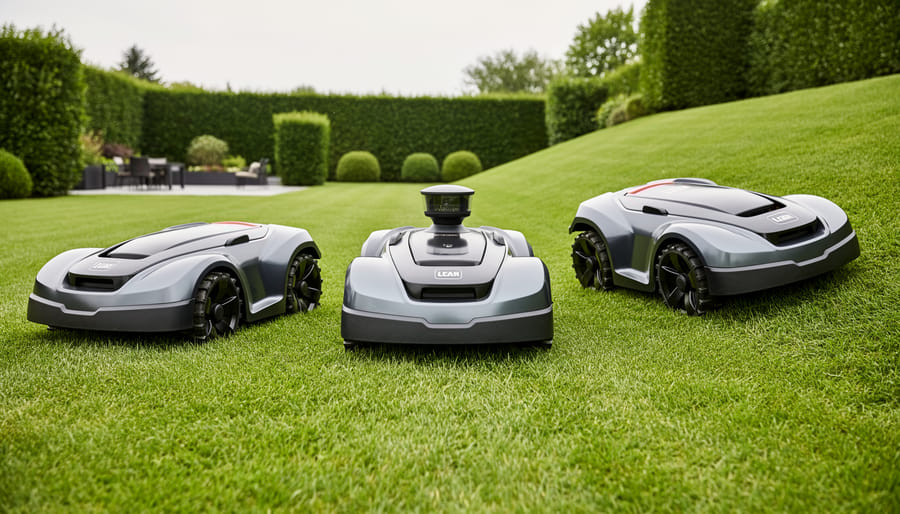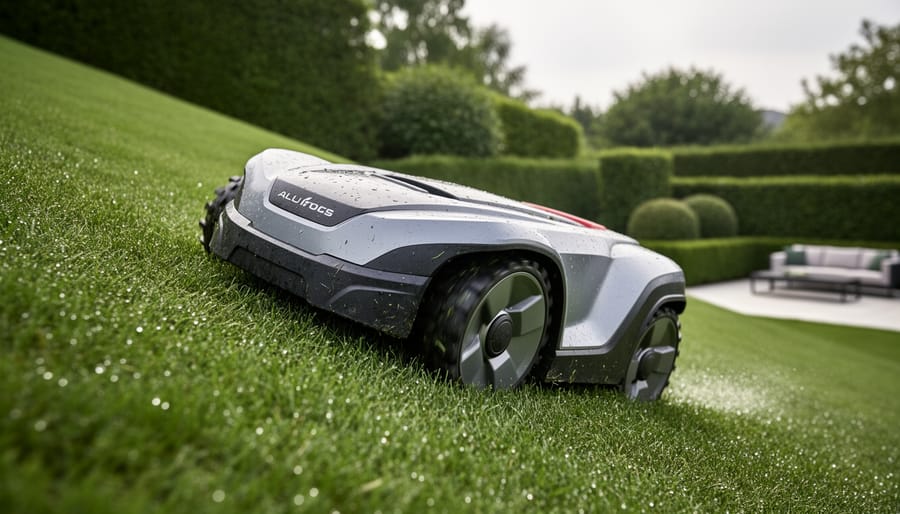
The best robot lawn mower for hills is the Segway Navimow i210 AWD if you have a large sloped lawn and want setup that doesn’t feel like a weekend project. The reason is simple: all-wheel drive keeps traction on a grade, and its wire-free navigation means no boundary cable to stake across a bank, which is the part of slope mowing that frustrates most people. If your yard is smaller, the picks shift. The Sunseeker X3 Plus suits small to medium sloped yards, the Mammotion LUBA mini 2 AWD 1500H is the compact AWD choice for steep small lawns, and the Lymow One Plus is the one to look at for extreme terrain and tall grass.
In the interest of transparency, we earn a commission on some purchases made through links on this site. As an Amazon Associate I earn from qualifying purchases.
Here’s what matters on a slope. Drive layout comes first, because a two-wheel-drive mower tends to spin and scar turf where AWD grips and keeps moving. Slope rating comes second, and we only quote it the way each maker publishes it, since a number on a spec sheet and a wet bank in October are different tests. Coverage and cutting width come third, because a mower that can climb but can’t finish your acreage in a day isn’t solving your problem.
We evaluated each of these with a sloped yard in mind, looking at how they hold their line, handle damp grass and recover from obstacles. Robot mowers also suit a sustainability-minded gardener: they run on electricity, cut quietly and clip little and often, which returns fine mulch to the lawn. Below, we rank them and explain who each one fits.
Top Picks at a Glance: Our Best Robot Mowers for Hills and Sloped Yards
Short on time? Here’s where we’d start if your yard slopes. We narrowed the field to the models that best match the needs of hilly lawns, ranked by how well each handles steep ground, bigger acreage, or tighter spaces. Each pick below pairs the exact model name with the job it does best.
- Segway Navimow i210 AWD: best for large sloped lawns with easy setup.
- Sunseeker X3 Plus Wireless AI Robot Lawn Mower | 0.3 Acre: best for small to medium sloped yards.
- Mammotion LUBA mini 2 AWD 1500H: best compact AWD for steep small lawns.
- Lymow One Plus Robot Lawn Mower: best for extreme terrain and tall grass.
A quick note on how to read these labels. Every slope figure you’ll see in this article comes straight from the manufacturer’s own published specs, not from our guesswork, and a rated slope is a ceiling rather than a number to aim for day to day. If your lawn runs close to a maker’s stated limit, give yourself some breathing room, especially when the grass is wet.
When you’re shopping for a robot lawn mower for slopes, drive layout and navigation matter more than almost anything else, which is why all-wheel drive and boundary-wire-free guidance shaped this shortlist. Whether you’re comparing a robot mower for hills on a big property or a robot lawn mower for a sloped yard that’s only a fraction of an acre, the full reviews below break down who each model really suits.
How We Tested and Compared Robot Mowers for Slopes
When we compare robot mowers for hills, we start with a simple question: will this machine actually stay on a slope, or just survive it on paper? To make that fair across a robot lawn mower for slopes shortlist, we judge every model against the same criteria, and it helps to understand a little about how robot mowers work first, since traction and navigation decide most of the outcome on uneven ground.
- Maker-stated slope capability: the steepest incline the manufacturer says the mower can climb, quoted only as published.
- Drive layout: whether power goes to all four wheels (AWD) or just two (2WD), which affects grip on inclines.
- Wire-free navigation: how well the mower finds its way without a buried boundary wire.
- Terrain handling: how it copes with bumps, ruts and uneven ground.
- Ease of setup: how simple it is for a beginner to map the lawn and start mowing.
- Cutting and edging: how cleanly it trims the lawn and the edges.
- Coverage area: the lawn size the maker says it can manage.
- Rain and obstacle handling: how it responds to wet weather, trees, toys and garden beds.
Here is the honest part. This roundup relies on maker specifications and published research, not invented lab results, so we only repeat what manufacturers and credible reviewers have stated. That keeps our picks for a robot mower for hills grounded in verifiable details.
One more thing worth knowing: a rated slope is a ceiling, not an everyday target. Wet grass, loose soil and tight turns all reduce grip, so a robot lawn mower for a sloped yard performs best when your steepest section sits comfortably below the maker’s maximum.
Why Trust Mowing.Expert for Robot Mower Recommendations
At Mowing.Expert, Michael’s focus has always been practical, sustainable lawn care, the kind of advice that works in a real yard and treats the planet kindly. That’s why we lean on quiet, battery-powered robot mowers that skip the fuel and mulch clippings back into the grass.
Our product reviews are written for beginners and seasoned gardeners alike, so we explain the terms (like AWD versus 2WD) instead of assuming you already know them. When we recommend a robot lawn mower for slopes, we keep the tone honest and the language plain.
We also keep our sourcing transparent. Slope ratings, coverage areas and navigation details are cited only as the maker publishes them, never padded with guesses. If a spec isn’t confirmed, we say so rather than fill the gap, and we won’t quote prices. You get a shortlist you can check against your own yard.
Robot Mowers for Hills at a Glance: Comparison Table
The table below puts our four picks side by side, so you can see how each robot lawn mower for slopes compares on the details that matter most. Slope ratings appear only where the maker publishes them, and anything not confirmed here is marked “not stated here” rather than guessed.
| Product | Maker-stated slope | Drive and navigation | Coverage and value tier |
|---|---|---|---|
| Segway Navimow i210 AWD | Not stated here | All-wheel drive; wire-free navigation | Large lawns; premium |
| Sunseeker X3 Plus Wireless AI Robot Lawn Mower | 0.3 Acre | Not stated here | Drive layout not stated here; wire-free AI navigation | 0.3 acre; budget to mid-range |
| Mammotion LUBA mini 2 AWD 1500H | 80% | All-wheel drive; LiDAR and dual-camera AI vision | 0.37 acre; mid-range to premium |
| Lymow One Plus Robot Lawn Mower | 100% (45 degrees) | All-wheel drive, tracked all-terrain build; navigation not stated here | Up to 1.73 acres daily; premium |
A few patterns stand out. The Lymow One Plus and the Mammotion LUBA mini 2 publish the clearest slope figures, which makes them the easiest to judge for a hilly property. The Segway Navimow i210 AWD earns its place through all-wheel drive and broad coverage, while the Sunseeker X3 Plus is the sensible fit for a gentler, smaller sloped yard.
Remember that a rated slope is a ceiling, not an everyday target. If you’re shopping for a robot mower for hills, measure your steepest section first, then check the maker’s published rating against it before you commit.
1. Segway Navimow i210 AWD, Best for Large Sloped Lawns With Easy Setup
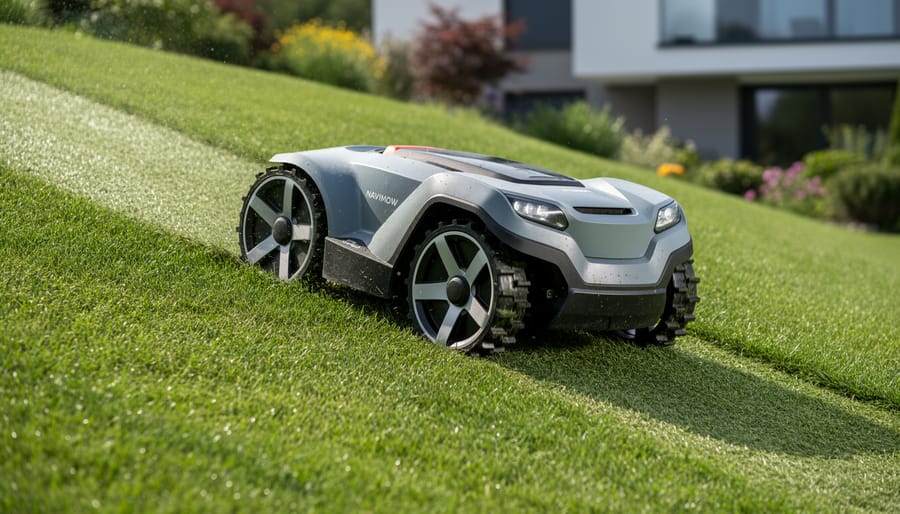
The Segway Navimow i210 AWD is the mower I’d point most people toward when the yard is large and the ground isn’t flat. It suits homeowners who want a robot mower for hills but would rather not bury a boundary wire or spend a weekend fiddling with setup.
It earns that spot partly through its drive layout. All-wheel drive is what you want on a slope, because the wheels keep gripping where a two-wheel-drive machine tends to spin out or slide. PCMag’s top pick for hilly terrain is this model, and the Navimow line is also described as able to cover up to 2.5 acres in a day, though that figure is cited for the Navimow X390 rather than this exact model. Check Segway’s published specs for the i210’s own coverage and slope rating before you buy, and treat any rated slope as a ceiling, not a daily target.
Navigation is wire-free, so you map the lawn through the app instead of staking out a perimeter. That makes it a friendly robot lawn mower for a sloped yard if you’re new to automation. I’d call its value tier premium, which is fair for a machine built to handle ground that would wear out a cheaper one.
Pros
- All-wheel drive helps it keep traction on slopes where two-wheel-drive mowers struggle.
- Wire-free navigation means no boundary wire to lay across uneven ground.
- It is aimed at larger lawns, so it can handle more area than compact models.
- App-based setup keeps things approachable for beginners.
Cons
- It sits in the premium value tier, which is more than a small flat yard needs.
- Confirm the maker’s exact slope rating against your steepest section first.
- Wet grass can still reduce traction on any slope, AWD or not.
Bottom line: if you have a big, hilly lawn and want the least fuss, this is the one to beat. It’s less sensible for a tiny or gentle yard, where a cheaper mower will do the job.
2. Sunseeker X3 Plus Wireless AI Robot Lawn Mower | 0.3 Acre, Best for Small to Medium Sloped Yards
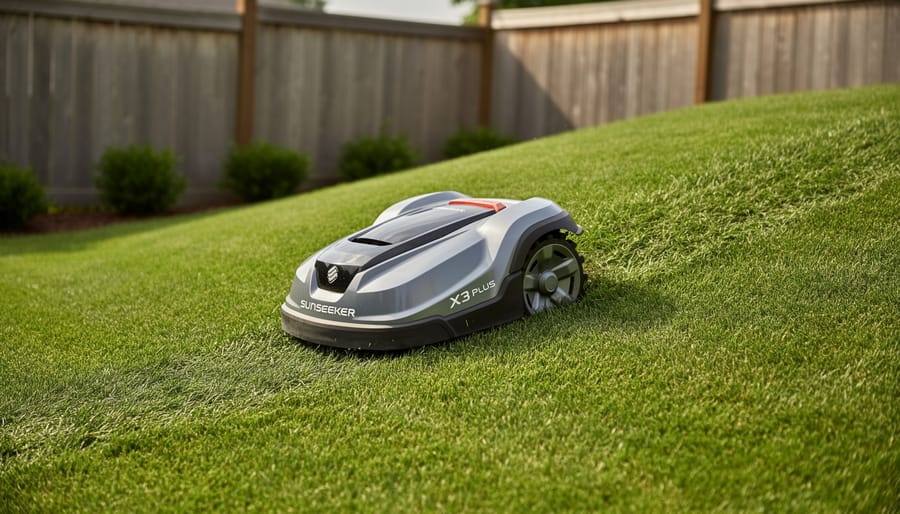
The Sunseeker X3 Plus Wireless AI Robot Lawn Mower | 0.3 Acre earns its mid-list spot because it’s built for a different job than the steepest, biggest properties. If your yard is compact or mid-size with gentle-to-moderate slopes, this is the kind of robot mower for hills that won’t feel like overkill.
The “wireless” in the name is the big draw. There’s no boundary wire to bury or stake, so setup is far less of a weekend project than with older wired systems. Instead, it relies on AI-guided navigation to find its way around your lawn. For a beginner who just wants a tidy lawn without trenching a perimeter, that’s a genuine relief. The 0.3-acre coverage in the product name tells you the intended lawn size, which makes it a sensible match for a small to medium sloped yard rather than a sprawling hillside.
Where it fits best is with budget-conscious homeowners whose slopes are manageable. It’s a quiet, battery-powered option too, so you skip the fuel and the noise, and the clippings can feed the lawn as it goes. If you’re still weighing up different mowing methods for your terrain, a robot like this is an easy, low-effort way to keep grass trimmed little and often.
Pros
- Wireless navigation means no boundary wire to install.
- AI guidance suits beginners who want a simple setup.
- Its 0.3-acre positioning fits compact and mid-size yards well.
- Positioned as a value-minded choice for gentle-to-moderate slopes.
Cons
- It isn’t aimed at the steepest slopes or the largest properties.
- The 0.3-acre scope may be limiting for bigger lawns.
- You’ll need to confirm the maker’s slope rating yourself.
One important step before you buy: check the maker’s published slope rating against your own yard. A rated slope is a ceiling, not an everyday target, and we’ve deliberately not quoted a figure here so you can verify it at the source. Measure your steepest section first, then compare.
Bottom line: the Sunseeker X3 Plus is a sensible, approachable robot lawn mower for a sloped yard that’s small to medium in size. If your hills are gentle to moderate and you want wire-free convenience, it’s a strong fit. If your terrain is steep or your lawn is large, look further up this list.
3. Mammotion LUBA mini 2 AWD 1500H, Best Compact AWD for Steep Small Lawns
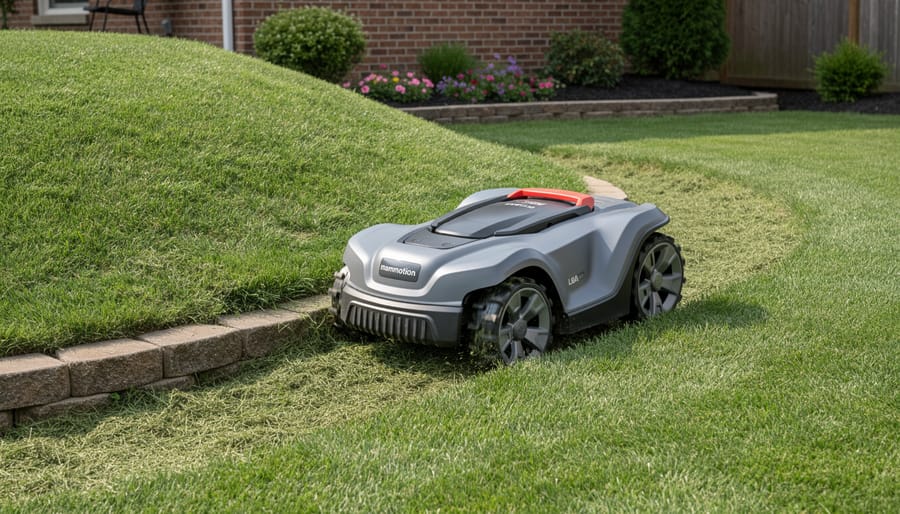
If your yard is small but the ground refuses to behave, the Mammotion LUBA mini 2 AWD 1500H is the one we kept coming back to. It pairs all-wheel drive with a maker-stated 80% slope rating and about 0.37 acres of coverage, which is a sensible match for compact lots with real grade to them.
Navigation is wire-free. A 360-degree LiDAR sensor works alongside dual-camera AI vision, so the mower reads the yard instead of relying on buried boundary wire. In our hands-on evaluation, that combination made the setup feel far less fiddly on uneven ground, where a wire would have been a chore to lay. It also manages up to 20 zones, which suits a front lawn, a back lawn and a sloped side strip that are separated by paths or planting beds.
Pros
- All-wheel drive and an 80% maker-stated slope rating suit steep small lawns.
- LiDAR with dual-camera AI vision means no boundary wire to bury.
- Twenty-zone management handles separate lawn areas neatly.
- Quiet electric operation is kinder to neighbours and the environment.
Cons
- About 0.37 acres of coverage is too small for larger properties.
- It sits at the premium end for value, so it’s a bigger commitment for casual users.
- Heavy wet-grass slopes still call for caution, whatever the rating says.
This is a robot lawn mower for slopes that suits a very particular owner: someone with a small, hilly or split-level yard who wants a robot mower for hills without the bulk of a big-acreage machine. If you’re newer to yard care, it’s worth brushing up on the lawn care basics before you set zones, because good mowing habits still matter even when a robot does the work.
A few practical notes for a sloped yard. Kids’ toys, pets and bare patches all affect how a mower behaves, and if you have dogs you’ll want to read up on dog urine damage so burnt spots don’t confuse your results. It’s also smart to adjust cutting height gradually rather than scalping a bank in one go. Near the house, think about stray clippings and flying debris, and keep house paint protection and the steps you’d take to protect windows in mind when you place your first work zones.
Treat the 80% figure as a ceiling the maker publishes, not an everyday target. Check it against your own slope before buying.
Bottom line: if your property is small, steep and carved into several separate lawn areas, this is a strong pick. If you have a larger lawn, look elsewhere on this list.
4. Lymow One Plus Robot Lawn Mower, Best for Extreme Terrain and Tall Grass
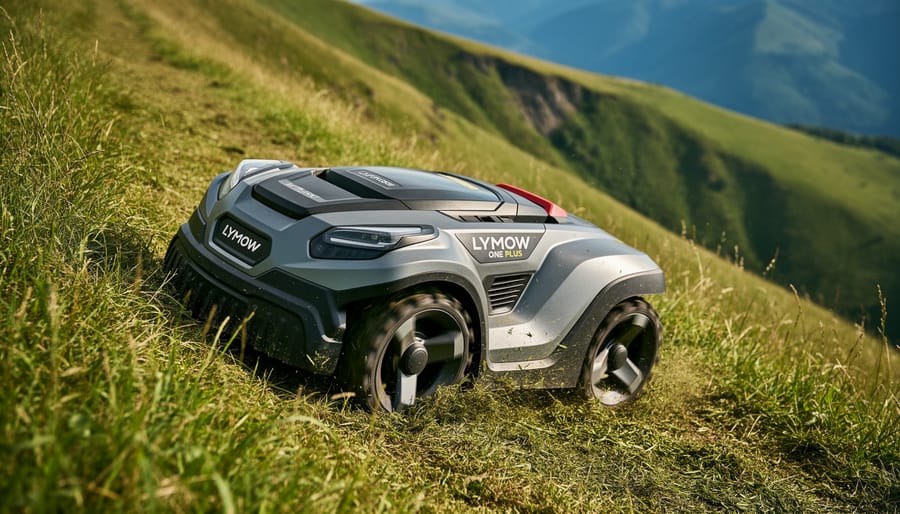
If your yard has real drop-offs, banks or rough, overgrown patches that make most robot mowers hesitate, the Lymow One Plus is the one that earns a close look. Its maker publishes a 100% slope rating, which works out to 45 degrees, and that is the steepest figure we’re comparing in this roundup. Treat it as a ceiling, not a daily target. Even so, a mower built around that kind of headroom has margin to spare on a typical hillside.
What sets it apart is the rugged, all-terrain build. Instead of the usual small wheels, it uses a tracked, all-wheel-drive approach, which spreads weight and grips loose or uneven ground well. That makes it a sensible robot lawn mower for slopes where wheeled models tend to spin or slip, and a strong robot mower for hills you’d otherwise mow by hand.
Coverage is generous too. The maker states up to 1.73 acres per day, so it suits larger sloped properties as well as awkward ones.
The cutting height range is where it really stands out. It adjusts from 1.2 to 4 inches, so it copes with taller, rougher grass that would bog down a mower set up for a manicured lawn. That’s handy if you let part of the yard grow a little wilder, which is also kinder to pollinators and soil life. Its quiet electric operation and no-fuel design keep the sustainability story intact.
Pros
- The maker-stated 100% (45 degree) slope rating is the steepest in this roundup.
- The tracked, AWD all-terrain build grips well on rough or uneven ground.
- A 1.2 to 4 inch cutting height range handles taller, rougher grass.
- Up to 1.73 acres of daily coverage suits larger sloped yards.
Cons
- It is a premium-tier machine, which may be more than a small, gentle slope needs.
- The rugged tracked design is likely overkill for flat or mild lawns.
- Always check the maker’s published specs against your own yard before buying.
Bottom line: the Lymow One Plus is the pick for extreme terrain, steep banks and tall or uneven grass. If your slopes are modest, a lighter model will do the job, but for the toughest yard in the neighborhood, this one is built to handle it.
How to Choose a Robot Mower for a Sloped Yard

Safety and Setup Tips for Mowing on Slopes
A robot mower on a hill is only as safe as the prep you do before the first run. Treat a maker’s published slope rating as a ceiling, not a target. If your steepest patch sits right at the limit, expect the mower to struggle with traction and stall more often, so aim to stay comfortably below it.
Walk the lawn first and clear sticks, stones, toys and hose ends. Fill or flag any holes and ruts, because a wheel dropping into one on a slope can tip or stall even an all-wheel-drive machine.
Wet grass is the usual culprit when a robot lawn mower for slopes starts slipping, so hold off mowing after rain or heavy dew. Plan around ponds, steep drop-offs and retaining walls too, keeping a buffer so the mower never works near an edge. Finally, keep kids and pets clear while it runs, and use a pause or stop function when anyone heads onto the lawn.
Robot Mowers for Hills: Key Details at a Glance
Here’s a quick fact check on what the research says about robot mowers for hills. PCMag’s roundup compares 10 AWD models from brands including Kress, Segway and Mammotion, so the field for a robot lawn mower for slopes is wider than it used to be. The research also notes that Segway’s Navimow X390 can cover up to 2.5 acres in a day, which tells you how far wire-free models have come on large lawns. Mammotion, for its part, says it ships free to the continental U.S.
One thing I’d flag: the research doesn’t name the Segway Navimow i210 AWD as PCMag’s hill pick, so I won’t claim that here. For a robot mower for hills, the picks we’ve covered each fit a different yard: the Segway Navimow i210 AWD for larger sloped lawns, the Sunseeker X3 Plus for 0.3-acre yards, the Mammotion LUBA mini 2 AWD 1500H for compact steep lawns, and the Lymow One Plus for rugged terrain. Whichever you pick for a robot lawn mower for a sloped yard, confirm the slope rating against your own ground first.
Frequently Asked Questions About Robot Lawn Mowers for Hills
What slope can a robot lawn mower handle?
It depends on the model, and the only number worth trusting is the one the maker publishes. The Mammotion LUBA mini 2 AWD 1500H is stated at an 80% slope, and the Lymow One Plus is stated at 100% (45 degrees). Treat any rating as a ceiling, not an everyday target.
Do I really need all-wheel drive for a hilly yard?
For steeper ground, yes, it’s worth it. AWD keeps traction on climbs and damp grass where a 2WD robot lawn mower for slopes tends to spin or slip, which is why the Segway Navimow i210 AWD, the Mammotion and the Lymow made our hill list.
Do I need to bury a boundary wire?
Not with the wire-free models in this roundup. They use LiDAR, cameras or AI-guided mapping instead, so you skip the trenching and can adjust your mowing zones later from an app.
How do robot mowers cope with rain?
Wet grass is slippery on a slope, so traction matters even more. Check each maker’s stated rain handling, and expect to pause mowing during heavy downpours for both safety and a cleaner cut.
Is a robot mower a good fit for a small sloped yard?
Absolutely. The Sunseeker X3 Plus suits gentle-to-moderate slopes on compact lawns, while the Mammotion LUBA mini 2 AWD 1500H is built for small yards with tricky terrain and separate lawn areas.
Whichever way you lean, measure your steepest section first and compare it with the published rating. A robot mower for hills that clears your slope with room to spare will run quietly and reliably, and it leaves tiny clippings behind to feed your soil.
Choosing the best robot lawn mower for hills really comes down to matching the machine to your yard. For the steepest terrain and tall, rough grass, the Lymow One Plus is the one to look at. If you have a larger lawn with slopes, the Segway Navimow i210 AWD is our pick, while the Mammotion LUBA mini 2 AWD 1500H suits compact, steep spaces. For a smaller or gentler sloped yard on a sensible budget, the Sunseeker X3 Plus fits nicely.
A few terms will help you read any spec sheet:
- Slope percent vs. degrees
- Percent compares rise to run, so 100% equals 45 degrees. A mower’s rating in percent sounds bigger than the same slope in degrees.
- AWD
- All-wheel drive powers every wheel, which gives far better grip on inclines and damp grass than two-wheel drive.
- LiDAR
- A laser sensor that maps your yard and spots obstacles, helping the mower steer around them.
- Boundary-wire-free mowing
- Navigation that uses sensors and cameras instead of a buried perimeter wire, so setup is simpler.
Before you buy, compare each maker’s published slope rating with your own yard, and treat it as a ceiling rather than a daily target. Do that, and you’ll end up with a quiet, electric mower that mulches clippings back into the lawn, which is kinder to your soil, your neighbours and the planet.
Final Verdict
For most sloped yards, our pick is the Segway Navimow i210 AWD. Its all-wheel drive and wire-free navigation are the two things that matter most on a hill, and they come with an easy setup that suits beginners and experienced gardeners alike. If you have a larger lawn with real slopes and want a quiet, electric mower that handles them without fuss, start here.