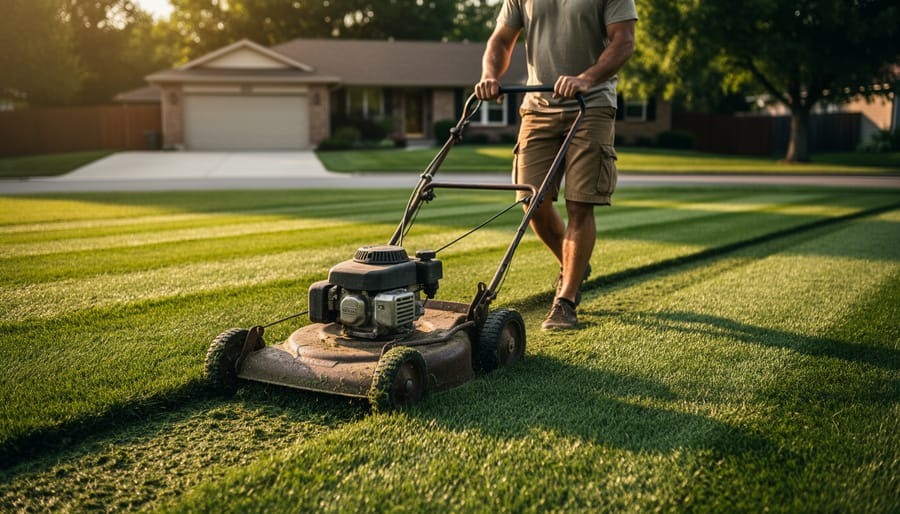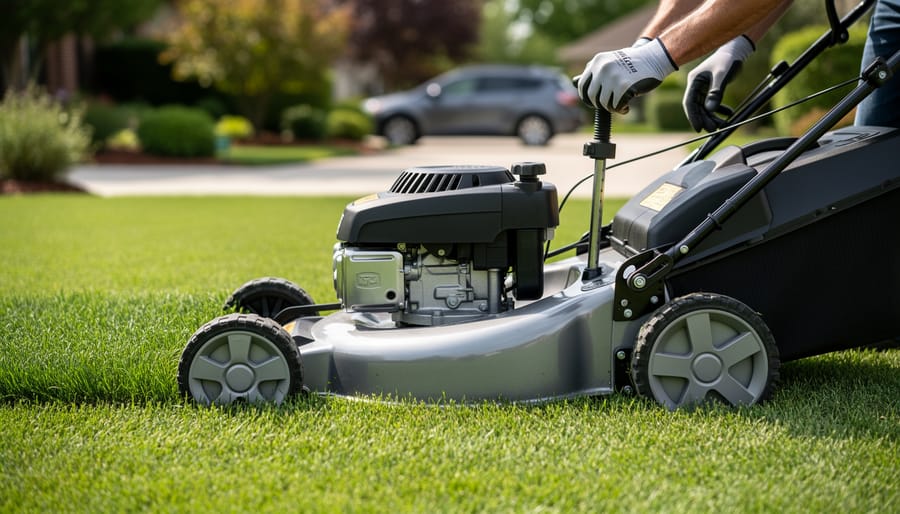
Getting your mowing height right means cutting cool-season grasses like Kentucky bluegrass and fescue to 3-4 inches, and warm-season varieties like Bermuda and zoosia to 1-2.5 inches. Set your mower deck using the adjustment lever or wheels at each corner, measure from a hard surface to the blade, and verify the actual cut height by mowing a small test patch and measuring the resulting grass with a ruler.
Most lawn problems trace back to cutting too short. When you scalp your grass below its ideal range, you weaken the root system, invite weeds to colonize bare spots, and stress the plant during hot or dry periods. The right height does more than keep your yard looking neat. It shades out crabgrass, encourages deeper roots that can tap into moisture during summer, and produces enough leaf surface to fuel healthy growth without triggering excessive clippings.
The challenge is that mower height settings rarely match the actual cutting height. A dial marked “3 inches” might deliver 2.5 or 3.5 inches depending on tire pressure, deck wear, and blade sharpness. That’s why verification matters as much as the initial setup.
Seasonal adjustments add another layer. You’ll raise the deck a notch when heat arrives in June and lower it slightly in fall as temperatures cool. This article walks you through the complete process: identifying your grass type, locating and using your mower’s adjustment system, measuring to confirm the setting, and adapting your approach as seasons change. You’ll also learn how to spot signs that your current height isn’t working and make corrections before damage sets in.
Why Mowing Height Matters More Than You Think
Every time you adjust your mower’s cutting height, you are making a decision that ripples through your entire lawn’s ecosystem. The height at which you cut your grass directly influences how well your lawn can feed itself, defend against threats, and survive stressful conditions. Understanding this relationship transforms mowing from a simple chore into a strategic tool for building a resilient, healthy lawn.
When grass blades grow taller, they produce more surface area for photosynthesis, the process by which plants convert sunlight into energy. This increased energy production fuels deeper, more extensive root systems. Research consistently shows that grass cut at proper heights develops roots that penetrate 50 to 100 percent deeper than grass cut too short. These deeper roots access moisture and nutrients beyond the reach of shallow-rooted plants, giving your lawn a critical advantage during drought or heat stress.
Taller grass also shades the soil surface, creating an inhospitable environment for weed seeds that need light to germinate. A lawn maintained at the correct height for its grass type forms a dense canopy that physically blocks weed establishment. When you scalp your lawn by cutting too short, you open the door for crabgrass, dandelions, and other opportunistic weeds to colonize bare spots.
Mowing too short creates stress that makes grass more susceptible to disease and insect damage. Scalped grass loses its energy reserves stored in leaf tissue and must divert resources to regrow blades rather than strengthening roots or fighting off pathogens. The result is a weakened plant that browns quickly in summer, thins out over time, and requires more water and fertilizer to maintain acceptable appearance.
The difference between a struggling lawn and a thriving one often comes down to the two or three inches you leave on the grass blade. Those extra inches represent stored energy, moisture retention, weed prevention, and resilience against whatever challenges your lawn faces.
Essential Tools and Equipment for Height Control
You don’t need expensive equipment to master mowing heights, but having the right tools makes accurate height control straightforward. Start with an adjustable lawn mower that lets you raise or lower the cutting deck in clear increments. Most modern mowers offer lever or knob adjustments ranging from one to four inches, though the mechanism varies by model. Check that your mower’s adjustment actually changes all four wheels equally, some older models adjust front and rear independently, creating an uneven cut.
A simple ruler or tape measure is essential for verifying actual cutting heights. Don’t trust the mower’s height markings alone. Manufacturers label settings by model, not universal standards, and those numbers often drift from reality as mowers age. Park your mower on a flat, hard surface like a driveway, and measure from the ground to the blade’s lowest point at each corner of the deck. This fifteen-second check reveals whether your “three-inch” setting truly cuts at three inches.
Here’s what you need for effective height management:
- Adjustable mower with visible height settings (rotary or reel type)
- Ruler or tape measure for verifying blade height and measuring grass
- Blade sharpening tools or service access, sharp blades cut cleanly at any height
- Tire pressure gauge to maintain even deck level
- Socket wrench or screwdriver for deck adjustment mechanisms
- Optional: mulching kit to recycle clippings at proper heights
Blade sharpness directly affects cut quality regardless of height settings. Dull blades tear grass instead of cutting it, leaving ragged brown tips that make your lawn look poorly maintained even at the correct height. Sharpen or replace mower blades at least twice per season, more if you mow frequently or hit debris. A clean cut heals faster, resists disease better, and maintains the deep green color that signals healthy grass.
Know Your Grass Type Before You Set Your Blade
Your lawn is not a one-size-fits-all proposition, and neither is the blade height that keeps it thriving. Cutting Kentucky bluegrass at the same height as Bermuda grass is like wearing winter boots to the beach: technically possible, but you’re going to regret it. Each grass species evolved with distinct growth patterns, root structures, and stress tolerances, which means they demand different cutting heights to stay healthy.
Cool-season grasses, the workhorses of northern lawns, prefer taller cuts. Kentucky bluegrass thrives at 2.5 to 3.5 inches, tall fescue at 3 to 4 inches, and perennial ryegrass at 2 to 3 inches. These grasses grow most actively during spring and fall when temperatures hover between 60 and 75 degrees. Their deeper root systems need taller blades to produce enough energy through photosynthesis, especially during summer heat stress. Cut them too short and you expose tender crown tissue to scorching sun, inviting weeds and disease.
Warm-season grasses, dominant across southern regions, tolerate and often prefer lower cuts. Bermuda grass performs best at 1 to 2 inches, Zoysia at 1 to 2.5 inches, St. Augustine at 2.5 to 4 inches, and Centipede at 1.5 to 2.5 inches. These species grow vigorously when soil temperatures exceed 65 degrees and go dormant in winter. Their lateral growth habit, spreading through stolons and rhizomes rather than vertical tillering, means they can handle aggressive mowing that would devastate cool-season varieties.
Not sure which grass you have? Look at the blade shape and texture. Cool-season grasses typically have wider, softer blades with boat-shaped tips. Warm-season grasses often feature narrower, coarser blades. Check when your lawn greens up in spring: cool-season lawns wake early, warm-season varieties wait until late spring. Your local extension office can identify samples if you’re stuck.
The biology is unforgiving. Mow warm-season grass at cool-season heights and you get a thin, stemmy lawn vulnerable to pests. Cut cool-season grass too low and you’re basically scalping it twice a week. Match your mowing heights to your actual grass type, not your neighbor’s schedule or generic internet advice. Your lawn will repay the attention with density, color, and resilience you can’t fake.
Step-by-Step: How to Adjust and Maintain Proper Mowing Heights
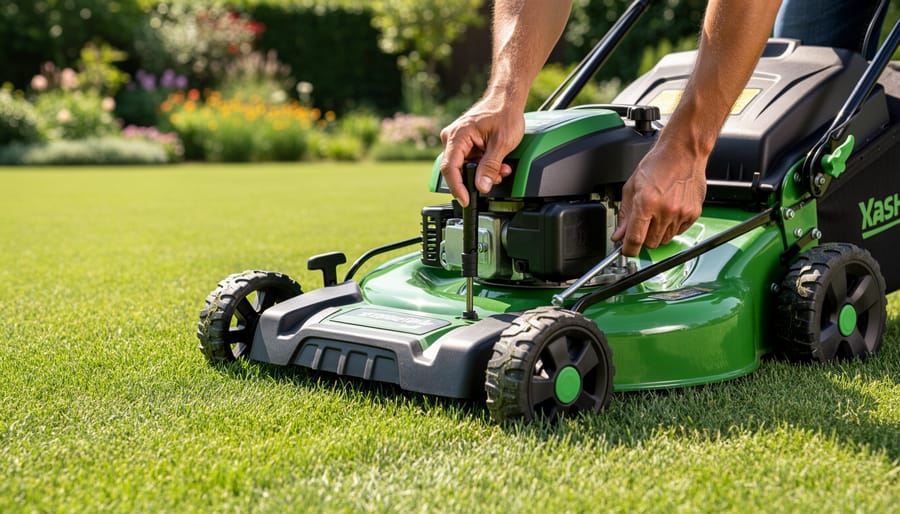
Measuring and Setting Your Mower Deck
Start on level pavement or concrete, your driveway works perfectly. Park the mower, turn off the engine, and disconnect the spark plug wire for safety. Check your tire pressure first, because low tires throw off your entire height measurement. Inflate all tires to the manufacturer’s recommended PSI, typically printed on the sidewall or in your owner’s manual.
Most mowers adjust height through a single lever near each wheel or a central lever controlling all four corners at once. Rotary mowers typically offer settings from one to four inches. Find your desired height based on your grass type, then move the adjustment lever to that notch.
Now verify the actual cutting height. Measure from the hard surface to the blade’s lowest point, not the deck bottom. Position a ruler vertically under the deck center where the blade path crosses. On multi-blade decks, check both blades. The measurement should match your setting. If it’s off by more than a quarter-inch, your deck might be tilted.
Deck level matters enormously for mowing heights. Most mowers should sit slightly lower in front (about an eighth-inch) to create proper blade overlap and prevent scalping. Check side-to-side level too, both sides should match within an eighth-inch. Adjust using the deck hangers or leveling hardware specified in your manual. This setup ensures your chosen cutting height translates to an even, consistent cut across your entire lawn.
Testing and Fine-Tuning Your Cut
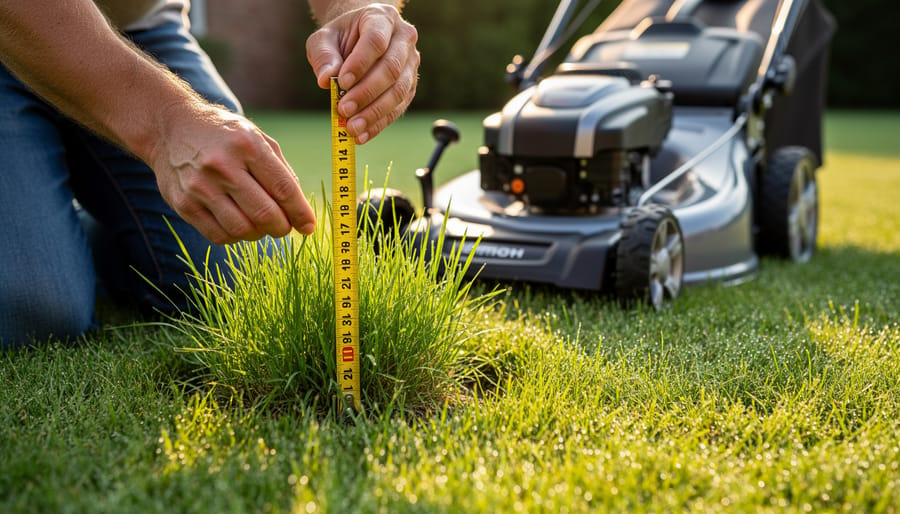
After setting your mower deck, don’t trust the numbers alone. Mow a small test strip in an inconspicuous area of your lawn, then let the grass blades stand upright for a minute or two. Measure the actual cut height with a ruler placed vertically from the soil surface to the grass tips, not from the thatch layer, which can throw off your reading by half an inch or more.
Compare this measurement to your target height for your grass type. If you’re aiming for 3 inches but measuring 2.5 inches, your mower setting needs adjustment. Most decks don’t cut exactly where the gauge indicates, especially if tire pressure is off or the deck isn’t level.
Make one adjustment at a time, moving the deck a quarter-inch higher or lower, then mow another test strip and remeasure. This iterative process takes ten minutes but saves you from scalping your entire lawn or leaving it taller than intended. Once you’ve dialed in the correct setting, mark it with tape or a permanent marker on your mower for future reference.
Check your actual mowing heights every few weeks during the growing season. Blade wear, deck buildup, and settling can shift your cut over time.
Applying the One-Third Rule
The one-third rule is the single most important principle for maintaining healthy grass at your chosen mowing heights. Simply put, never remove more than one-third of the blade length in any single cut. If your target height is three inches, you should mow when the grass reaches about 4.5 inches tall. Cutting more than this stresses the plant, reduces root growth, and leaves the lawn vulnerable to heat and drought.
Calculate your mowing frequency by watching growth rates, which vary by season and weather. During peak spring growth, cool-season lawns might need cutting every four to five days. In summer heat or drought, that stretches to every ten days or more. The key is to mow at proper height frequency based on how fast your specific grass grows, not a fixed calendar schedule.
If your lawn gets away from you and grows too tall, resist the urge to scalp it back to your target in one pass. Instead, raise your deck, remove only one-third, then lower it gradually over two or three mowings. This staged approach lets the grass recover between cuts without shock. Your lawn will thank you with thicker, healthier growth.
Seasonal Height Adjustments: When and Why to Change
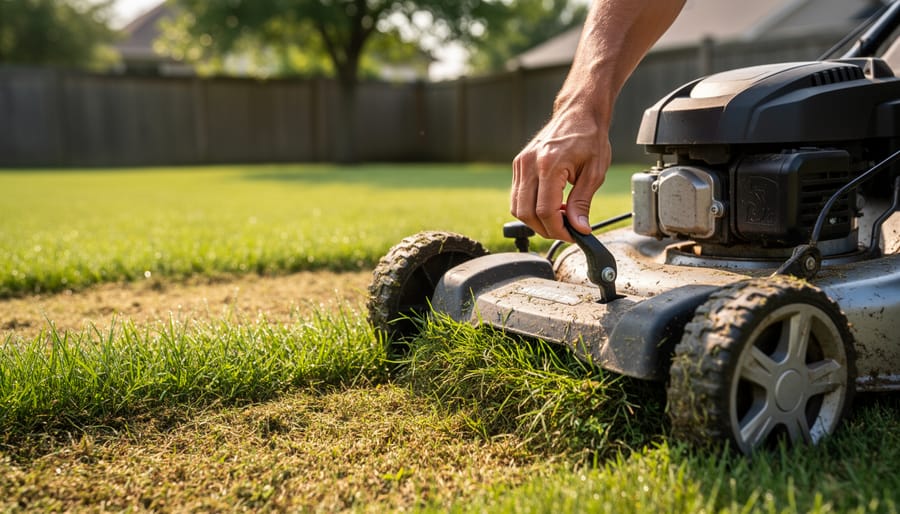
Your grass responds to seasonal conditions the same way you adjust your wardrobe: what worked in April won’t serve you well in July. Understanding when and why to shift your mowing heights throughout the year transforms maintenance from guesswork into a strategic advantage for your lawn’s health.
Spring: Gradual Awakening (March-May)
As grass emerges from dormancy, start with a slightly lower cut, about half an inch below your grass type’s optimal summer height. This allows sunlight to reach the crown and warm the soil, encouraging vigorous root development and tillering. For cool-season grasses like Kentucky bluegrass or fescue, begin around 2.5 inches in early spring, then gradually raise to 3-3.5 inches as temperatures climb. Warm-season grasses can start at 1.5 inches and move toward 2-2.5 inches as they green up. The key word is gradual: raise your deck a quarter-inch every two to three weeks rather than jumping straight to summer height.
Summer: Maximum Protection (June-August)
Heat and drought stress demand your highest mowing heights of the year. Taller grass shades soil, reduces evaporation, and maintains deeper roots that access moisture lower in the profile. Raise cool-season grasses to 3.5-4 inches during peak heat, and keep warm-season varieties at their upper recommended range (typically 2.5-3 inches for bermudagrass, 3-4 inches for St. Augustine). This isn’t the time to chase a golf-course look.
Fall: Strengthening for Winter (September-November)
As temperatures moderate, cool-season grasses experience their second growth surge. Maintain summer heights through early fall to maximize photosynthesis and carbohydrate storage before dormancy. About three to four weeks before your first expected frost, gradually lower the deck by a quarter-inch per mowing until you reach 2.5-3 inches. This reduces the risk of snow mold and matting while still protecting crowns. Warm-season grasses should stay at their standard height until they begin natural dormancy, then you can drop slightly for the final cut.
Winter: Dormancy Considerations (December-February)
In regions where grass remains semi-active, maintain fall heights through winter. Most lawns require little to no mowing during true dormancy. Never scalp going into winter, exposed crowns are vulnerable to frost heaving and desiccation. The last cut of the season should still follow the one-third rule, even if it means mowing more frequently as growth slows.
Safety Warnings and Common Mistakes to Avoid
Before you adjust your mowing heights, turn off the engine completely and disconnect the spark plug wire. This simple step prevents accidental starts while your hands are near the blade. Never reach under the deck or adjust height settings with the engine running, no matter how quick you think the change will be.
Here are the most common mistakes that damage lawns or create hazards:
- Cutting grass shorter than three inches during summer heat stress
- Scalping turf when mowing over bumps, dips, or uneven terrain
- Using dull blades that tear grass instead of cutting cleanly
- Dropping mowing heights by more than half an inch at once
- Mowing wet grass at low settings, which clumps and clogs the deck
- Failing to check actual cut height after adjusting the mower
The summer scalping mistake is particularly brutal. When temperatures climb and rainfall drops, grass already struggles. Cutting below three inches removes too much leaf surface for photosynthesis, stresses roots, and leaves soil exposed to direct sun. You’ll see browning within days, and recovery takes weeks.
Uneven ground exposes another risk. If your yard has slopes, raised beds, or settled areas, a deck set at two inches might dig into high spots while leaving low areas untouched. Walk your property before mowing and raise the deck over problem zones, or accept a slightly higher overall cut.
Dull blades shred grass tips instead of slicing them cleanly, creating ragged brown edges that invite disease. Even if your height setting is perfect, torn grass responds as if you scalped it. Sharpen blades every 20 to 25 hours of mowing, or roughly twice per season for most homeowners.
Drastic height changes shock grass. If you’ve let the lawn grow too tall, raise it gradually over several mowings rather than dropping straight to your target height. Patience protects the crown and lets grass adapt without shutting down growth.
How to Verify You’re Mowing at the Right Height
Your lawn will tell you whether your mowing height is right. You just need to know how to read the signs.
Start with grass color and thickness. Healthy grass at the correct height looks vibrant green and grows densely. If your lawn appears yellowish or thin, you might be cutting too short. The grass blades should stand upright and recover quickly after foot traffic.
Check for weeds. A thick, properly-mowed lawn shades out weed seeds and prevents them from germinating. If dandelions, crabgrass, or clover are taking over despite your efforts, raising your cutting height often solves the problem. Taller grass creates a natural weed barrier.
Walk your lawn and look for bare patches or scalped areas. These typically appear on high spots where the mower deck cuts too close. If you’re seeing soil or crowns exposed, especially after mowing, your height is definitely too low for those areas.
Feel the soil a day or two after watering. Grass mowed at proper heights shades its own root zone, keeping moisture in the soil longer. If the ground dries out quickly and feels crusty, taller grass will help retain water.
Pay attention to recovery time. Well-maintained grass at the right height bounces back within 24 hours of mowing and shows steady growth. If your lawn looks stressed or brown-tipped for days after cutting, or if it’s growing so aggressively you’re mowing twice weekly, adjust accordingly.
When the grass struggles, raise the deck. When weeds dominate or growth is excessive, you’ve likely got room to experiment within your grass type’s recommended range.
Sustainable Mowing Practices and Environmental Benefits
Maintaining the right mowing heights does more than create an attractive lawn, it’s one of the most effective sustainability practices in your gardening toolkit. When you cut grass at its optimal height, you’re building a self-sufficient ecosystem that demands fewer resources and less intervention.
Taller grass develops deeper root systems, sometimes reaching eight to twelve inches into the soil. These extensive roots access moisture that shorter grass can’t reach, cutting your watering needs by 30 to 40 percent during dry spells. In practical terms, a lawn mowed at three inches instead of two inches can go an extra three to four days between waterings, saving thousands of gallons over a season.
The shade created by properly-height grass blades cools the soil surface, slowing evaporation and creating conditions that discourage weed seeds from germinating. You’ll apply less herbicide because crabgrass, dandelions, and other opportunistic plants struggle to establish when grass grows thick and tall. This natural weed suppression means fewer chemical inputs leaching into groundwater.
Nutrient cycling improves dramatically when you combine correct mowing heights with grasscycling, leaving clippings on the lawn. Longer grass produces clippings that decompose quickly, returning nitrogen, phosphorus, and potassium to the soil. This natural fertilization can reduce your synthetic fertilizer use by 25 percent or more, keeping those nutrients out of storm drains and waterways.
The environmental math is simple: proper mowing heights create resilient grass that needs less water, fewer chemicals, and reduced fertilizer while supporting beneficial insects and soil organisms. Your cutting height becomes a sustainability lever that compounds benefits throughout the growing season.
Frequently Asked Questions About Mowing Heights
Can I change my mowing height mid-season?
Yes, you can adjust cutting heights throughout the growing season as conditions change. Raise the blade during hot, dry summer periods to help grass retain moisture and lower it slightly in spring or fall when temperatures are cooler. Always make changes gradually, shifting no more than half an inch at a time.
What should I do if my grass is overgrown?
Never try to bring overgrown grass back to target height in one mowing. Cut only one-third of the current blade length, wait three to five days, then mow again to gradually reach your desired height. Cutting too much at once stresses the grass and exposes weak stems to sun damage.
Should I mow shorter before going on vacation?
No, cutting extra short before leaving weakens your lawn and makes it vulnerable to heat stress and weeds. Instead, mow at your regular height right before you go, or arrange for someone to mow while you’re away. A slightly longer lawn handles neglect better than a scalped one.
Does mulching versus bagging affect what mowing height I should use?
Mulching works best when you maintain proper height and mow frequently, returning small clippings that decompose quickly. If you let grass grow too tall between mowings, heavy clumps can smother the lawn, making bagging necessary. The height itself stays the same regardless of method, but mulching rewards consistency.
What mowing heights work for newly seeded lawns?
Wait until new grass reaches about three to four inches before the first mowing, then cut it back to the recommended height for your grass type. Set your mower a quarter to half inch higher than the target for the first few mowings to avoid stressing young roots. Sharp blades are critical since new grass pulls out easily.
These questions come up repeatedly because mowing heights interact with real-world complications like weather, travel schedules, and equipment choices. The answers share a common thread: gradual changes protect your lawn better than dramatic adjustments. When you face an unusual situation, err toward cutting higher rather than shorter. Grass recovers from being slightly tall far more easily than from being scalped, and patient adjustments always outperform rushed corrections.
Getting your mowing heights right isn’t a one-and-done decision. It’s an ongoing conversation with your lawn, where you adjust and respond based on what you see. The grass tells you what it needs through its color, thickness, and how it bounces back between cuts. Start with the recommended height for your grass type, then watch how your lawn responds across different seasons and weather patterns.
Don’t expect perfection immediately. It takes a few weeks to see how height changes affect your lawn’s health, weed pressure, and drought tolerance. Raise the blade when stress hits in summer, lower it slightly in spring when growth explodes, and resist the urge to scalp the lawn short just because it looks tidy. Healthy grass grows from the roots up, and those roots thrive when you leave enough blade length to fuel them.
Check in regularly, measure your actual cut height a few times each season, and keep notes on what works best for your specific conditions. Mastering mowing heights transforms lawn care from guesswork into a reliable system that builds resilience, reduces maintenance headaches, and gives you the thick, green turf you’re after.