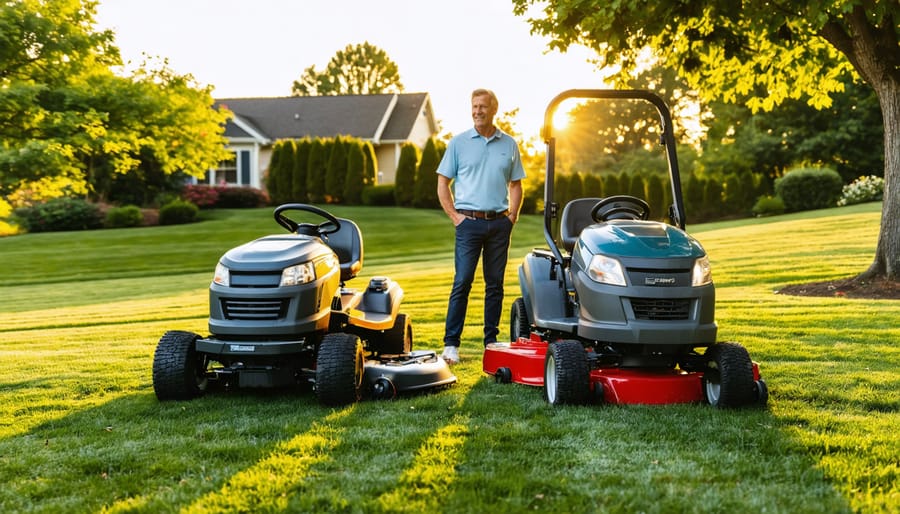
Standing in front of two promising machines at your local dealer, you’re facing one of the most significant lawn care decisions you’ll make: choosing between a traditional riding lawn mower and a sleek zero-turn model. This isn’t just about cutting grass—it’s about investing hundreds or thousands of dollars in equipment that will shape your weekend routine for the next decade.
The confusion is understandable. Both machines will get your lawn mowed, but the similarities end there. Zero-turn mowers promise lightning-fast mowing times and the ability to pivot on a dime around your flower beds, while traditional riders offer familiar controls, gentler learning curves, and often friendlier price tags. Your neighbor swears by their zero-turn’s efficiency, but your brother-in-law insists his riding mower handles hills better and costs half as much to maintain.
The truth is, neither option is universally better. Your perfect choice depends on your lawn’s unique characteristics, your physical comfort, and how you actually spend time in your yard. A zero-turn might slash your mowing time by forty percent on a flat, obstacle-filled property, but that same machine could feel unstable and frustrating on slopes where a traditional rider would excel.
This guide cuts through the marketing hype to give you practical, honest comparisons that match real-world conditions, helping you invest wisely in the machine that truly fits your lawn care needs.
Understanding the Two Mower Types: What Makes Them Different
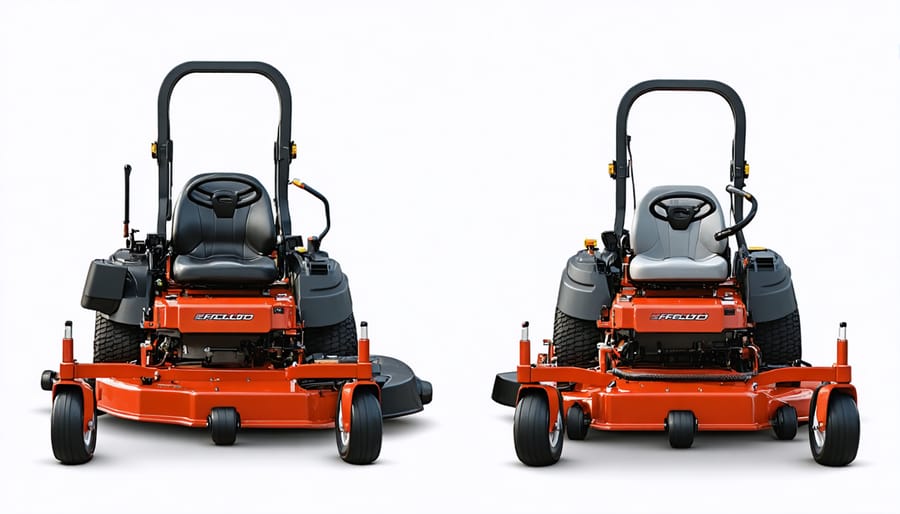
How Traditional Riding Mowers Work
If you’ve ever driven a car, you’ll feel right at home on a traditional riding mower. These familiar machines operate with a steering wheel positioned in front of you, controlling the front wheels just like your vehicle. You simply turn the wheel left or right, press the gas pedal to move forward, and use the brake when you need to stop. It’s an intuitive setup that requires virtually no learning curve.
The front-wheel steering system means your mower pivots from the front, creating wider turning arcs similar to a car. While this familiar operation feels comfortable and reassuring, especially for first-time riding mower owners, it does mean you’ll need more space to navigate around trees, flower beds, and garden obstacles. Most traditional riders have a turning radius between 16 and 18 inches, so you might find yourself making multiple passes or backing up to maneuver around tight corners.
This car-like design also provides stability on slopes and uneven terrain, making traditional riders a practical choice for properties with hills. The weight distribution and steering mechanics give you confident control, even when cutting grass on an incline. For many homeowners, this predictable, straightforward operation outweighs the need for lightning-fast maneuverability.
The Zero Turn Revolution: Dual-Lever Control
Here’s what makes zero turn mowers truly revolutionary: their unique dual-lever control system. Instead of a traditional steering wheel, you’ll find two lap bars (sometimes called control levers) positioned on either side of your seat. At first glance, they might look intimidating, but most folks get comfortable with them after just one mowing session.
Each lever independently controls one of the rear wheels, which is the secret behind their incredible maneuverability. Push both levers forward, and you move straight ahead. Pull them back together, and you reverse. Here’s where the magic happens: push the right lever forward while holding the left stationary, and your mower pivots left around that wheel. Push the right forward and pull the left back simultaneously, and you’ll spin in a complete circle without moving forward at all—that famous zero-degree turning radius.
This independent wheel control means you can navigate around trees, flower beds, and garden ornaments with remarkable precision, significantly reducing your mowing time. You’ll spend less time making multiple passes and practically eliminate the need for string trimming around obstacles. For those managing larger properties with varied landscaping, this efficiency translates to real fuel savings and a more sustainable approach to lawn maintenance.
Maneuverability: The Feature That Changes Everything
Why Your Lawn Shape Matters More Than You Think
Before you get swept up in horsepower ratings and cutting deck sizes, let me share something I’ve learned from years of helping gardeners choose the right equipment: your lawn’s personality matters just as much as the mower’s specs.
Think about your yard for a moment. Is it a wide-open canvas, or does it resemble an obstacle course with scattered trees, garden beds, and that decorative fountain you installed three summers ago? This distinction is crucial because it determines whether you’ll be grinning or grumbling during mowing sessions.
Traditional riding mowers excel on straightforward, open lawns where you can make long, sweeping passes. They’re efficient workhorses when your property has minimal turns and few obstacles. Picture a typical suburban lot with perhaps one or two shade trees—that’s riding mower territory.
Zero-turn mowers, however, shine in more complex landscapes. If you’re constantly navigating around flower beds, fruit trees, or garden sculptures, the ability to pivot on a dime becomes invaluable. I’ve watched homeowners cut their mowing time nearly in half simply by switching to a zero-turn for their obstacle-rich yards. Those tight 180-degree turns around tree trunks and precise edges along garden borders transform from tedious back-and-forth maneuvers into smooth, one-pass operations.
Consider this practical test: count how many times you currently back up or make multiple attempts to navigate tight spaces. If that number is high, your lawn is probably calling out for a zero-turn’s maneuverability.
The Real-World Time Savings (Or Lack Thereof)
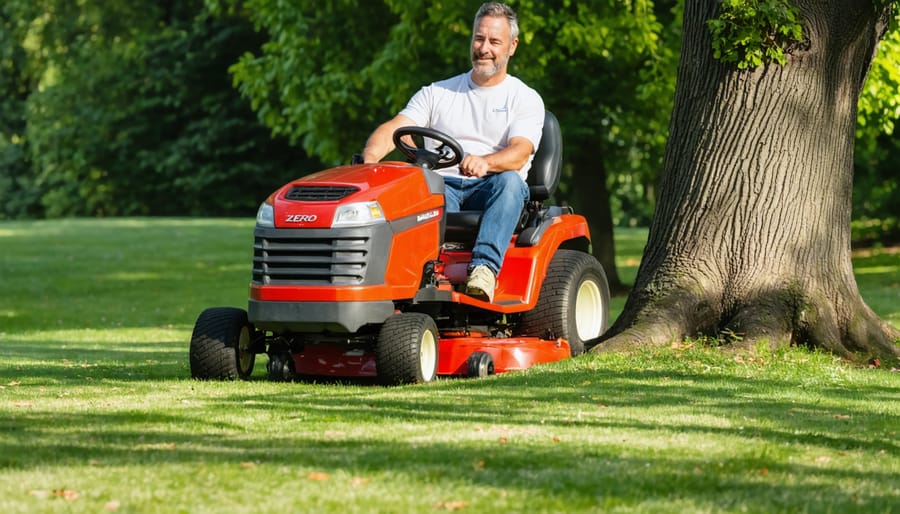
Let’s get real about time savings. If you’re mowing two acres or more with lots of open space, zero-turn mowers genuinely shine, cutting your mowing time by 40-50% compared to traditional riders. That two-hour Saturday afternoon job becomes just over an hour, which is legitimately significant.
However, for smaller lawns under an acre, especially those with many obstacles like trees, flowerbeds, or garden paths, the time difference shrinks considerably. You might save only 10-15 minutes per session because you’re constantly stopping, pivoting, and maneuvering regardless of which machine you’re using. A traditional riding mower’s wider turning radius matters less when you’re already navigating tight spaces.
The sweet spot for meaningful time savings sits around 1.5 to 3 acres with relatively open terrain. If your property is smaller or heavily landscaped, base your decision on comfort, budget, and ease of use rather than expecting dramatic time reductions. Remember, sustainable lawn care isn’t just about speed—it’s about choosing equipment that matches your actual needs without overbuying.
Comfort and Ease of Use: The Learning Curve Factor
The Beginner’s Perspective: Which Is Easier to Master?
If you’re new to power lawn equipment, the traditional riding mower wins hands-down for ease of learning. It operates much like driving a car—steering wheel, gas pedal, brake pedal. Most people hop on and feel comfortable within minutes. Your muscle memory from years of driving naturally transfers, making it an intuitive choice for beginners who want to start mowing right away without much practice.
Zero turn mowers, however, require patience and practice. Instead of a steering wheel, you control them with two lap bars that independently control each rear wheel. Push both forward to move straight, pull one back while pushing the other forward to spin in place. It feels counterintuitive at first, and many beginners report feeling a bit nervous during their initial attempts. You might zigzag across your lawn or turn too sharply, potentially damaging your grass.
That said, most users master zero turn controls within a few hours of practice. Start in an open area away from trees, flower beds, and other obstacles. The investment in learning pays off with significantly faster mowing times and superior maneuverability. For environmentally conscious homeowners, this efficiency means less fuel consumption and reduced emissions over the mower’s lifetime, making the learning curve worthwhile for both your schedule and the planet.
Long-Session Comfort: Seats, Suspension, and Fatigue
If you’re planning to spend hours mowing each week, comfort becomes a crucial factor in your decision. Zero-turn mowers typically offer more robust seating options with high-back designs, armrests, and better cushioning—features borrowed from commercial-grade equipment. Many higher-end models now include advanced suspension systems that genuinely absorb bumps and dips, making them considerably more comfortable on uneven terrain. This matters more than you might think when you’re navigating rough ground or areas with gopher mounds.
Traditional riding mowers generally have simpler seats and less sophisticated suspension, though they do provide a smoother, more stable ride on flat lawns. The wider wheelbase and slower speeds naturally reduce jarring movements. However, the steering wheel operation can cause more arm fatigue compared to zero-turn lap bars, especially during tight maneuvers.
For extended mowing sessions beyond two hours, zero-turns with quality suspension will leave you less exhausted. That said, if your yard is relatively flat and your sessions are shorter, a standard riding mower’s simplicity might be perfectly adequate without the premium price tag.
Speed and Efficiency: Beyond the Spec Sheet
When you’re standing in the showroom looking at spec sheets, the advertised ground speeds might catch your eye. Zero-turn mowers typically boast speeds of 7-12 mph, while traditional riding mowers cruise at 5-7 mph. But here’s what I’ve learned after years of helping folks choose the right equipment: those numbers don’t tell the whole story of how quickly you’ll actually finish mowing your lawn.
Think about your actual mowing patterns for a moment. With a traditional riding mower, you’ll spend considerable time making wide turns at the end of each row, often requiring a three-point turn that means going over the same ground multiple times. A zero-turn mower eliminates almost all of that wasted motion. Even if it’s only moving slightly faster in straight lines, the ability to pivot instantly can cut your mowing time by 40-50 percent on properties with obstacles like trees, flower beds, or garden borders.
For smaller yards under half an acre with simple rectangular layouts, the efficiency advantage of zero-turns becomes less dramatic. You’re mostly mowing in straight lines anyway, so those nimble turning capabilities don’t save as much time. This is where a riding mower’s lower cost might make more sense for your situation.
Terrain plays a crucial role too. On slopes and uneven ground, you’ll naturally slow down with any mower for safety, which narrows the real-world speed difference. Wet conditions, dense grass, and challenging terrain all impact productivity more than the spec sheet suggests.
The most efficient choice depends on your property’s complexity rather than maximum speed alone. A zero-turn on a tree-filled yard might finish in 45 minutes versus 80 minutes with a riding mower, while the time difference shrinks to minutes on open, rectangular properties.
Terrain Handling: Hills, Slopes, and Rough Ground
The Hill Problem: Safety Limitations You Need to Know
Let’s talk honestly about hills—this is where zero turns face their biggest challenge. Most zero turn mowers are limited to slopes of 15 degrees or less, and that’s being generous. Their rear-wheel drive system and high center of gravity make them prone to tipping on steep terrain, which is genuinely dangerous.
Traditional riding mowers, with their front-engine design and lower center of gravity, typically handle slopes up to 15-20 degrees more safely. The steering wheel also gives you better control when navigating inclines compared to lap bars, which can feel unstable on uneven ground.
Here’s what many dealers won’t emphasize: if your property has significant hills, a zero turn might not just be less effective—it could be unsafe. I’ve heard too many stories of homeowners who bought zero turns for hilly yards and ended up either struggling through their mowing or trading up for a traditional rider.
Before committing to a zero turn, walk your property with a slope measuring app on your phone. If you’ve got grades approaching 15 degrees, seriously consider a riding mower instead. It’s not the exciting choice, but it’s the practical one. Your safety and a stress-free mowing experience are worth prioritizing over fancy maneuverability you might rarely use.
Weight Distribution and Traction Differences
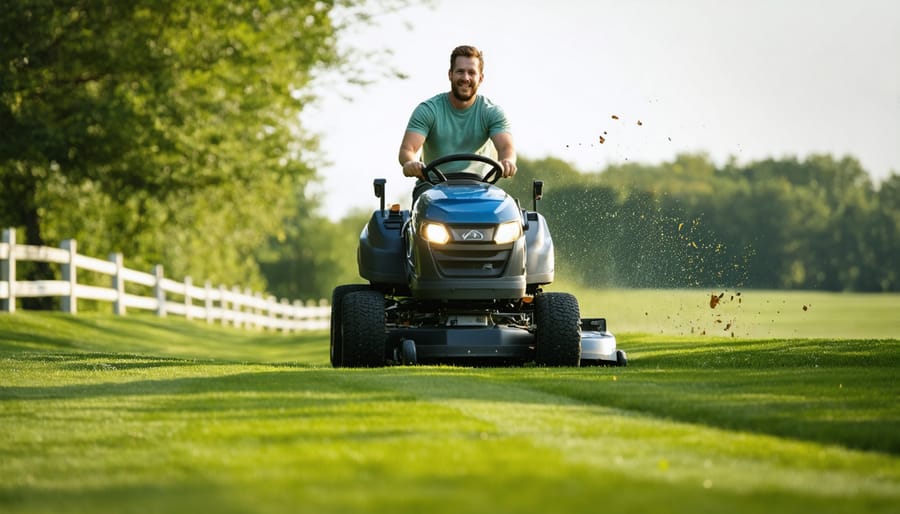
Weight distribution plays a surprisingly important role in how well your mower handles challenging conditions. Traditional riding mowers position most of their weight over the rear drive wheels, which generally provides solid traction on flat, dry lawns. This rear-heavy design works well for predictable terrain but can struggle when conditions get tricky.
Zero-turn mowers distribute weight differently, with a lower center of gravity and more balanced positioning. This can be advantageous for stability, but their wider rear tires sometimes leave deeper tracks in soft, wet soil. On soggy spring lawns or after heavy rain, you might notice zero-turns sinking slightly more than traditional riders.
For handling rough terrain and slopes, weight distribution becomes critical for safety. Riding mowers typically offer better hillside stability due to their front-wheel steering and weight balance. Zero-turns require more caution on inclines steeper than 15 degrees, as their maneuverability can become a liability rather than an asset on uneven ground.
Durability and Maintenance: The Long-Term Investment
What Breaks First: Common Issues for Each Type
Let’s talk about what you can expect when it comes to repairs and maintenance, because understanding these challenges upfront can save you headaches down the road.
Traditional riding mowers typically see issues with their steering systems first. Those steering gears and linkages take a beating over time, especially if you’re navigating around lots of obstacles. The transmission can also require attention, with belt replacements being a common maintenance task every few seasons. On the bright side, parts are generally affordable and widely available, and many repairs are straightforward enough for confident DIYers to tackle.
Zero-turn mowers face different challenges, primarily with their hydraulic systems. The hydraulic pumps and wheel motors are workhorses that eventually need servicing or replacement, and these repairs tend to be pricier than traditional mower fixes. The lap bar control mechanisms can also develop issues with heavy use. Additionally, because zero-turns put more stress on your turf during turns, you might find yourself doing more lawn repair work if you’re not careful with your technique.
From a sustainability perspective, keeping either mower well-maintained extends its lifespan significantly, reducing waste and the environmental impact of premature replacement. Regular oil changes, blade sharpening, and proper winter storage go a long way for both types. Budget roughly 200 to 400 dollars annually for routine maintenance on either style, with zero-turns potentially requiring higher repair costs when major components fail.
Sustainable Ownership: Repairability and Parts Availability
When considering long-term ownership, both riding mowers and zero-turns have distinct serviceability profiles that affect your wallet and the planet. Riding mowers typically shine here, with straightforward designs that make DIY maintenance more accessible. You’ll find parts readily available at local hardware stores, and many repairs require just basic tools. This simpler construction means less specialized knowledge needed for routine upkeep, making them friendlier for hands-on gardeners who enjoy maintaining their equipment.
Zero-turn mowers, while incredibly durable, often require more specialized parts and expertise for repairs. Their complex hydrostatic transmission systems may need professional attention, and replacement parts can be pricier and harder to source locally. However, many commercial-grade models are built to last decades with proper care, which reduces environmental impact through longevity rather than disposability.
From a sustainability perspective, consider that keeping either mower running longer beats buying new equipment every few years. Look for models with strong parts support networks and manufacturer commitment to long-term availability. Some brands offer refurbished parts programs, reducing waste. Regular maintenance, proper storage, and choosing quality over bargain pricing ultimately creates the most environmentally responsible ownership experience, regardless of which mower type you choose.
Price Breakdown: Understanding the Cost Difference
Let’s talk money, because this is often where the decision gets real for most homeowners. The price gap between riding lawn mowers and zero turns can be significant, but understanding what you’re actually paying for helps make sense of those numbers.
Traditional riding lawn mowers typically start around $1,500 to $2,500 for solid entry-level models, with quality mid-range options sitting comfortably in the $2,000 to $3,500 range. Zero turn mowers, on the other hand, generally begin around $3,000 for residential models, with most homeowners investing between $3,500 and $6,000 for reliable performance. That’s roughly double the entry cost, which understandably gives many people pause.
But here’s where it gets interesting: the initial sticker price only tells part of the story. Zero turns typically complete mowing tasks 40 to 50 percent faster than traditional riders, which means less fuel consumption per lawn session and reduced engine hours over the mower’s lifetime. If you’re mowing two acres weekly, that time savings translates to hundreds of hours reclaimed over several years—and fewer gallons of gas burned.
Maintenance costs run fairly comparable between the two, though zero turns sometimes require more frequent tire replacements due to their maneuverability putting extra wear on the turf tires. Both need regular oil changes, blade sharpening, and seasonal tune-ups.
From a sustainability perspective, burning less fuel to accomplish the same job gives zero turns an edge, though the best choice depends on your specific needs. For smaller properties under one acre with simple layouts, the riding mower’s lower cost and adequate performance make it the practical winner. But for larger spaces or properties with multiple obstacles, that zero turn premium often pays for itself through efficiency gains and the sheer joy of not spending your entire Saturday behind the wheel.
Making Your Decision: Match the Mower to Your Lawn
When a Traditional Riding Mower Is Your Best Bet
Traditional riding mowers shine in several specific situations where they’re genuinely the smarter investment. If your property features significant slopes or hillsides, a traditional rider’s lower center of gravity and longer wheelbase provide superior stability and safer operation on inclines. You’ll feel more confident navigating those challenging terrains.
Budget-conscious homeowners will appreciate that riding mowers typically cost $1,000-$2,000 less than comparable zero-turn models, making them an excellent entry point for upgrading from a push mower. This price difference allows you to invest those savings in quality maintenance tools or even some beautiful native plants for your landscape.
Properties with open, straightforward layouts without intricate landscaping benefit perfectly from traditional riders. If you’re mowing large, rectangular sections or gently rolling fields without many obstacles, the slightly slower turning radius won’t impact your efficiency significantly. You’ll still complete the job efficiently while enjoying excellent traction and a comfortable ride.
First-time riding mower buyers often find traditional models less intimidating to operate. The familiar steering wheel and straightforward controls feel more intuitive, reducing the learning curve considerably. Plus, their reputation for durability and simpler maintenance means fewer headaches down the road, letting you focus more on enjoying your beautifully maintained lawn.
When Zero Turn Mowers Justify Their Premium
Zero turn mowers truly shine when your property features specific characteristics that play to their strengths. If you’re managing 2+ acres with multiple obstacles like mature trees, flower beds, or decorative features, the time savings become genuinely substantial. I’ve seen homeowners cut their mowing time nearly in half, which translates to more hours enjoying your garden rather than just maintaining it.
Properties with complex landscaping layouts benefit enormously from zero turn maneuverability. When you’re navigating around garden ornaments, natural areas you’re preserving for pollinators, or irregular property boundaries, that pivot-on-a-dime capability becomes worth every penny. The precision also means less need for string trimming afterward, reducing both time and noise pollution in your yard.
If you’re physically active and comfortable operating responsive equipment, zero turns offer an engaging mowing experience. They require attention and coordination, which some find enjoyable rather than tedious. For those managing larger properties sustainably, the efficiency means less fuel consumption per acre compared to slower alternatives, even if the initial investment is higher. The premium pays dividends when speed, precision, and reduced maintenance time align with your lawn care goals and environmental values.
Here’s the truth that might surprise you: there’s no universal winner in the riding mower versus zero-turn debate. I’ve seen homeowners absolutely delighted with their traditional riding mowers, while their neighbors sing the praises of their zero-turns—and both are completely right for their situations.
The key is honest self-assessment. If you’ve got a flat, obstacle-filled lawn and value efficiency above all else, a zero-turn makes perfect sense. But if your property features slopes, you prioritize a smooth learning curve, or you simply don’t need to shave 20 minutes off your mowing time, a traditional rider will serve you beautifully without the extra expense.
Don’t get caught up chasing features you won’t actually use. That lightning-fast maneuverability sounds impressive until you realize your straightforward lawn doesn’t need it. Similarly, spending less on a rider makes little sense if you’ll spend every mowing session frustrated by its limitations.
Both mower types represent solid investments that can deliver a decade or more of reliable service when properly matched to your lawn’s characteristics. Take the time to evaluate your terrain, obstacles, and genuine priorities rather than just specs on paper. Your future self—the one enjoying effortless Saturday mornings instead of wrestling with an ill-suited mower—will thank you for making the thoughtful choice today.