Master your zero turn mower’s full potential by mastering precise steering control first – grip both lap bars firmly and practice small, controlled movements before attempting tight turns. Establish consistent mowing patterns, starting with the perimeter and working inward, to maximize efficiency while maintaining essential safety considerations. Position your body weight centrally, keeping your back straight and arms relaxed to maintain optimal control and reduce fatigue during extended mowing sessions.
Zero turn mowers revolutionize lawn maintenance through their unmatched maneuverability and time-saving capabilities, but proper technique directly impacts both cut quality and lawn health. Professional-grade results demand understanding the machine’s pivot point, maintaining appropriate speed control, and adapting your approach based on terrain conditions. Whether you’re maintaining a small residential yard or large commercial property, mastering these fundamental skills transforms challenging mowing tasks into precision operations that consistently deliver superior results while protecting your turf investment.
Learn to read your lawn’s specific needs – factors like grass type, growth patterns, and moisture levels should inform your mowing strategy. This adaptive approach, combined with technical expertise, elevates basic maintenance into artistic lawn care that stands out in any neighborhood.
Getting Started: Basic Zero Turn Controls
Understanding the Lap Bars
The lap bars on a zero turn mower are your gateway to precise control and smooth operation. Unlike traditional steering wheels, these two levers work independently to control each rear wheel. Think of them as extensions of your arms – pushing forward moves the corresponding wheel forward, while pulling back reverses it.
Sensitivity is key when handling lap bars. New operators often make the mistake of using too much force, resulting in jerky movements. Instead, use gentle, controlled motions. Start by gripping the bars lightly with your palms facing inward, keeping your elbows relaxed. When moving forward, push both bars evenly and slowly. For turns, reduce the speed of the inside wheel while maintaining the outside wheel’s pace.
The “dead zone” in the middle position requires special attention. This neutral stance lets you pause without engaging the brake. Practice finding this sweet spot in an open area until it becomes second nature. Remember, smooth operation not only creates better cutting patterns but also reduces wear on your machine and lawn.
Speed and Deck Height Control
Mastering speed control and deck height settings is crucial for achieving a perfect cut across different lawn conditions. For most regular mowing, maintain a speed between 4-6 mph, which allows the blades sufficient time to properly cut grass without leaving stragglers. However, when tackling thicker or taller grass, reduce your speed to 2-3 mph to prevent overwhelming the mower and ensure an even cut.
Your deck height should be adjusted based on both grass type and seasonal conditions. During peak growing seasons, set the deck higher (around 3-4 inches) to promote healthy root growth and drought resistance. For the final mow before winter, you can lower the deck slightly, but never cut more than one-third of the grass blade length in a single pass.
When mowing wet or dense grass, raise the deck height slightly higher than normal and reduce your speed to prevent clumping and maintain clean discharge. For slopes or uneven terrain, increase deck height to avoid scalping while maintaining a moderate speed for better control. Remember that consistent deck height across your entire lawn promotes uniform growth and helps prevent weed invasion.
Essential Mowing Patterns for Perfect Results
Straight Line Technique
Mastering straight lines with a zero turn mower is a fundamental skill that will dramatically improve your lawn’s appearance. Start by choosing a reference point in the distance, such as a tree or fence post, and keep your eyes focused on it rather than looking directly in front of the mower. This technique helps maintain a consistent path and prevents wavering.
Position both control levers evenly and push them forward with the same pressure to ensure your mower travels in a straight line. If you notice any drift, make subtle adjustments by applying slightly more pressure to the appropriate lever. Remember, less is more when making corrections – aggressive adjustments will result in visible zigzags in your cutting pattern.
For the best results, overlap each pass by about 3-4 inches. This prevents missed strips and creates a more uniform cut. Many experienced operators use the discharge chute or deck edge as a reference point for maintaining consistent overlap. Practice this technique on longer stretches of your lawn first, where minor imperfections are less noticeable, before tackling more visible areas near walkways or gardens.
Executing Perfect Turns
Mastering turns on a zero-turn mower requires finesse and practice to maintain a pristine lawn. The key to perfect turns lies in smooth control movements and appropriate speed adjustment. When approaching a turn, gradually slow down before you reach the turning point – this prevents turf damage and maintains control.
For 180-degree turns at the end of a mowing line, practice the pivot turn technique. Slowly move one control lever forward while pulling the other back with equal pressure. This creates a smooth pivot around the mower’s axis, minimizing grass damage. Keep your speed consistent and controlled throughout the turn.
For gentle curves, use graduated steering movements by pushing one lever slightly further than the other. This creates a wider turning radius that’s gentler on your lawn. When making tight turns around obstacles like trees or garden beds, reduce your speed significantly and maintain a steady hand on both control levers.
Remember that different soil conditions affect turning performance. On wet grass, make wider, more gradual turns to prevent tearing up the turf. On slopes, always turn while traveling uphill or downhill, never across the slope, to maintain stability and prevent turf damage.
A common mistake is turning too sharply at high speeds, which can leave ugly divots or bare patches in your lawn. Instead, think of each turn as a smooth, flowing movement rather than an abrupt change in direction. With practice, you’ll develop a feel for the perfect balance between speed and turning radius.
Striping and Professional Patterns
One of the most satisfying aspects of using a zero-turn mower is creating professional lawn stripes that transform your yard into a showcase. These eye-catching patterns occur when grass blades are bent in opposite directions, reflecting light differently to create contrasting stripes. To achieve this effect, alternate your mowing direction on each pass, and consider installing a striping kit for more pronounced results.
Popular patterns include the classic straight stripe, checkerboard, and diagonal designs. For straight stripes, use a distant fixed point as your reference and maintain consistent speed. The checkerboard pattern is created by mowing in perpendicular directions, while diagonal stripes add visual interest by cutting at 45-degree angles across your lawn.
For best results, maintain a slightly higher cutting height and ensure your grass is healthy. The taller grass blades will bend more dramatically, creating more visible stripes. Remember to vary your patterns occasionally to prevent grass from developing a permanent lean and to promote healthier growth. Consider your yard’s shape and features when planning patterns, using them to enhance your landscape’s natural flow.

Advanced Tips for Challenging Areas
Slopes and Hills
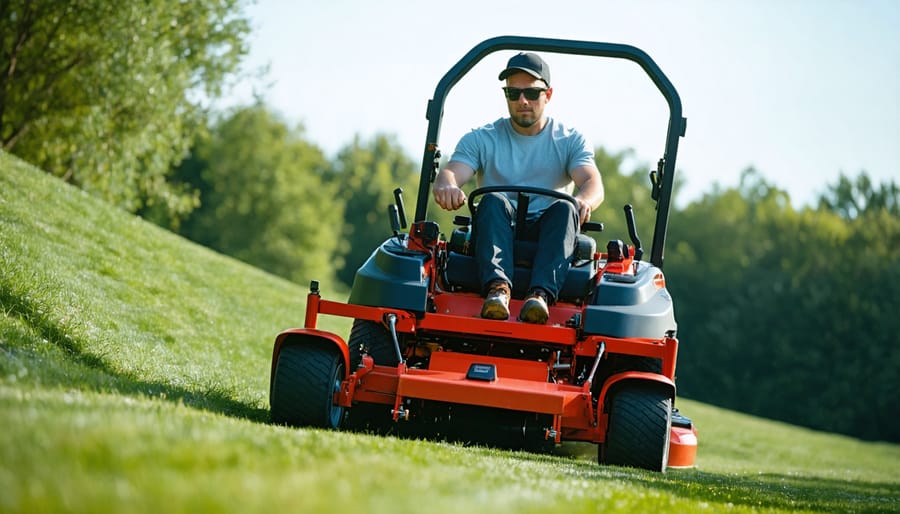
Mowing slopes and hills with a zero turn mower requires extra caution and specific techniques to ensure safety. Always mow up and down slopes rather than across them, as zero turn mowers have a higher center of gravity than traditional lawn tractors. When tackling inclines, maintain a steady, slow speed and avoid sudden movements or sharp turns.
For slopes steeper than 15 degrees, consider finding alternative mowing solutions, as zero turn mowers aren’t designed for severe inclines. Before mowing any hill, check that the ground is dry to prevent slipping, and ensure your tires have good traction. Low tire pressure can significantly reduce grip, so maintain proper inflation levels.
When descending hills, keep the deck engaged and move forward slowly – never mow in reverse down a slope. If you feel the mower becoming unstable, gradually reduce speed and carefully make your way to level ground. Keep your weight centered on the seat and avoid leaning in any direction.
For enhanced stability, some operators add wheel weights or tire chains when mowing slopes. However, these modifications should be used cautiously and according to manufacturer recommendations. Remember that different zero turn models have varying slope capabilities, so always consult your owner’s manual for specific guidelines.
Consider marking hazardous areas or particularly steep sections of your lawn to remind yourself where extra caution is needed. This proactive approach helps maintain safety while ensuring consistent mowing results.
Tight Spaces and Obstacles
One of the biggest advantages of a zero turn mower is its ability to navigate tight spaces with precision. When approaching trees, start by mowing a perimeter circle around the trunk, maintaining a safe distance to protect both the tree and your mower. As you complete the circle, gradually work your way outward in concentric rings until you blend with your main mowing pattern.
For garden beds and landscaping features, take advantage of your mower’s pivot point. Position your mower parallel to the edge, then make small adjustments with your control levers to follow the contours smoothly. Remember to slow down when maneuvering around obstacles – there’s no prize for speed in these delicate areas.
When dealing with multiple obstacles close together, plan your route in advance. Think of it like a maze – identify the most efficient path that minimizes backing up and allows for smooth transitions between spaces. For very tight spots between objects, consider making a single pass, then returning from the opposite direction to catch any missed grass.
Gate passages and narrow pathways require extra attention. Center your mower carefully and move through slowly, keeping your wheels aligned. If a space looks too tight, it probably is – better to finish those areas with a push mower than risk damage to your equipment or property.
Maintenance Tips for Optimal Performance
Before and After Mowing Checks
Before firing up your zero turn mower, a thorough pre-mowing inspection is essential for both safety and performance. Start by checking fuel levels and ensuring your oil is clean and at the proper level. proper tire maintenance is crucial – verify tire pressure is even on both sides to ensure smooth, level cutting.
Inspect your blades for sharpness and damage, as dull blades tear grass rather than cut it cleanly. Check that all safety shields and guards are in place, and test the parking brake and control levers for smooth operation. Clear your lawn of any debris, toys, or obstacles that could damage the mower or become projectiles.
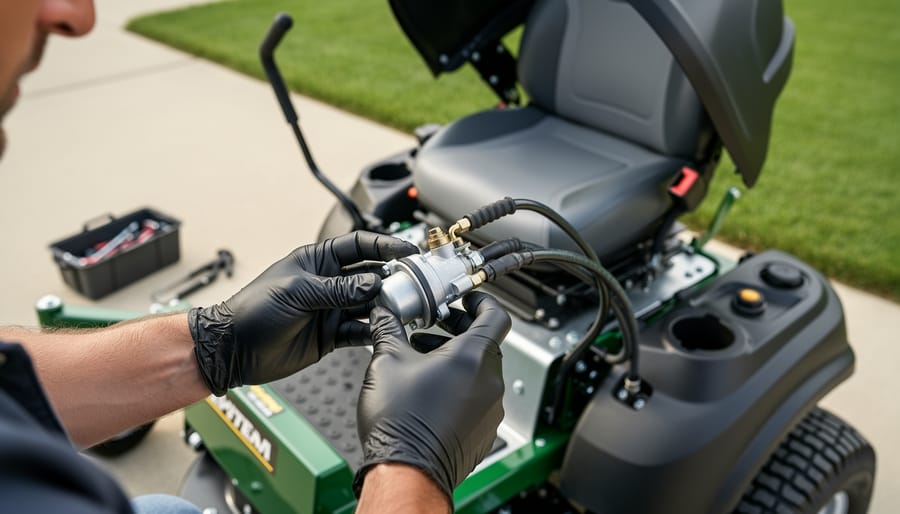
After mowing, take time for post-cut maintenance to extend your mower’s life. Clean grass clippings from the deck, especially around the spindles and belts, to prevent rust and maintain proper airflow. Check for any loose bolts or unusual wear that may have developed during operation. If you noticed any concerning sounds or vibrations while mowing, investigate them immediately rather than waiting for the next use.
Remember to clean or replace the air filter regularly and keep detailed maintenance records. A well-maintained zero turn mower not only performs better but also provides years of reliable service and a consistently beautiful lawn.
Blade Care and Deck Maintenance
Maintaining sharp blades and a clean deck is crucial for achieving those perfectly manicured stripes and promoting healthy grass growth. Start by sharpening mower blades at least twice during the mowing season – you’ll notice the difference immediately in cut quality and reduced strain on your mower’s engine.
Check your blades for signs of wear, bending, or nicks after each mowing session, especially if you’ve hit any obstacles. A good rule of thumb is to sharpen or replace blades after every 25 hours of use. Dull blades tear grass instead of cutting it cleanly, leaving your lawn vulnerable to disease and discoloration.
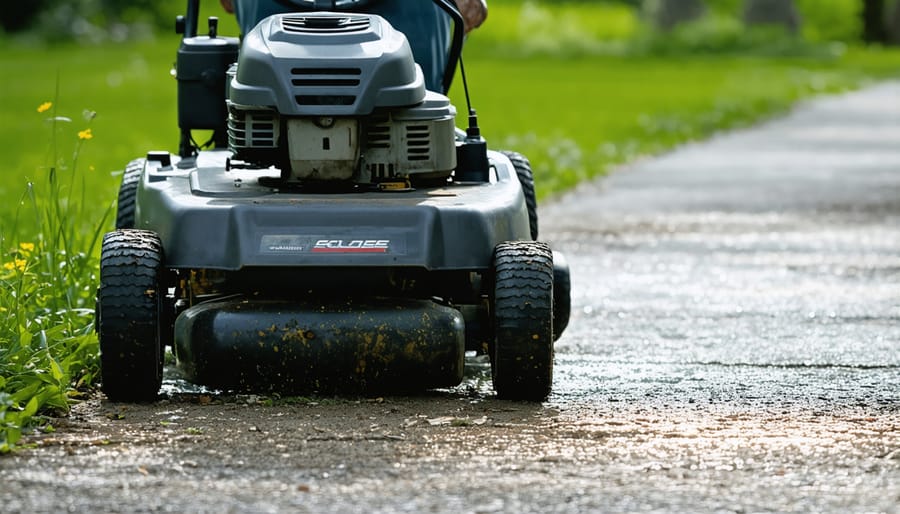
Regular mower cleaning is equally important. After each use, remove grass clippings from the deck to prevent rust and maintain optimal cutting performance. Pay special attention to the underside of the deck where wet clippings can accumulate and harden. A plastic scraper works well for removing stubborn debris without damaging the deck’s surface.
For best results, adjust your deck height according to grass type and season. Keep the deck level by checking and adjusting the deck leveling brackets periodically. This ensures even cuts across your entire lawn and prevents scalping, which can damage both your grass and mower blades.
Mastering zero-turn mowing techniques takes time and practice, but the rewards are well worth the effort. By following proper operating procedures and safety guidelines, you’ll achieve professional-looking results while maintaining your lawn’s health. Remember to always start with slower speeds until you’re comfortable with the controls, and gradually work your way up to more advanced maneuvers.
The key to success lies in maintaining consistent overlap between passes, properly adjusting your speed based on grass conditions, and planning your mowing pattern strategically. Pay special attention to your turning techniques, especially around obstacles and on slopes, to prevent turf damage and ensure your safety.
As you continue to practice these techniques, you’ll develop a natural feel for your zero-turn mower and discover which patterns work best for your specific lawn layout. Don’t forget to regularly maintain your equipment and adjust your cutting height seasonally for optimal grass health.
With dedication to proper technique and a focus on safety, you’ll soon be creating those enviable stripe patterns and maintaining a beautiful, healthy lawn that’s the pride of your neighborhood.