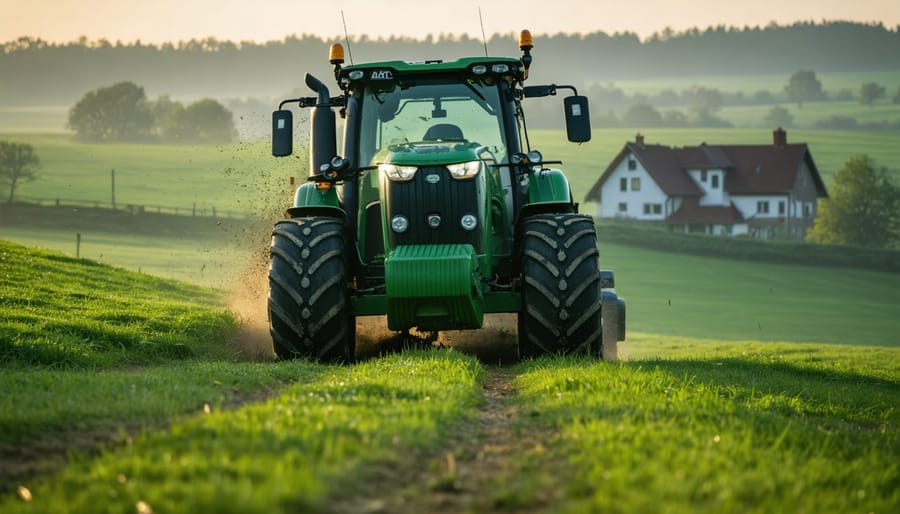
**Evaluate your property’s terrain before investing in a 4WD lawn tractor.** If you’re mowing slopes steeper than 10 degrees, navigating wet conditions regularly, or maintaining several acres with challenging topography, the extra traction could transform your mowing experience from a white-knuckle struggle into confident, efficient work. For flat, dry lawns under two acres, you’re likely paying $1,500-$3,000 extra for capability you’ll rarely use.
Four-wheel drive lawn tractors deliver power to all wheels simultaneously, dramatically increasing grip on hills, muddy patches, and uneven ground where standard two-wheel drive tractors spin helplessly. This isn’t just about convenience—it’s about safety on slopes and access to areas that become off-limits with traditional tractors after rainfall. The technology mirrors what you’d find in 4WD vehicles, using a transfer case to distribute engine power, though lawn tractor systems are specifically engineered for the unique demands of turf maintenance.
The real question isn’t whether 4WD works—it absolutely does—but whether your specific lawn conditions justify the premium price tag and slightly higher fuel consumption. Understanding the genuine performance benefits, recognizing when this feature becomes essential rather than optional, and weighing the trade-offs against your actual mowing challenges will help you make a confident purchasing decision. This guide cuts through marketing hype to deliver honest, practical insights about when 4WD truly matters and when you’re better off saving your money for other lawn care investments.
What Makes a 4WD Lawn Tractor Different
Understanding the difference between 2WD and 4WD lawn tractors is simpler than you might think, and it’s worth knowing before you invest in your next mowing machine.
Most standard lawn tractors use a 2WD system, where power from the engine travels through the transmission to only the rear wheels. The front wheels simply roll along, steered by your input but not contributing any pulling power. This setup works perfectly fine on flat, dry lawns—think of it like most everyday cars on regular roads.
A 4WD lawn tractor, however, sends power to all four wheels simultaneously. Through a series of drive shafts and differentials (mechanical components that allow wheels to turn at different speeds while still receiving power), the engine’s force is distributed evenly across the entire machine. This means every tire is actively gripping and pulling, rather than just two doing all the work while the others tag along.
Here’s where it gets practical for your yard: when you’re dealing with challenging terrain—whether that’s a slope, wet grass, loose soil, or uneven ground—having all four wheels powered makes a remarkable difference. Instead of the rear wheels spinning helplessly while the front wheels sit idle, each tire contributes to moving the tractor forward. It’s the same principle that makes 4WD trucks better at handling rough conditions than their 2WD counterparts.
The engineering behind this capability does add weight and complexity to the machine, which partly explains the higher price tag. But for those managing larger properties with hills, damp areas, or less-than-perfect terrain, that extra mechanical sophistication translates directly into getting the job done without frustration—or getting stuck midway through your mowing session. The power distribution system essentially gives you more traction and control exactly when you need it most.

Real-World Performance Advantages of 4WD Systems
Superior Traction on Hills and Slopes
If your property features slopes, inclines, or uneven terrain, you’ll quickly appreciate what 4WD riding mowers bring to the table. The four-wheel drive system distributes power to all wheels simultaneously, dramatically reducing the risk of wheel slippage that plagues standard two-wheel drive tractors on hills.
When you’re mowing uphill, rear wheels on traditional tractors can lose traction and spin uselessly, leaving you stuck mid-slope. With 4WD, even if one or two wheels encounter a slick patch of wet grass or loose soil, the remaining wheels maintain grip and keep you moving forward safely. This consistent traction means you can tackle inclines with confidence rather than anxiety.
Beyond just getting up the hill, four-wheel drive provides superior control when mowing across slopes or descending. You’ll experience less sliding and drifting, which not only makes the job safer but also delivers a more even, professional-looking cut. For anyone managing hilly terrain regularly, this feature transforms what could be a white-knuckle experience into routine lawn care, while reducing soil compaction and turf damage from spinning wheels.
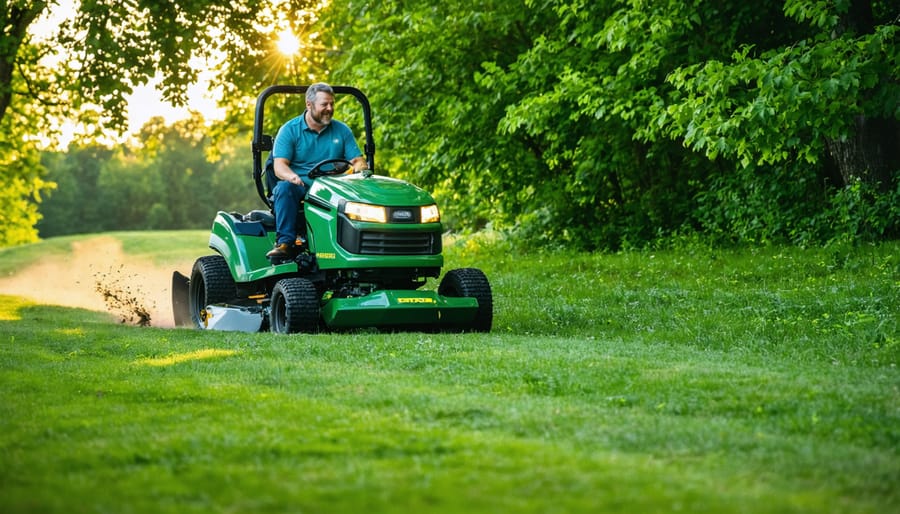
Performance in Wet and Muddy Conditions
If you’ve ever tried mowing after a rainstorm or dealing with those persistently damp, shaded areas of your yard, you know how quickly a regular lawn tractor can turn into a turf-destroying monster. This is where 4WD truly shines. By distributing power evenly across all four wheels, these tractors maintain consistent traction even when the ground is soft or the grass is slippery wet.
Here’s what makes a real difference: without 4WD, your rear wheels might spin helplessly, digging ruts and tearing up your carefully tended lawn. Those muddy tracks not only look terrible, but they also create drainage problems and bare spots that invite weeds. A 4WD system prevents this by ensuring at least some wheels always have grip, allowing you to keep moving forward smoothly without churning up the soil.
I’ve found this particularly valuable in early spring and fall when morning dew is heavy, or if you’re maintaining areas near ponds or natural water features. You can stick to your mowing schedule regardless of conditions, which is crucial for maintaining healthy grass height and preventing those sustainability-damaging scenarios where overgrown grass gets scalped later.
Pulling Power for Attachments and Hauling
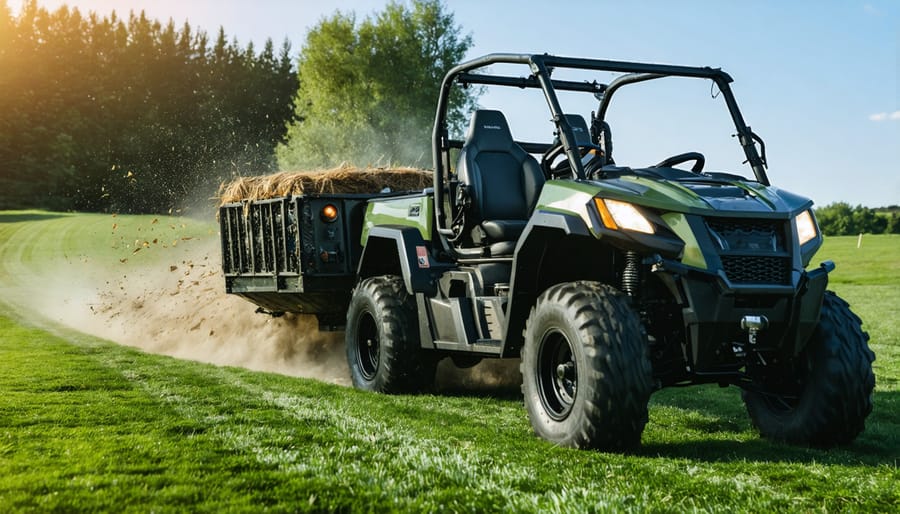
If you’ve ever struggled to pull a loaded cart uphill or watched your tractor’s wheels spin helplessly while operating a heavy aerator, you’ll immediately appreciate what 4WD brings to the table. The enhanced traction means you can confidently haul heavier loads of compost, mulch, or yard waste without worrying about getting stuck or damaging your lawn from wheel spin.
When you’re operating demanding attachments and accessories like dethatchers, aerators, or spreaders, 4WD distributes the pulling force across all four wheels rather than just the rear two. This not only improves efficiency but also reduces soil compaction—a real win for sustainable lawn care. You’ll find that tasks requiring consistent power, like towing a roller for lawn leveling or pulling a utility cart loaded with gardening supplies, become noticeably easier and more predictable with 4WD engaged, especially on slopes or softer ground conditions.
Reduced Turf Damage and Rutting
One of the most frustrating problems with traditional 2WD lawn tractors is the unsightly ruts they leave behind, especially on slopes or damp grass. When your rear wheels lose traction, they spin furiously, tearing up your carefully maintained turf. With 4WD, power distributes evenly across all four wheels, dramatically reducing wheel spin and the resulting damage. This means no more patching torn grass or dealing with muddy tracks after routine mowing. The improved traction also prevents that dreaded scenario where you’re stuck spinning your wheels on a slightly wet hillside, creating deeper ruts as you try to escape. For those committed to maintaining a pristine, healthy lawn while tackling challenging terrain, 4WD offers a genuinely sustainable solution that protects your investment in your landscape.
When You Actually Need 4WD (And When You Don’t)
Property Characteristics That Demand 4WD
Let me be honest with you—not every property needs a 4WD lawn tractor, but certain conditions make it absolutely essential rather than just a nice-to-have feature.
**Slopes are the main game-changer.** If your property includes inclines steeper than 10-15 degrees (roughly 18-27% grade), you’ll quickly discover the limitations of a 2WD system. Here’s a practical test: if you feel your footing slip slightly when walking uphill on wet grass, your tractor will struggle even more. Properties with rolling terrain or hillside sections benefit tremendously from the enhanced traction that 4WD provides, especially during spring when moisture levels are high.
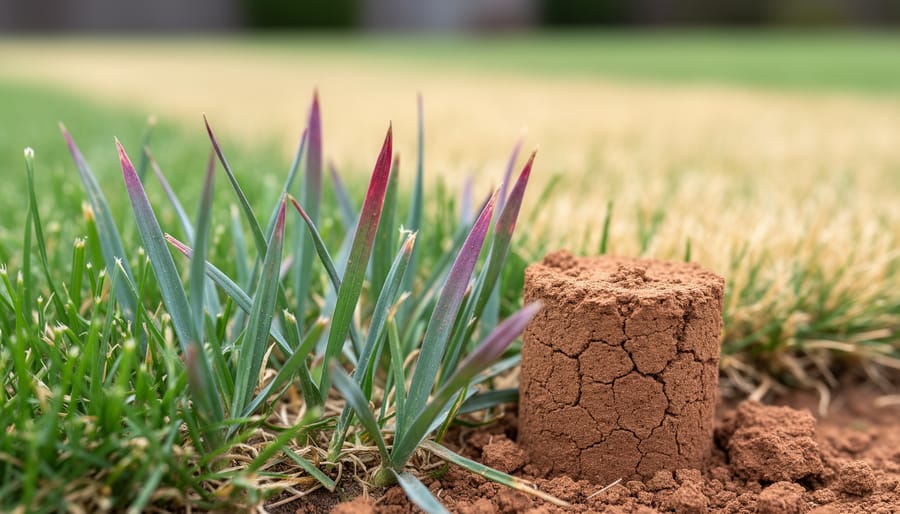
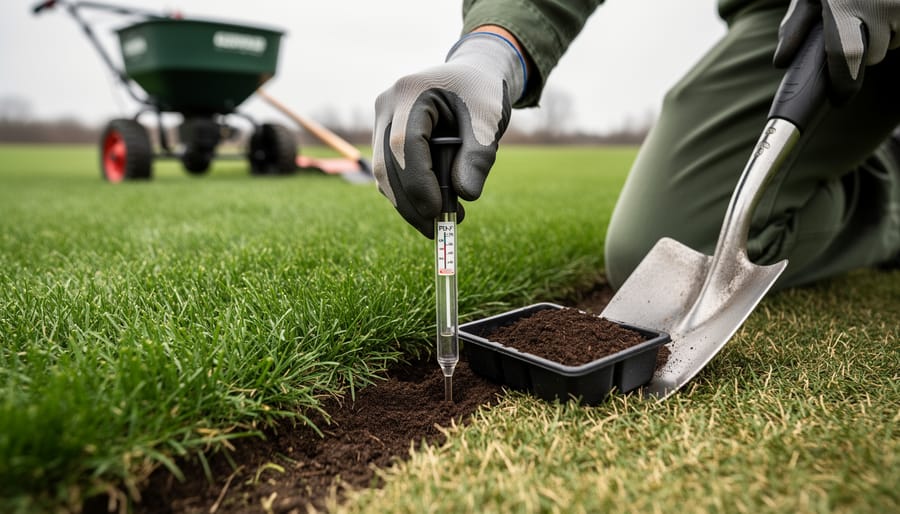
**Soil composition matters significantly.** Clay-heavy soils that retain moisture, sandy areas prone to rutting, or properties with frequent wet spots create challenging conditions where rear wheels alone can’t generate sufficient grip. If you’ve noticed areas where your feet sink slightly or where previous mowing attempts left tire tracks, 4WD becomes necessary.
**Ground obstacles and uneven terrain** also demand consideration. Properties with tree roots near the surface, drainage swales, or naturally undulating landscapes require consistent power distribution to all wheels. The same applies if you’re maintaining larger acreage (typically over two acres) with varied conditions throughout.
**Weather patterns** in your region play a role too. Areas with frequent rain, morning dew that lingers, or properties with shaded sections that stay damp benefit from 4WD’s reliable traction, making lawn care less dependent on perfect weather windows.
When Standard 2WD Is Perfectly Adequate
If you’re fortunate enough to have a flat, well-maintained lawn without significant slopes or challenging terrain, a standard 2WD lawn tractor will likely serve you beautifully—and save you a considerable chunk of change in the process. Let’s be honest: not every property needs the extra muscle that 4WD provides.
For properties under two acres with gentle, even terrain and established grass coverage, a quality 2WD tractor handles routine mowing with ease. These machines excel on level ground, especially when you’ve invested time in maintaining consistent soil conditions and drainage. If you’re debating between different mower types altogether, you might find our comparison of lawn tractor vs zero turn helpful for understanding your options.
The beauty of sticking with 2WD in suitable conditions is the practical advantages it offers. You’ll enjoy simpler maintenance, fewer mechanical components that could need servicing, and better fuel efficiency—a win for both your wallet and sustainability goals. The lighter weight also means less soil compaction, which is gentler on your lawn’s root system and promotes healthier grass growth over time.
Consider your actual mowing conditions honestly. Do you regularly encounter wet grass, steep inclines, or loose terrain? If not, investing the extra $800-$1,500 for 4WD capability might be unnecessary. That money could instead go toward quality attachments, better blades, or building a rain barrel system for more sustainable lawn irrigation. Sometimes the most practical solution is the simplest one.
The Trade-Offs: What You Give Up with 4WD
Before you fall in love with the idea of a 4WD lawn tractor, let’s have an honest conversation about what you’re signing up for. Like choosing between a sedan and an SUV, there are real trade-offs to consider, and understanding them now will help you make a decision you’ll be happy with for years to come.
**The Price Premium**
Here’s the reality: 4WD systems typically add $1,000 to $3,000 to your tractor’s price tag. That’s not pocket change for most of us! You’re paying for additional drivetrain components, more sophisticated engineering, and enhanced capabilities. If you’re working with a tight budget and have relatively flat terrain, that money might serve you better elsewhere—perhaps toward a mulching kit, a trailer attachment, or even professional landscape design for those tricky slopes.
**Thirstier at the Pump**
Four-wheel drive systems require more power to operate, which translates directly to increased fuel consumption. Expect to use about 10-20% more gas compared to a 2WD model doing similar work. For environmentally conscious gardeners, this is worth weighing carefully. The extra fuel isn’t just an expense—it’s also a larger carbon footprint.
**Maintenance Complexity**
More moving parts mean more maintenance points. The front axle differential, additional U-joints, and extra drivetrain components all need regular attention. You’ll spend more time on upkeep and potentially face higher repair costs down the road. Not all local repair shops are equipped to service 4WD systems either, which could mean longer waits or traveling farther for service.
**The Weight Factor**
4WD tractors are considerably heavier due to the extra mechanical components. This increased tractor weight can actually work against you on delicate turf or in tight spaces. You might find yourself creating ruts in wet conditions or struggling with nimble turns around flower beds and ornamental features. The added bulk also makes them harder to maneuver into storage spaces.
Top 4WD Lawn Tractor Models Worth Considering
Choosing the right 4WD lawn tractor depends on your property’s challenges and budget. Here are four models that consistently deliver reliable performance across different price ranges.
**Cub Cadet XT2 LX46 (Mid-Range Champion)**: This model hits the sweet spot for homeowners with 1-3 acres of moderately sloped terrain. Its hydrostatic transmission and tight turning radius make navigating around flower beds effortless, while the 4WD system confidently tackles wet morning grass without leaving ruts. The 46-inch deck strikes a nice balance between maneuverability and efficiency. Best for those with mixed terrain who value versatility over raw power.
**John Deere X590 (Premium Performance)**: If you’re managing larger properties with significant slopes, this tractor justifies its higher price tag. The power steering feels responsive, and the 4WD traction is exceptionally smooth when climbing hills or working in less-than-ideal conditions. Its heavier build means better stability on uneven ground. Ideal for serious property maintenance where durability matters.
**Husqvarna YTH24V48 (Budget-Friendly Option)**: For gardeners wanting 4WD capability without breaking the bank, this model delivers honest performance. While it lacks some premium features, the 4WD system works reliably on gentle to moderate slopes. Perfect for those transitioning from 2WD who want to test the waters without a major investment.
**Craftsman T310 (Best for Small Hills)**: This compact option excels in suburban yards with challenging drainage or mild inclines. The smaller deck makes it nimble around established gardens, and the 4WD provides confidence on dewy slopes. Great for sustainability-minded homeowners maintaining pollinator gardens alongside their lawns, as its precise handling minimizes accidental damage to planted areas.
Maintenance Tips for 4WD Systems
Keeping your 4WD lawn tractor running smoothly doesn’t require a mechanic’s expertise—just a little regular attention goes a long way. Think of it like caring for your garden: consistent maintenance yields the best results.
Start by checking your drivetrain components regularly, especially after working in challenging conditions. Mud, grass clippings, and debris love to accumulate around axles and differential housings, potentially causing premature wear. A simple rinse with water and a brush after muddy sessions prevents buildup—just avoid high-pressure sprayers that can force water into sealed components.
Lubrication is your 4WD system’s best friend. Follow your manufacturer’s schedule for greasing universal joints and checking differential fluid levels. Most 4WD tractors need differential oil changes every 100-200 hours of operation. Using biodegradable lubricants when possible reduces environmental impact without compromising performance.
Pay attention to unusual sounds—grinding, clicking, or whining often signals issues before they become expensive repairs. Engage your 4WD regularly, even during easy mowing sessions, to keep components moving and prevent seals from drying out.
Tire pressure matters more with 4WD than you might think. Uneven pressure creates unnecessary strain on the drivetrain. Keep all tires inflated to manufacturer specifications and replace them in sets to maintain balanced power distribution.
Store your tractor on level ground during off-season, and if possible, engage the 4WD briefly every few weeks to circulate fluids. This small habit prevents components from seizing and extends your investment’s lifespan considerably.
Choosing a 4WD lawn tractor isn’t a decision to take lightly, but for the right property, it’s an investment that pays dividends season after season. If your lawn features significant slopes, frequently damp areas, or challenging terrain that makes you nervous on a standard tractor, four-wheel drive delivers genuine peace of mind and practical performance benefits. The enhanced traction means you’ll spend less time spinning wheels and more time actually caring for your lawn—a win for both efficiency and your soil health.
However, honesty is your best guide here. If your property is mostly flat and well-drained, you’ll likely be paying for capability you won’t use regularly. Take a realistic walk around your yard in different weather conditions. Where do you struggle with traction? Are there slopes that feel unsafe? Do spring and fall leave sections perpetually muddy?
Your answers to these questions matter more than any sales pitch. The most sustainable choice is the one that matches your actual needs—preventing future purchases, reducing frustration, and helping you maintain your property effectively for years to come. A well-chosen tractor, whether 4WD or not, becomes a trusted partner in your lawn care journey.