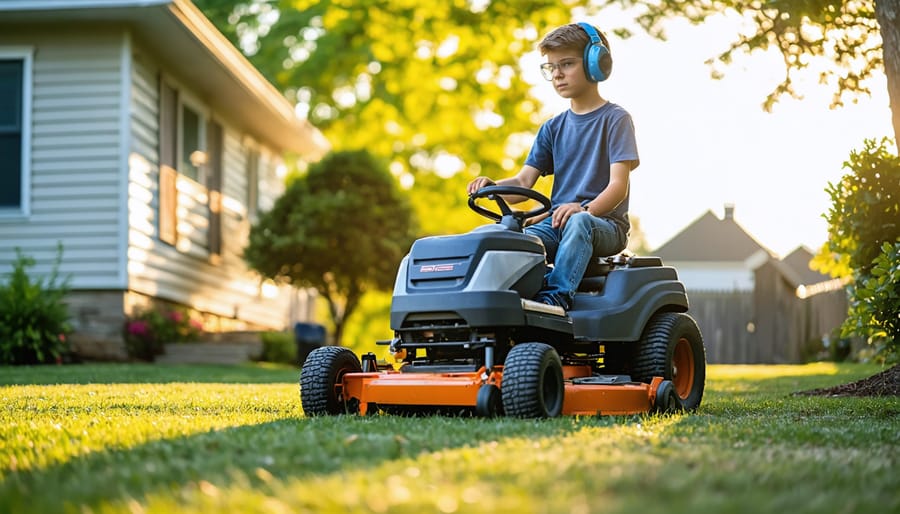
**Understand that no federal law dictates riding lawn mower age restrictions, but the American Academy of Pediatrics and Consumer Product Safety Commission firmly recommend children be at least 16 years old to operate riding mowers.** This isn’t arbitrary—every year, thousands of children suffer severe injuries from lawn mower accidents, including amputations, burns, and crushing injuries that can change lives forever.
**Recognize that a riding mower is essentially a small vehicle with sharp rotating blades spinning at 200+ mph beneath the deck.** Your child needs the physical strength to control steering and braking, the cognitive ability to anticipate hazards like slopes and hidden objects, and the judgment to stop immediately when something goes wrong. Most children under 16 simply haven’t developed these capabilities fully, regardless of how mature they seem.
**Evaluate your specific mower’s features before making any decisions.** Zero-turn mowers demand exceptional coordination and spatial awareness. Standard riding mowers with automatic transmissions are more forgiving but still require significant responsibility. Consider your yard’s terrain too—flat, open lawns present fewer challenges than properties with slopes, water features, or multiple obstacles.
**Start teenagers with supervised practice sessions in controlled areas, teaching them pre-operation safety checks, emergency shut-off procedures, and proper mowing patterns before allowing independent operation.** Even at 16, maturity varies considerably between individuals. Your best judgment as a parent, combined with professional recommendations, should guide your final decision about when your teen is truly ready for this responsibility.
Why Age Matters When Operating Riding Mowers
The Physical Demands of Riding Mower Operation
Operating a riding mower isn’t quite like steering a toy car around the yard—it demands real physical capability and mental sharpness. Let’s talk about what it actually takes to handle one of these machines safely.
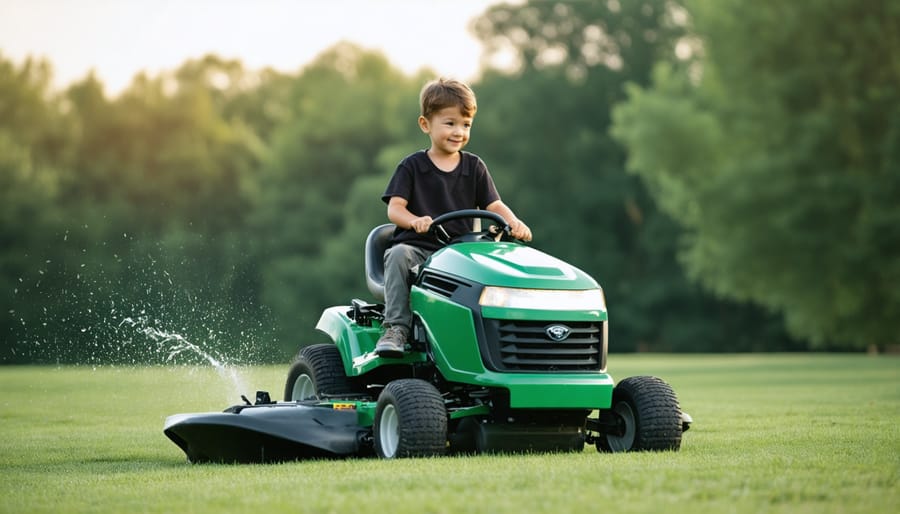
First, there’s the matter of strength. Your child needs enough leg power to firmly press the brake pedal and enough upper body strength to control the steering wheel, especially when navigating slopes or making tight turns around garden beds. These aren’t power-assisted like modern cars; they require genuine muscle engagement.
Coordination is equally critical. Operating a riding mower means simultaneously managing the steering, speed controls, brake, and blade engagement while watching for obstacles—tree roots, garden decorations, or that favorite soccer ball hiding in tall grass. It’s a multitasking challenge that requires developed motor skills.
Reaction time matters tremendously too. When a pet dashes across the lawn or a branch suddenly falls, the operator needs to respond instantly. Younger children simply don’t have the neurological development for these split-second decisions.
Physical maturity also affects reach and visibility. The operator must comfortably reach all controls while maintaining clear sightlines around the mower deck—a challenge when legs and torsos are still growing.
Understanding Risk: What Can Go Wrong
Riding lawn mowers are powerful machines that make yard work more efficient, but they deserve our respect and careful attention. Each year, thousands of accidents occur involving riding mowers, with children and teens representing a significant portion of these incidents. Understanding what can go wrong helps us make informed decisions about when our kids are truly ready.
The most common accidents involve rollovers on slopes, collisions with obstacles, and injuries from the mower’s cutting deck. Younger operators face higher risks not because they lack good intentions, but because they’re still developing crucial skills. Their ability to judge distances, anticipate hazards, and react quickly in unexpected situations continues maturing well into their teenage years. Physical strength matters too—controlling a machine that can weigh 400 pounds or more requires muscle development that comes with age.
Visibility challenges create another layer of risk. Many riding mowers have blind spots, and smaller operators may struggle to see over the hood or gauge their turning radius accurately. Add in the distraction factor—let’s face it, kids are still learning impulse control—and the potential for accidents increases significantly.
This isn’t about fear-mongering; it’s about realistic assessment. Just as we wouldn’t hand car keys to a child who can’t reach the pedals, we need to ensure young mower operators have the physical size, mental maturity, and judgment necessary to handle these powerful machines safely and responsibly.
Official Age Guidelines and Legal Considerations
What Manufacturers Recommend
Most major riding mower brands recommend a minimum operator age of 16 years old, aligning with guidelines from safety organizations. John Deere, Cub Cadet, and Husqvarna all emphasize this threshold in their operator manuals, and there’s solid reasoning behind it.
These manufacturers base their recommendations on cognitive development, physical strength requirements, and the maturity needed for split-second safety decisions. Operating a riding mower demands simultaneous attention to steering, blade engagement, speed control, and environmental awareness—skills that typically develop fully in mid-teens.
Beyond age, manufacturers stress that operator readiness matters more than a specific birthday. They consider factors like the ability to reach all controls comfortably, understand safety warnings, and demonstrate responsible judgment. Many brands suggest supervised practice sessions before independent operation, even for teens who meet the age requirement.
It’s worth noting that these are manufacturer recommendations, not legal requirements in most areas. However, following them helps ensure your young operator’s safety while protecting your warranty coverage. Think of these guidelines as your starting point—a baseline built on decades of safety research and real-world experience.
Safety Organization Standards
When it comes to keeping our young gardeners safe around power equipment, several trusted organizations have established clear guidelines that every parent should know. The Consumer Product Safety Commission (CPSC) sets the bar high, recommending that children under 12 should never operate walk-behind mowers, while those under 16 should avoid riding mowers altogether. These aren’t arbitrary numbers—they’re based on decades of accident data and child development research.
The American National Standards Institute (ANSI) echoes these recommendations in their safety standards for outdoor power equipment. They emphasize that operating a riding mower requires more than just reaching the pedals—it demands quick decision-making, sustained attention, and the physical strength to control a machine that can weigh over 400 pounds.
The Outdoor Power Equipment Institute (OPEI) takes it a step further, stressing that even when teens reach the recommended age, proper training is non-negotiable. They advocate for supervised practice sessions and a thorough understanding of the specific mower model before any independent operation.
These guidelines aren’t meant to dampen anyone’s enthusiasm for lawn care—they’re here to ensure that when young people do start mowing, they’re truly ready to handle the responsibility safely and confidently.
Safety Features That Make a Difference for Younger Operators
Operator Presence Controls and Kill Switches
Modern riding mowers come equipped with operator presence controls (OPCs) that automatically shut off the blades or engine when the operator leaves the seat—and these features are absolute lifesavers, especially for younger or less experienced users. Think of them as your mower’s built-in safety net.
Here’s how they work: sensors detect when you stand up or shift your weight off the seat, instantly disengaging the cutting blades within seconds. Many models also include kill switches on the control panel that let you immediately stop all operations with one quick motion. Some mowers even require you to engage a brake or clutch before the engine will start—preventing accidental roll-aways.
For teens and beginners, these automatic shut-offs provide crucial protection against common mistakes like standing up while blades are spinning or forgetting to disengage equipment before dismounting. They’re designed to compensate for the split-second lapses in judgment that happen when you’re still learning.
When introducing a young person to mower operation, make sure these safety features are functioning properly before each use. Test the seat sensor by starting the mower and briefly standing—the blades should stop immediately. These mechanisms aren’t foolproof, but they significantly reduce injury risk while building confidence and good habits.
Speed Limiters and Transmission Controls
Modern riding mowers come with various speed and transmission options that directly impact how easily a young operator can maintain control. Think of it like learning to drive—you wouldn’t start someone in a sports car! Speed limiters are fantastic safety features that let you cap maximum speeds, typically ranging from 3 to 8 mph. This gives younger or less experienced operators time to react to obstacles like garden beds, trees, or uneven terrain without feeling overwhelmed.
Transmission types matter too. Automatic transmissions are generally more forgiving for beginners, requiring less coordination and allowing them to focus on steering and awareness. Manual or hydrostatic transmissions offer more precision but demand greater skill and multitasking ability. For teens just starting out, an automatic transmission paired with a speed limiter creates a gentler learning curve.
Here’s a practical tip: start young operators at the lowest speed setting in an open area free of obstacles. As their confidence and spatial awareness grow, you can gradually increase speeds. This patient, progressive approach builds competence while prioritizing safety—and helps protect your carefully maintained lawn from those inevitable rookie mistakes we’ve all made!
Visibility, Stability, and Ergonomic Design
When you’re evaluating whether someone is ready to operate a riding mower, the machine’s physical design plays a crucial role that goes beyond just skill level. Think of it this way: a riding mower designed for adults wasn’t built with smaller operators in mind, and that creates real safety challenges.
The seat height and positioning matter tremendously. Younger or smaller operators who can’t firmly plant both feet on the deck while seated have trouble with stability and quick reactions. If their feet are dangling or barely touching, they’ll struggle to maintain balance during turns or when navigating slopes. Similarly, visibility becomes compromised when an operator can’t see clearly over the steering wheel or around the mower deck—those blind spots become serious hazards.
Center of gravity is another critical factor that varies significantly between operators of different sizes. Lighter, smaller individuals may find it harder to counterbalance the machine on uneven terrain, increasing rollover risk. The ergonomic placement of controls—pedals, steering, and safety switches—assumes a certain reach and strength. When operators strain to access these controls or can’t engage them fully, their response time suffers exactly when they need it most.
This is why age recommendations aren’t arbitrary—they account for typical physical development that matches the mower’s design requirements, ensuring operators can safely handle the machine while maintaining full control and awareness.
Matching Mower Complexity to Operator Experience
Entry-Level vs. Professional-Grade Features
Understanding the difference between residential and commercial mowers is crucial when considering age-appropriate operation. Entry-level riding mowers designed for home use typically feature straightforward controls, automatic transmissions, and smaller cutting decks—making them more manageable for younger, less experienced operators. These machines usually have slower maximum speeds and simpler maintenance requirements, which means teens around 16 can often handle them safely with proper training.
Professional-grade machines, however, are a different story entirely. Commercial mowers feature higher horsepower engines, wider cutting decks (sometimes exceeding 60 inches), manual or more complex hydrostatic transmissions, and significantly greater speeds. They’re built for efficiency and extended use, but this power comes with increased responsibility. The controls require more finesse, the turning radius demands better spatial awareness, and the overall weight makes them less forgiving of operator errors.
From a practical standpoint, think of it like driving: you wouldn’t put a new driver behind an 18-wheeler. Similarly, even a mature 16-year-old ready for a residential mower may need several more years of experience before tackling commercial equipment. This progression approach supports both safety and skill development while maintaining your lawn care sustainability goals.
Zero-Turn vs. Traditional Steering Systems
Understanding the differences between zero-turn versus traditional mowers is crucial when considering age-appropriate equipment for young operators. Here’s what makes these systems so different from a safety perspective.
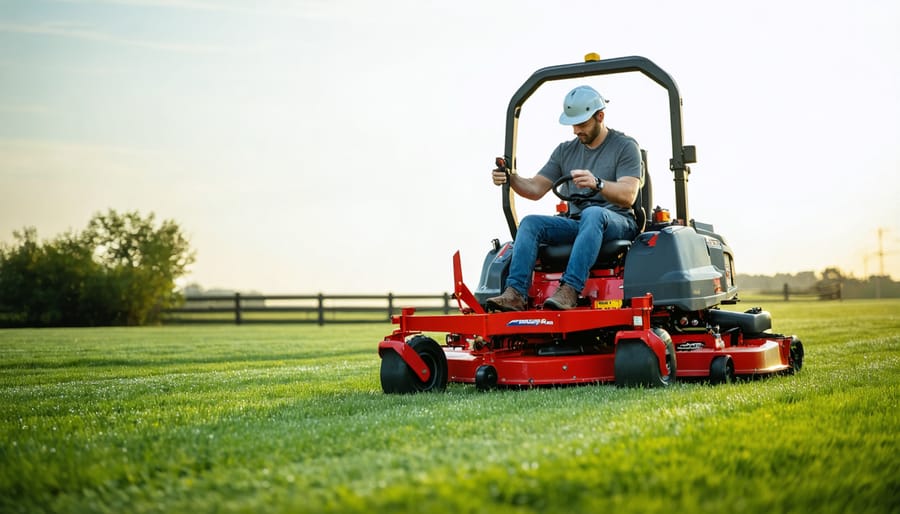
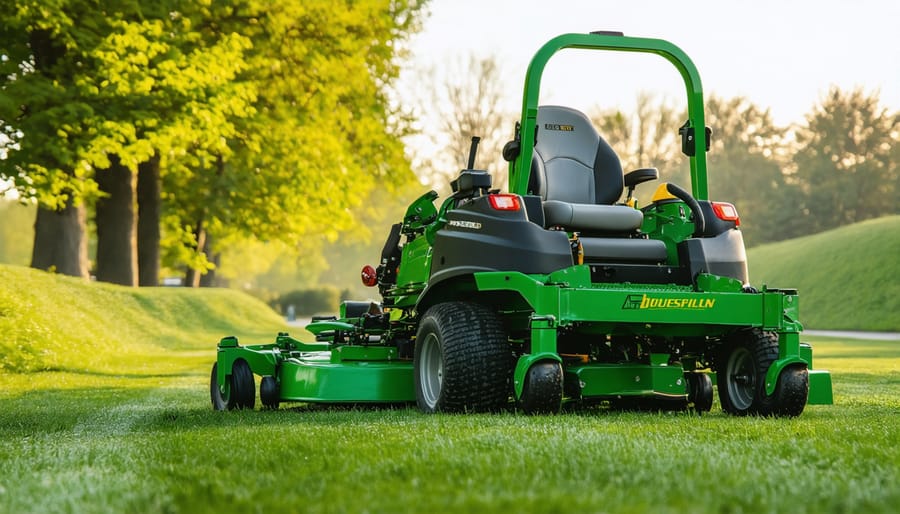
Zero-turn mowers use independent lever controls for each rear wheel, allowing incredible maneuverability but requiring significantly more coordination and spatial awareness. Think of it like the difference between driving a car and piloting a helicopter—zero-turns demand constant attention and quick reflexes. A momentary distraction or overcorrection can send the mower spinning unexpectedly, creating potential safety hazards near obstacles, slopes, or property edges.
Traditional steering systems, with their familiar steering wheel design, offer more intuitive control for younger operators. The gradual turning radius provides more time to react and correct course, making them a practical choice for teens just learning mower operation. They’re also more forgiving on uneven terrain, reducing the risk of losing control.
For most families, starting young operators on traditional steering lawn tractors around age 12-14 makes sense, while reserving zero-turn operation for more mature teens (16+) who’ve demonstrated responsibility and coordination with simpler equipment first.
Preparing Young Operators for Safe Mowing
The Supervised Learning Approach
Teaching a responsible teen to operate a riding mower isn’t something that happens overnight—think of it as similar to teaching them to drive. Start by having them observe you from a safe distance, explaining each step as you mow: how you check the area for hazards, adjust the cutting height, and navigate around obstacles. This builds understanding before they ever touch the controls.
Next, practice sessions in a controlled environment work wonders. Choose a flat, open section of your lawn free from trees, rocks, or slopes. Let them sit beside you first, then progress to hands-on operation with you standing nearby, ready to guide them. Keep initial sessions short—15 to 20 minutes—to prevent fatigue, which can lead to mistakes.
As their confidence grows, introduce more challenging terrain gradually. Always maintain clear communication, and never rush the process. Each teen learns at their own pace, and that’s perfectly okay. Set clear rules about weather conditions (no wet grass!), appropriate footwear, and when they can operate independently.
Remember, this supervised approach not only builds competence but also instills respect for the equipment and responsibility for lawn care—skills they’ll carry forward as they maintain sustainable, healthy outdoor spaces.
Safety Gear and Pre-Operation Checklists
Before any young person takes the wheel of a riding mower, let’s talk about gearing up properly and developing good habits that’ll last a lifetime. Think of this as building a foundation for responsible lawn care—skills that grow alongside your garden!
**Essential Safety Gear**
Start with the basics: sturdy closed-toe shoes with good traction (flip-flops are absolutely off-limits!), long pants to protect against flying debris, and safety glasses or goggles. Ear protection is often overlooked but crucial—riding mowers can reach 85-90 decibels, and protecting young ears matters. A dust mask helps on dry, dusty days, making the experience more comfortable while keeping airways clear.
**Pre-Operation Checklist**
Teaching young operators a solid pre-mow routine builds responsibility and prevents accidents. Walk around the mower checking for loose parts, damaged blades, or fluid leaks. Clear the lawn of sticks, toys, rocks, and other hazards—this protects both the mower and bystanders. Check tire pressure, fuel levels, and ensure all safety features like blade guards are intact. Make sure the parking brake engages properly.
This checklist isn’t busywork—it’s about developing the mindful awareness that separates responsible operators from accidents waiting to happen. When kids master these habits early, they’re learning sustainable equipment care that extends mower life and reduces environmental impact.
Sustainable and Responsible Lawn Care Alternatives
Age-Appropriate Lawn Care Tasks
While your younger family members may not be ready for riding mowers yet, there are plenty of meaningful ways they can contribute to lawn care that build skills and responsibility. For teens aged 12-15, a well-maintained push mower can be an excellent starting point—it teaches the fundamentals of mowing patterns and safety awareness without the complexity of motorized steering. Just ensure they’re physically capable of controlling the equipment and always provide proper supervision.
Younger children can tackle essential gardening tasks that support your lawn’s overall health. Raking leaves, pulling weeds, and spreading mulch are sustainable practices that reduce chemical dependency while teaching patience and attention to detail. Kids aged 8-11 often enjoy watering duties with a hose or sprinkler system, learning about proper irrigation techniques that conserve water. They can also help with edging walkways using manual tools, creating those crisp lines that make lawns look professionally maintained.
Consider assigning age-appropriate tasks seasonally—collecting grass clippings for composting in summer, gathering fallen branches in fall, or spreading grass seed in spring. These activities foster environmental stewardship while gradually building the judgment and physical coordination needed for more advanced equipment later. Remember, lawn care is a progression, not a race.
Considering Electric and Battery-Powered Options
Modern electric battery-powered options are reshaping the conversation around youth and mower operation. These quieter machines eliminate fumes and significantly reduce noise pollution—making them less intimidating for younger operators while creating a more pleasant learning environment. Electric riding mowers typically feature simpler controls with fewer moving parts, which can make them easier for teens to master. The instant torque response gives new operators more predictable handling, while automatic shutoff features add extra safety layers. From a sustainability perspective, they’re excellent teaching tools for environmental stewardship. However, remember that their weight and power still demand the same maturity level and physical capability as traditional mowers. The reduced complexity doesn’t eliminate the need for proper training, supervision, and adherence to age guidelines—it simply offers a cleaner, potentially safer entry point for responsible young operators ready to take on lawn care duties.
Deciding when your teen is ready to operate a riding lawn mower isn’t just about hitting a magic number—it’s about thoughtfully assessing their maturity, physical capabilities, and readiness to handle this responsibility. While the general recommendation is 16 years or older, you know your child best. Take time to evaluate whether they can follow safety protocols consistently, demonstrate good judgment under pressure, and show genuine respect for the equipment’s power.
Remember, teaching proper lawn care skills is an investment in your teen’s future self-sufficiency and connection to sustainable outdoor practices. Start with thorough training on your specific mower model, supervise initial sessions closely, and gradually increase independence as they prove their competence. Don’t rush the process—safety should always come first, even if it means waiting another season.
By prioritizing comprehensive education over convenience, you’re not just preventing accidents; you’re fostering a lifelong appreciation for responsible lawn stewardship. Every safe mowing session builds confidence and develops practical skills that will serve them well into adulthood. Trust your instincts, invest in proper training, and celebrate each milestone as your teen grows into a capable, safety-conscious lawn care practitioner.