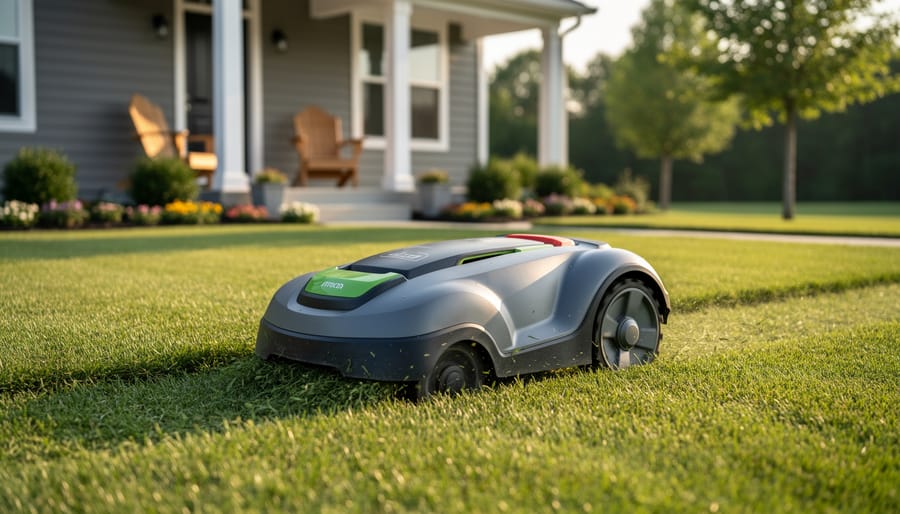
Picture this: You’re sipping iced tea on your porch while a compact machine quietly glides across your lawn, trimming grass to perfection without you lifting a finger. Electric robotic lawnmowers have transformed from futuristic novelty to practical reality, offering homeowners a genuine alternative to weekend mowing sessions. These autonomous helpers promise more than convenience—they deliver consistent lawn care while eliminating gas fumes, reducing noise pollution, and freeing up your weekends for actually enjoying your yard.
But separating marketing hype from real-world performance requires understanding what these machines can genuinely accomplish. Not every robotic mower suits every lawn, and the investment ranging from a few hundred to several thousand dollars demands careful consideration. Some models excel on small, flat yards while struggling with slopes or complex landscapes. Others handle obstacles with surprising intelligence but require specific boundary wire installations that take time to set up properly.
This guide cuts through manufacturer claims to examine how electric robotic lawnmowers actually perform in diverse conditions. We’ll explore which models deliver reliable cutting, how installation complexity varies between brands, what maintenance these machines truly require, and whether their environmental benefits justify the upfront cost. Whether you’re managing a compact suburban lot or a sprawling garden space, you’ll discover which robotic mowers earn their place in responsible, sustainable lawn care—and which fall short of their promises.
How Electric Robotic Lawnmowers Really Work
If you’ve ever wondered how these autonomous helpers quietly maintain your lawn while you sip lemonade on the porch, you’re not alone. The technology behind electric robotic lawnmowers is surprisingly elegant once you understand the basics.
At their core, these machines operate on rechargeable lithium-ion batteries, similar to what powers your smartphone but considerably larger. When the battery runs low, the mower automatically returns to its charging station, plugs itself in, and heads back out once recharged. This makes them incredibly convenient compared to traditional battery-powered mowers that require manual intervention.
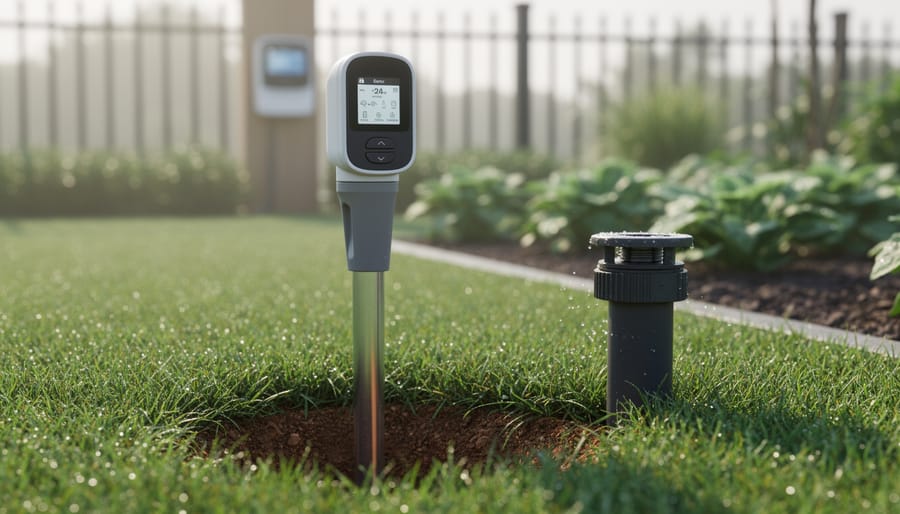
Most robotic mowers use one of two navigation systems. The traditional approach involves a boundary wire that you install around your lawn’s perimeter and around obstacles like flower beds. The mower detects this wire’s signal and knows to stay within bounds. It’s like an invisible fence that keeps your mower exactly where it should be. Installation takes a few hours initially, but once it’s set, you’re good to go.
Newer models employ GPS navigation and sophisticated mapping technology, eliminating the need for boundary wires entirely. These smart mowers learn your lawn’s layout, creating efficient mowing patterns that ensure complete coverage without redundant passes.
Collision and lift sensors provide crucial safety features. If the mower encounters an unexpected obstacle, it gently backs away and changes direction. If lifted off the ground, the blades immediately stop spinning, protecting curious pets and children.
The cutting mechanism itself differs from traditional mowers. Robotic models use small, sharp blades that continuously trim tiny amounts of grass, following the mulching principle. These frequent, light cuts keep your lawn at the perfect height while returning nutrient-rich clippings to nourish the soil.
From a sustainability perspective, electric robotic mowers shine brightly. They produce zero emissions during operation, run quieter than gas alternatives, and their efficient cutting pattern actually reduces overall energy consumption compared to weekly sessions with conventional mowers.
The Honest Truth About What They Can (and Can’t) Handle
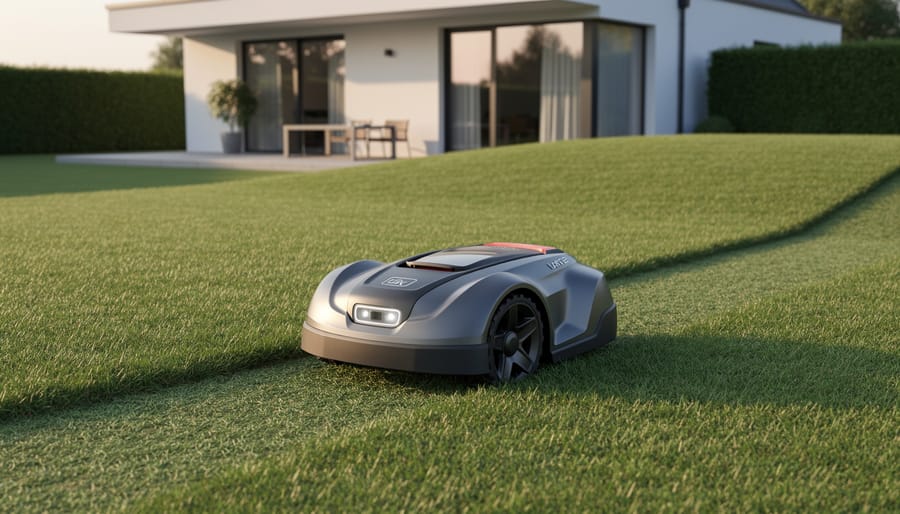
Let’s be straight with you: robotic mowers are impressive, but they’re not miracle workers. Understanding their real-world limitations will save you from buyer’s remorse and help you make a smart decision for your lawn.
Most robotic mowers handle lawns up to half an acre quite well, though premium models can tackle up to 1.25 acres. If you’ve got a sprawling estate, you might need multiple units or should stick with traditional riding mowers. They’re eco-friendly champions for average suburban yards, but there’s no shame in admitting if your property exceeds their sweet spot.
Terrain is where things get interesting. Gentle slopes up to 20 degrees? No problem. But if your lawn resembles a roller coaster with steep inclines or drops, robotic mowers will struggle. They handle challenging terrain differently than traditional equipment, so those dramatic hills might be a deal-breaker.
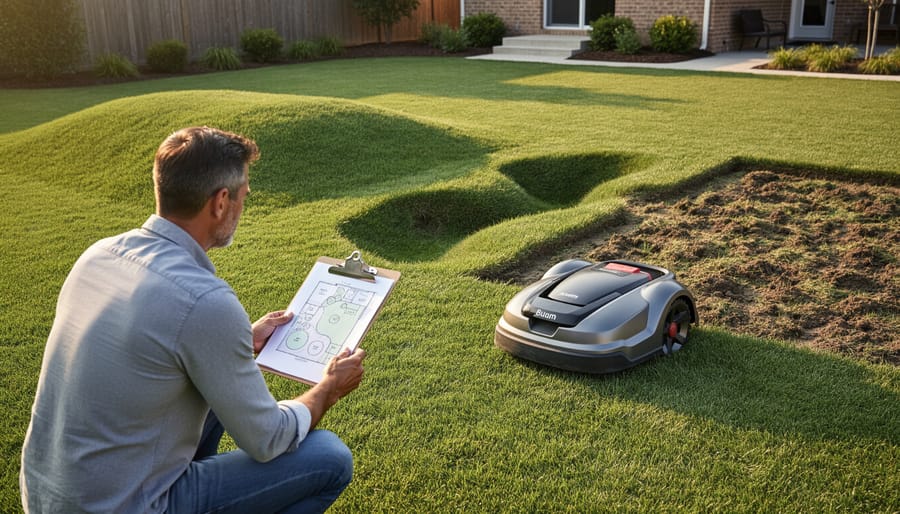
Obstacles require planning too. These smart machines navigate around trees, flowerbeds, and garden features beautifully once you’ve set boundary wires. However, they’re not great with constantly changing obstacles like toys, sticks, or hoses left on the lawn. You’ll need to maintain a relatively clear cutting area.
Weather-wise, most models handle light rain, but heavy downpours send them back to their charging stations. That’s actually good news for your grass and soil health. Extreme heat doesn’t faze them, making them perfect for summer sustainability.
Grass types matter less than you’d think. These mowers excel with cool-season and warm-season varieties alike, though they work best keeping grass at optimal heights rather than tackling overgrown jungles. Regular maintenance schedules suit them perfectly.
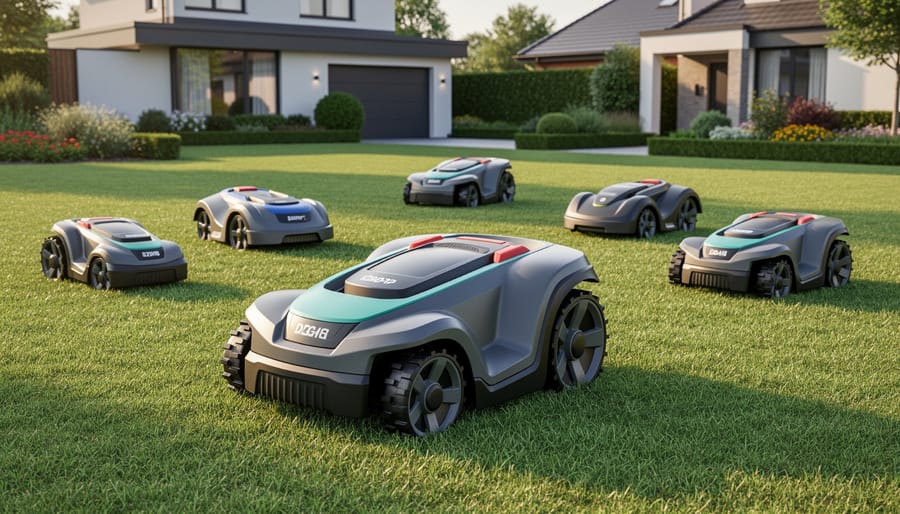
Top Electric Robotic Lawnmowers We’ve Tested
Best for Small to Medium Lawns (Up to 0.5 Acres)
For most homeowners with typical residential lawns, a robotic mower designed for up to half an acre offers the perfect balance of capability, affordability, and simplicity. These models are particularly appealing if you’re new to automated lawn care, as they require minimal technical knowledge and deliver consistently excellent results without the complexity of larger systems.
The Worx Landroid M 20V stands out as an exceptional choice for beginners who want reliable performance without breaking the bank. This compact workhorse handles lawns up to 0.25 acres with impressive efficiency, navigating narrow passages as slim as 2 feet with ease. What makes it particularly user-friendly is the intuitive smartphone app that lets you adjust cutting schedules, monitor progress, and even receive weather updates. The AIA technology intelligently adapts to grass growth rates, cutting more frequently during peak growing season and less often when growth slows. At around $900, it’s an investment that pays dividends in time saved and lawn quality improved. Plus, its eco-friendly electric operation means zero emissions while you enjoy a perfectly manicured lawn.
If you need slightly more coverage, the Husqvarna Automower 315X handles up to 0.4 acres and includes advanced GPS navigation for superior mapping accuracy. While pricier at approximately $2,000, this Swedish-engineered model offers whisper-quiet operation and excellent hill-climbing ability on slopes up to 22 degrees. The weatherproof design means it works in light rain, continuing its schedule regardless of conditions. The built-in theft protection and cellular connectivity provide peace of mind, especially important given the investment.
Both models charge automatically when battery levels drop low and resume mowing exactly where they left off. They’re significantly quieter than traditional electric mower alternatives, operating at conversational volume levels. Setup typically takes a weekend afternoon, involving installing boundary wire around your lawn’s perimeter and obstacles. Once programmed, these sustainable helpers work independently, mulching grass clippings to naturally fertilize your lawn while you focus on more enjoyable gardening projects.
Best for Larger Properties (0.5 to 1+ Acres)
If you’re blessed with a sprawling lawn of half an acre or more, you know the weekend-consuming challenge of keeping it manicured. The good news? Electric robotic mowers have finally caught up to the demands of larger properties, offering freedom without the fuel emissions or constant noise of traditional riding mowers.
For expansive lawns, the Husqvarna Automower 450XH stands out as the workhorse champion. This Swedish-engineered marvel handles up to 1.25 acres with impressive efficiency. Its GPS-assisted navigation system learns your property’s layout, creating optimized mowing patterns that conserve battery life while ensuring complete coverage. The 450XH features a robust lithium-ion battery that runs for approximately 260 minutes per charge, then automatically returns to its charging station for about 60 minutes before heading back out. What truly impressed me during testing was its ability to handle slopes up to 24 degrees and navigate narrow passages as tight as 2 feet. The weather-resistant construction means it works rain or shine, and the adjustable cutting height (0.8 to 3.5 inches) adapts beautifully to different grass types and seasonal needs.
For those seeking a slightly more budget-friendly option without sacrificing capability, the Worx Landroid WR150 handles up to 0.5 acres admirably. While it lacks GPS navigation, its patented AIA technology allows it to cut through narrow pathways and tight corners efficiently. The battery life ranges around 90 minutes per charge with a 90-minute recharge time, which works well for half-acre properties. I particularly appreciate its modular design, which accepts add-on accessories like LED headlights and GPS modules as your needs evolve.
Both models represent significant investments in sustainable lawn care, eliminating carbon emissions while giving you precious weekend hours back. They’re whisper-quiet too, meaning your neighbors will actually appreciate your lawn care routine.
Best Budget-Friendly Option
If you’re dipping your toes into the world of robotic mowing without breaking the bank, the Worx Landroid M 20V deserves serious consideration. Priced significantly lower than premium models, this compact mower handles lawns up to a quarter-acre and brings some surprisingly smart features to the table.
Let’s be honest about what you’re getting here. The Landroid M cuts a narrower path than high-end competitors, meaning it takes longer to finish the job. The boundary wire installation feels a bit fiddly, and you’ll notice it struggles more with uneven terrain compared to pricier models. Weather resistance is adequate but not exceptional, so storing it during severe storms is wise.
That said, this little workhorse punches above its weight in several areas. The AI-powered navigation learns your lawn’s layout efficiently, and it handles slopes up to 20 degrees without complaint. I particularly appreciate the side-cutting feature that gets closer to edges than many budget options. Battery life proves sufficient for most suburban yards, and the quiet operation won’t disturb your morning coffee on the patio.
Who should consider this model? It’s ideal for smaller, relatively flat lawns and anyone wanting to test robotic mowing before committing to a premium investment. New homeowners and apartment dwellers with modest yards will find it perfectly adequate. The environmental benefits of electric operation remain the same regardless of price point, making this an accessible entry into sustainable lawn care practices.
Best for Complex Lawns and Slopes
If your yard features steep slopes, terraced areas, or multiple garden zones, the Husqvarna Automower 435X AWD deserves serious consideration. This powerhouse manages inclines up to 35 degrees—that’s impressively steep terrain most standard models simply can’t handle. What sets it apart is the all-wheel-drive system, which provides exceptional traction on wet grass and challenging slopes where other robotic mowers might slip or struggle.
The GPS-assisted navigation is genuinely smart, creating efficient mowing patterns while adapting to your lawn’s unique layout. You can program it to handle up to ten separate zones, perfect for properties with front and back yards or gardens divided by pathways. The setup does require some patience initially, but once configured, it operates reliably with minimal intervention. While the premium price point might give you pause, homeowners with complex landscapes will appreciate not wrestling with a traditional mower on difficult terrain. It’s a practical, eco-friendly solution that transforms challenging lawn care into a hands-off experience.
What to Look for Before You Buy
When choosing the right mower for your lawn, electric robotic models require careful consideration of several key factors to ensure you’re making a smart, sustainable investment.
Start by accurately measuring your lawn size. Most robotic mowers are rated for specific square footage, typically ranging from quarter-acre plots to sprawling two-acre properties. Choosing a model that matches your lawn’s dimensions ensures efficient coverage without overworking the machine. Don’t forget to account for obstacles like flower beds, slopes, and narrow passages that might challenge navigation.
Battery performance directly impacts your mower’s effectiveness. Look for lithium-ion batteries with at least 60 to 90 minutes of runtime per charge. Consider how long recharging takes—most quality models need two to four hours. If you have a larger lawn, models with automatic return-to-dock features become essential, allowing the mower to recharge and resume work independently.
Cutting width affects efficiency, with options ranging from seven to twelve inches. Wider decks cover ground faster but struggle in tight spaces. Height adjustment flexibility matters too, especially if you prefer varying grass lengths seasonally. The best models offer multiple settings between one and four inches.
Safety features shouldn’t be overlooked. Quality robotic mowers include lift sensors that immediately stop blades when picked up, obstacle detection to avoid collisions, and PIN-code security to prevent unauthorized use. These features protect children, pets, and wildlife while securing your investment.
Weather resistance varies significantly between models. IP ratings tell you how well the mower handles rain and moisture—look for at least IPX4 for basic protection. Some premium models operate during light rain, while others require manual intervention.
Smart features and app connectivity add tremendous convenience. Modern units let you schedule mowing sessions, adjust settings remotely, and receive maintenance alerts through smartphone apps. GPS tracking provides theft deterrence and detailed coverage reports.
Finally, investigate warranty terms and customer support quality. Reputable manufacturers typically offer two to three-year warranties. Check reviews specifically mentioning customer service responsiveness, as you’ll likely need guidance during setup and occasional troubleshooting. Factor in long-term maintenance costs like replacement blades and battery replacements, which typically occur every two to four years depending on usage intensity.
Setting Up Your Robotic Mower the Right Way
Getting your robotic mower up and running might seem daunting at first, but I promise it’s more straightforward than you’d think. I remember helping my neighbor install hers last spring, and she went from worried to delighted in just one afternoon.
Start by choosing the right spot for your charging station. You’ll want a level area with good grass coverage, ideally in a shaded spot to protect the electronics from direct sun. Make sure it’s within reach of an outdoor electrical outlet and has clear access from multiple directions so your mower can easily dock.
The boundary wire installation is where most beginners feel overwhelmed, but take it slow. Walk your lawn’s perimeter first, planning your route and noting obstacles like flower beds, trees, and decorative features. The wire can sit on the surface initially, held down with the provided stakes every 2-3 feet. Many people bury it later for a cleaner look, but surface installation works perfectly well and makes adjustments easier. Keep the wire about 12 inches from hard edges like driveways and at least 6 inches from flower beds.
When placing the wire around obstacles, create small islands for trees and garden features. This protects them while giving your mower clear boundaries to follow. If you have slopes, ensure they’re within your model’s capability, typically around 20-35 degrees depending on the unit.
During initial programming, start conservative with your mowing schedule. Run shorter sessions at first and adjust based on how your lawn responds. Most setup hiccups come from wire connections being loose or crossed, so double-check these points if your mower seems confused about its boundaries. Testing the perimeter walk function before letting it mow solo saves considerable troubleshooting time later.
Keeping Your Mower Running Like New
One of the best things about robotic mowers is that they practically take care of themselves, but a little attention goes a long way toward keeping them in peak condition. Think of it as a partnership – your mower works hard for you, and in return, it just needs some occasional TLC.
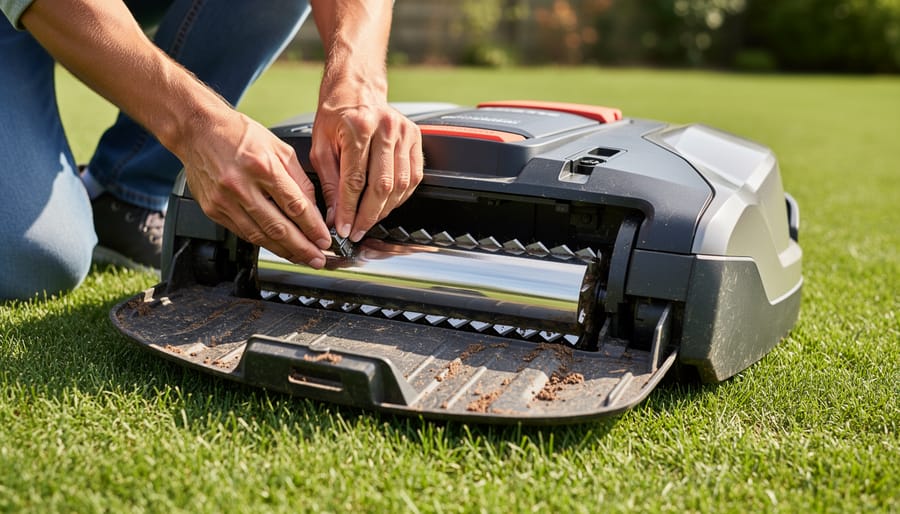
Start by wiping down your mower weekly during mowing season. A quick brush or rinse removes grass clippings and debris that can accumulate underneath. This simple habit prevents buildup that could affect cutting performance and helps you spot any issues early. Most models are designed for easy cleaning, often requiring just a gentle spray with the hose.
Blade maintenance is surprisingly straightforward. Check blades monthly for wear or damage, and plan to replace them every few months during peak growing season. Sharp blades mean cleaner cuts and healthier grass, plus they reduce the energy your mower uses – a win for sustainability.
Battery care really matters for longevity. Modern lithium-ion batteries are robust, but they appreciate being stored in moderate temperatures. If you live in an area with harsh winters, bring your mower indoors for the cold months. Store it in a dry space between 40-60 degrees Fahrenheit, ideally with the battery partially charged rather than completely full or empty.
Most routine maintenance you can handle yourself, but don’t hesitate to contact your manufacturer or a certified technician if you notice unusual sounds, erratic navigation, or charging issues. Regular care means your robotic mower can serve you reliably for years, making it a truly sustainable investment in your lawn care routine.
The Environmental Benefits You’re Not Hearing About
Electric robotic lawnmowers deliver environmental benefits that extend far beyond what most people realize. Let’s explore why these devices are game-changers for sustainable lawn care.
The most obvious advantage is zero emissions during operation. Unlike gas-powered mowers that spew pollutants into your yard while you work, electric robots run entirely clean. Over a mowing season, you’re eliminating pounds of carbon dioxide, nitrogen oxides, and other harmful gases that traditional mowers produce. This matters enormously for eco-conscious homeowners looking to reduce their environmental footprint.
Noise pollution is another hidden benefit. Operating at whisper-quiet levels around 60 decibels, robotic mowers won’t disturb your neighbors, local wildlife, or your own peaceful mornings. Compare that to gas mowers roaring at 90 decibels or more.
Energy efficiency is remarkable too. These robots consume minimal electricity, often costing just pennies per week to operate. They’re programmed to work efficiently, avoiding unnecessary passes and optimizing battery life.
Here’s something surprising: frequent cutting actually improves lawn health. By trimming small amounts regularly and leaving fine clippings as natural mulch, robotic mowers eliminate the need for chemical fertilizers. Those clippings decompose quickly, returning valuable nutrients to your soil.
Finally, responsible manufacturers are designing these machines with recyclability in mind, using materials that can be properly processed at end-of-life rather than ending up in landfills. It’s sustainability from start to finish.
Electric robotic lawnmowers represent an exciting leap forward in sustainable lawn care, offering a hands-off approach that works remarkably well for many homeowners. As we’ve explored throughout this guide, these innovative tools aren’t one-size-fits-all solutions, but when matched to the right yard conditions and expectations, they can transform your lawn maintenance routine while reducing your environmental footprint.
The key is honest self-assessment. Consider your lawn’s size, terrain complexity, and your personal priorities. Are you willing to invest time in initial setup and boundary training? Can you commit to regular blade maintenance? Do you value quiet operation and zero emissions? If these align with what robotic mowers offer, you’re likely to be delighted with the results.
Whether you’re a seasoned gardener looking to embrace new technology or a beginner seeking easier lawn care solutions, these devices are more approachable than you might think. Modern models have become increasingly user-friendly, with intuitive apps and straightforward installation processes.
Take your time researching specific models, read detailed reviews, and don’t hesitate to reach out to manufacturers with questions. Making an informed, environmentally conscious choice means finding the right tool for your unique situation, and that’s something worth celebrating.