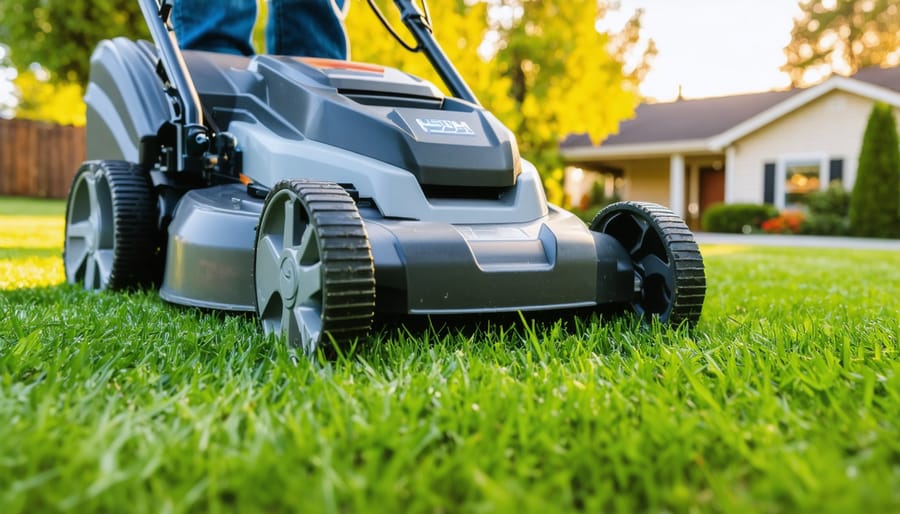
Battery-powered lawn mowers have evolved from underpowered novelties into legitimate alternatives that can handle most residential lawns with surprising efficiency. If you’re wondering whether they’re worth your investment, the honest answer is: it depends on your specific situation, but for many homeowners, they’ve become the smarter choice.
The technology has matured dramatically over the past five years. Modern lithium-ion batteries now deliver runtime that matches or exceeds the time most people spend mowing, typically 30-60 minutes on a single charge. They cut through thick grass with nearly the same authority as gas models, start instantly with the push of a button, and require almost zero maintenance beyond blade sharpening. You won’t miss wrestling with pull cords on humid mornings or scheduling oil changes.
That said, battery mowers aren’t perfect for everyone. They struggle with properties larger than half an acre unless you invest in backup batteries, and they cost more upfront than comparable gas models. Wet, overgrown grass still challenges their motors, and battery replacement after 3-5 years adds to long-term costs.
The real question isn’t whether battery mowers are “good” in absolute terms, but whether they’re good for your lawn and lifestyle. This guide cuts through the marketing hype to give you real-world performance data, honest cost comparisons, and clear criteria for determining if a battery mower makes sense for your specific needs.
The Performance Question: Can Battery Mowers Handle Real Lawns?
Cutting Power and Grass Types
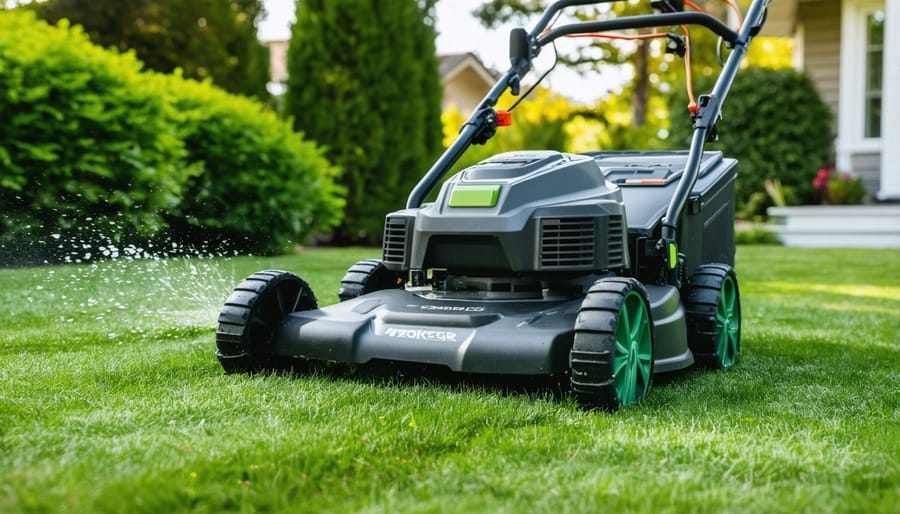
Let’s be honest about what battery mowers can and can’t handle. For regular lawn maintenance on dry to slightly damp grass, they perform remarkably well. I’ve tested models like the Greenworks 80V battery mower on various grass types, and they tackle typical suburban lawns with confidence. Fine fescues, Kentucky bluegrass, and even moderately thick ryegrass cut cleanly when you’re keeping up with weekly mowing.
However, here’s where reality sets in. If you let your grass grow too tall, battery mowers struggle more than their gas counterparts. That overgrown spring growth after a rainy week? You’ll likely need to make two passes or mow at the highest setting first. The motor simply doesn’t have the same brute force as gas engines when dealing with dense, tall grass.
Wet grass is another challenge worth mentioning. While most battery mowers can handle slightly damp conditions from morning dew, soaking wet grass clogs the deck quickly and drains batteries faster. It’s best to wait for things to dry out.
For those with smaller lawns under half an acre with relatively flat terrain, battery mowers deliver solid performance. They excel at routine maintenance but demand consistency. Think of them as fitness enthusiasts who thrive on regular workouts rather than powerlifters ready for occasional heavy duty. Understanding these realistic limitations helps you decide if they match your lawn care needs.
Runtime Reality: How Long They Actually Last
Let’s talk real numbers, because manufacturer claims can sometimes paint a rosier picture than your actual mowing experience. Most battery-powered mowers will give you between 30 to 60 minutes of runtime on a single charge, though this varies considerably based on several factors.
For small lawns up to 1,500 square feet, a basic battery mower with a single battery will handle the job comfortably in one go. You’ll typically finish with charge to spare. Medium-sized lawns between 1,500 and 5,000 square feet sit in that sweet spot where you might cut it close with one battery, or you’ll want a second battery on standby. Anything larger than 5,000 square feet usually requires either multiple batteries or a higher-voltage system with extended capacity batteries.
Here’s what actually drains your battery faster than you’d expect: thick, wet grass is the biggest culprit, sometimes cutting your runtime nearly in half. Tall grass that you’ve neglected for a couple weeks will also chew through battery life quickly. Even the terrain matters, with slopes and uneven ground demanding more power than flat lawns.
The good news? Most manufacturers are actually pretty honest with their estimates, but they’re testing on ideal conditions with dry, regularly maintained grass at moderate heights. If you’re mowing in less-than-perfect conditions, expect about 20 percent less runtime than advertised.
A practical tip from experience: invest in a second battery if your lawn is anywhere near the maximum coverage area claimed for your mower. The peace of mind is worth it, and you’ll avoid that frustrating mid-mow battery death. Plus, having a backup means you’re never stuck waiting for a recharge when the grass desperately needs cutting.
The Environmental Trade-Off Everyone Misses
Emissions and Noise Pollution Wins
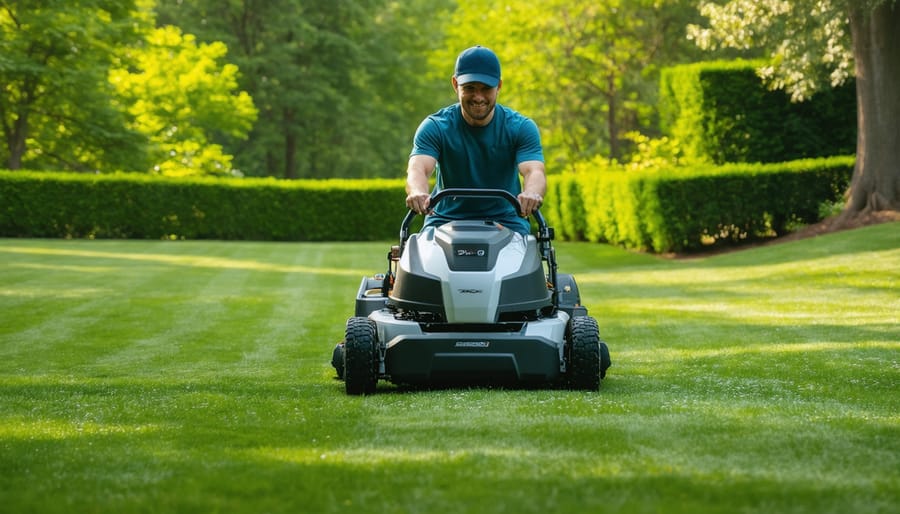
Here’s where battery-powered mowers truly shine, and the benefits are immediate. From the moment you start mowing, you’ll notice the difference: zero exhaust fumes, no fuel smell lingering on your clothes, and noise levels that typically range between 60-75 decibels—about as loud as a normal conversation. Compare that to gas mowers screaming at 90-100 decibels, and you’ll understand why battery mowers for eco-conscious homeowners are gaining such popularity.
This quieter operation means you can mow early morning or evening without annoying neighbors or waking sleeping family members. You’re also doing your bit for cleaner air—especially important if you have children or pets playing on the lawn shortly after mowing. While your individual impact might seem small, consider this: one gas mower running for an hour can produce emissions equivalent to driving a new car several hundred miles. Battery mowers eliminate that entirely during operation, making them a genuinely sustainable choice for regular lawn maintenance without sacrificing performance.
The Battery Manufacturing Reality
Let’s be honest about something that doesn’t get discussed enough: the environmental story of battery-powered mowers isn’t entirely squeaky clean. While these machines eliminate emissions during use, their lithium-ion batteries come with their own environmental considerations.
The manufacturing process for lithium batteries requires mining operations that can impact ecosystems and local water supplies. Cobalt, lithium, and other rare earth materials need extraction, and while the industry is improving its practices, this remains a legitimate concern for environmentally conscious gardeners like us.
Here’s the encouraging part: batteries are lasting longer than ever. Most lithium-ion mower batteries maintain good performance for 3-5 years with proper care, and some exceed that significantly. When you factor in the years of emission-free mowing, the environmental math still favors battery power over gas engines for most situations.
The real challenge comes at end-of-life. These batteries shouldn’t end up in landfills, where they pose environmental hazards. Fortunately, responsible disposal is becoming easier. Most major retailers and manufacturers now offer recycling programs, and many municipalities have dedicated battery collection points.
To maximize your battery’s lifespan and minimize environmental impact, store batteries at moderate temperatures, avoid complete discharge cycles when possible, and never toss them in regular trash. When it’s time for replacement, always use manufacturer recycling programs or certified e-waste facilities. Think of it as completing the sustainability circle you started when you chose battery power in the first place.
What They Actually Cost You (Beyond the Price Tag)
Upfront Investment vs. Long-Term Savings
Let’s talk money, because I know that initial price tag on a battery-powered mower can make you catch your breath. A quality battery mower typically runs between $300 and $600, while comparable gas mowers might cost $250 to $400. Yes, you’re paying more upfront, and that’s worth acknowledging honestly.
But here’s where the story gets interesting. Gas mowers are like that friend who seems low-maintenance until you calculate what they actually cost you over time. You’re looking at roughly $50 to $100 annually in fuel, assuming average lawn size and weekly mowing. Add another $30 to $50 for oil changes, spark plugs, and air filters. Then there’s the annual tune-up or carburetor cleaning, which can run $75 to $150 if you’re not doing it yourself.
Battery mowers? Their ongoing costs are refreshingly minimal. You’re basically looking at electricity for charging, which typically adds just $5 to $15 to your annual electric bill. That’s it for routine expenses.
Now, batteries don’t last forever. Most quality lithium-ion batteries give you 3 to 5 years of solid performance before needing replacement, costing $100 to $200 depending on voltage and brand. That’s definitely a consideration in your long-term planning.
When you run the numbers over five years, gas mowers often cost $600 to $1,000 in operating expenses, while battery mowers might cost $150 in electricity plus one battery replacement. The break-even point usually hits around year three, after which your battery mower becomes the more economical choice. And that’s before considering the value of your time saved on maintenance tasks and trips to get fuel. For environmentally conscious gardeners, the sustainability benefits make those upfront dollars feel like an investment in both your lawn and the planet.
The Maintenance Advantage
Here’s where battery mowers truly shine. If you’ve ever dealt with spark plugs, air filters, or oil changes on a gas mower, you’ll appreciate how refreshingly simple battery models are. There’s no winterizing process, no stale fuel problems, and no carburetor issues to troubleshoot when spring arrives.
Your maintenance checklist shrinks to just a few tasks. Keep the blade sharp and balanced, checking it once or twice per season depending on your mowing frequency. Clean grass clippings from the underside after each use to prevent buildup that affects performance. Check that all bolts stay tight, particularly around the blade assembly. That’s essentially it.
Battery care is straightforward too. Store batteries in a cool, dry place during winter, ideally at around 50% charge rather than fully depleted or completely charged. Most quality batteries include indicator lights showing charge status and health.
The financial impact adds up over time. You’ll save roughly $50-100 annually on maintenance costs compared to gas mowers. No oil, no filters, no tune-ups. For many homeowners, this simplified routine means they actually maintain their mower properly instead of letting tasks slide, which extends the machine’s lifespan considerably.
Who Should (and Shouldn’t) Make the Switch
Ideal Scenarios for Battery Mowers
Battery mowers truly shine in certain situations, and knowing whether yours fits the bill can help you make the right choice. If you’re tending to a small to medium-sized lawn, typically under half an acre, you’ve found the sweet spot for battery power. These mowers handle lawns up to about 15,000 square feet beautifully, completing the job on a single charge without breaking a sweat.
Urban and suburban homeowners particularly benefit from battery mowers. If you’re in a neighborhood with houses close together, your neighbors will genuinely appreciate the whisper-quiet operation during those Saturday morning mowing sessions. Some communities and homeowners associations actually have noise restrictions that make gas mowers problematic, and battery models solve this challenge elegantly while keeping you compliant with local regulations.
Properties with relatively flat terrain and well-maintained grass see the best results. Battery mowers work wonderfully for weekly maintenance cutting where you’re removing moderate growth rather than tackling overgrown jungle conditions. They’re also fantastic if you have gardens, patios, or outdoor living spaces nearby where exhaust fumes and noise would be particularly unwelcome.
From a sustainability perspective, these mowers align perfectly with eco-conscious property management. If you’re already powering your home with solar panels or green energy, you’re creating an entirely emissions-free lawn care routine. Additionally, if you have mobility concerns or simply prefer lighter equipment, battery mowers typically weigh less than their gas counterparts and require no wrestling with pull cords. For the right property and situation, they genuinely excel at delivering practical, effective lawn care results.
When Gas Still Makes More Sense
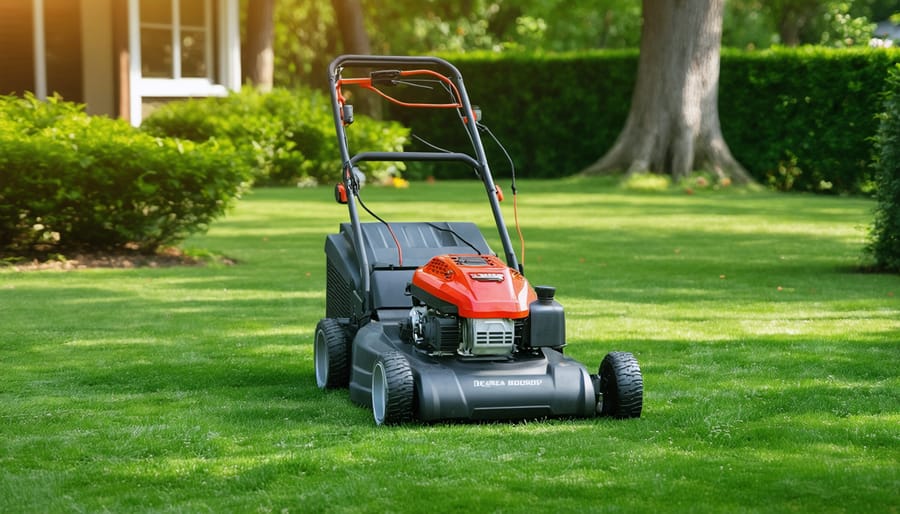
Let’s be honest—battery-powered mowers have come incredibly far, but they’re not the perfect solution for everyone just yet. If you’re managing a property larger than an acre, you might find yourself playing a frustrating game of battery musical chairs. Most battery mowers can handle 30-45 minutes of runtime, which translates to about half an acre on a single charge. For bigger spaces, you’d need multiple backup batteries, and at $150-300 each, that investment adds up quickly.
Commercial landscapers face an even tougher reality. When you’re mowing six to eight properties daily, swapping batteries between jobs simply isn’t practical. Gas mowers still win for continuous, all-day use where downtime means lost income. The professional-grade battery equipment is improving, but the initial investment remains substantial for fleet operations.
Then there’s the challenge of extremely overgrown or thick grass. While modern battery mowers handle regular weekly mowing beautifully, they can bog down when tackling neglected lawns or dense, wet vegetation. The motors lack the raw torque of gas engines in these demanding conditions. If you’re dealing with uneven terrain, tall weeds, or frequently skipped mowing sessions, you might find yourself wishing for more power.
Heavy-duty properties with steep hills also push battery technology to its limits. The constant power draw on inclines drains batteries much faster than advertised runtimes suggest.
This doesn’t mean battery mowers are bad—they’re fantastic for most suburban yards. But choosing the right mower type means honestly assessing your specific needs. For extensive acreage or commercial demands, gas or hybrid solutions might still be your most practical choice until battery technology catches up completely.
The Technology Has Changed (What’s Actually Improved)
Battery Chemistry Breakthroughs
The real game-changer in modern battery-powered mowers is the switch to lithium-ion technology. Unlike the old nickel-cadmium batteries your neighbors might remember from disappointing cordless tools of the past, today’s lithium-ion batteries pack significantly more punch in a lighter package.
Here’s what makes them special: lithium-ion batteries deliver consistent power throughout their charge cycle, meaning your mower cuts just as effectively at 20% battery as it does at 100%. Older battery types would gradually lose power as they drained, leaving you with weak performance halfway through your lawn. Modern batteries also charge remarkably fast—many fully recharge in under an hour, with some models reaching 80% capacity in just 30 minutes.
The longevity improvements are equally impressive. Quality lithium-ion batteries can handle 500-1,000 charge cycles before showing significant degradation, translating to several years of reliable service. Makita’s battery-powered model, for example, uses professional-grade cells that maintain capacity season after season. This combination of quick charging, sustained power delivery, and extended lifespan makes today’s battery mowers genuinely practical alternatives to gas models, addressing the performance concerns that once made battery power impractical for lawn care.

Smart Features Worth Having
Not all smart features are created equal, and it’s worth distinguishing between genuinely helpful innovations and unnecessary bells and whistles. Variable speed control tops the list of worthwhile additions—it lets you adjust power based on grass thickness and terrain, conserving battery when you don’t need full throttle. This practical feature can extend runtime by 20-30% on lighter patches.
Battery monitoring systems deserve serious consideration too. LED indicators showing real-time charge levels help you plan your mowing session without unexpected power loss halfway through. Some advanced models even display estimated runtime remaining, which proves invaluable for larger properties.
Adjustable cutting height remains essential, and the best battery mowers now offer single-lever adjustments rather than fiddly per-wheel controls. Look for models with at least five height settings between 1-4 inches.
Meanwhile, skip features like Bluetooth connectivity or smartphone apps unless they genuinely enhance functionality. Recent cutting technology improvements matter far more than digital gimmicks. Self-propulsion on battery mowers represents another genuinely useful feature for slopes and larger lawns, though it does drain batteries faster. Focus on innovations that solve real mowing challenges rather than marketing hype.
Making Battery Mowers Work Better: Practical Tips
Getting the most from your battery mower doesn’t require a degree in engineering, just a few smart habits that quickly become second nature. I’ve learned these lessons through trial and error, and they’ve made a real difference in how my mower performs season after season.
Start with mowing patterns that work with your battery, not against it. Tackle the most challenging areas first when your battery is fully charged. Thick, overgrown sections demand more power, so hit those early. Then move to easier terrain as the charge depletes. I’ve also found that slightly overlapping your passes reduces the need for touch-ups, which saves battery life overall. If you have a larger lawn, consider the two-battery shuffle: charge one while using the other, creating a rhythm that lets you work continuously.
Battery care makes the biggest difference in longevity. Store batteries in a cool, dry place, not in the shed where temperatures swing wildly. Extreme heat is particularly damaging, so bringing them indoors during summer storage is worthwhile. Don’t let batteries fully drain before recharging, and avoid leaving them at 100% charge for extended periods. The sweet spot for storage is around 40-60% charge. During winter, check on stored batteries monthly and top them up if needed.
Mow more frequently with battery mowers, even if it seems counterintuitive. Cutting shorter lengths requires less power per session, and you’ll maintain better performance. The old rule about removing only one-third of the grass height becomes even more important here. Wet grass is your enemy, drawing significantly more power and clogging the deck, so wait for dry conditions whenever possible.
Keep your blade sharp. A dull blade forces the motor to work harder, draining batteries faster and delivering mediocre results. Sharpen it at least twice per season, more if you’re mowing frequently. Clean the underside of the deck after every few mows to prevent grass buildup that creates drag.
If you notice reduced runtime, don’t immediately assume the battery is failing. Check for deck obstructions, verify the blade isn’t bent or damaged, and ensure the cutting height isn’t set too low for current conditions. These simple checks often restore performance without any expense.
So, are battery-powered lawn mowers any good? The honest answer is: it depends on your specific situation, but for many homeowners, they’re an excellent choice that keeps getting better.
If you have a typical suburban yard under half an acre, prioritize convenience and quiet operation, and appreciate environmentally friendly options, you’ll likely be delighted with a quality battery mower. They genuinely deliver on the promise of hassle-free mowing without gas, oil changes, or pull-cord frustrations. The technology has matured to the point where performance concerns are minimal for most users.
However, if you’re managing multiple acres, have thick or overgrown grass that needs frequent attention, or require marathon mowing sessions, you might find current battery technology limiting. In these scenarios, gas mowers or riding equipment still make more practical sense, though that gap continues narrowing each year.
The trajectory of battery mower technology is genuinely encouraging. Batteries are becoming more powerful, longer-lasting, and more affordable with each generation. What seemed impossible five years ago is now commonplace, and this trend shows no signs of slowing.
The key to satisfaction is matching the tool to your actual needs rather than getting swept up in either the hype or the skepticism. Measure your lawn, consider your grass type and mowing habits, and evaluate your budget realistically. When you choose based on your genuine circumstances rather than assumptions, battery mowers often exceed expectations. For most homeowners embracing sustainable lawn care, they represent a smart investment in both your time and our planet’s future.